


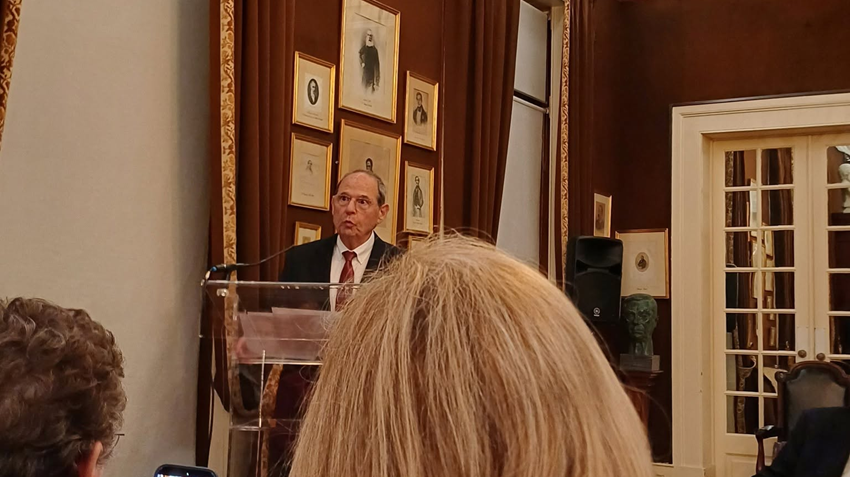
On November 27, the Grémio Literário in Lisbon hosted the launch of Sefarad, The Immortal Heritage, a book by Julio Casoy that chronicles the journey of the Jews on the Iberian Peninsula, from biblical times to the present day.
In the author's own words, this is not a chronicle of victims, but an account of survival and triumph. It tells the story of a people who, even in the face of the Inquisition and the trauma of forced conversion, refused to disappear, transforming exile into a global network of commerce, science, and cultural exchange.
Click here to read Julio Casoy’s interview with PJN.
About the Author
Julio Casoy is a physician and scientist with a distinguished career dedicated to the research and development of new pharmaceuticals. Born in São Paulo in 1951, he has a cosmopolitan background, having lived in Brazil, the United States, and England. His life's journey reflects the intersection of scientific rigor and a profound passion for anthropology.
A polymath in the truest sense of the word, Casoy has devoted years to studying diasporas and cultural and religious phenomena. He notably co-authored works on Candomblé, exploring the richness of oral traditions and the transmission of knowledge.
After settling in Lisbon, his research took a more personal direction as he turned his attention to his own roots. A secular Jew of Ashkenazi descent, he became fascinated by the history and journey of Sephardic Jews on the Iberian Peninsula.
Published in Portugal by Cordel d’Prata, Sefarad, The Immortal Heritage reflects the author's meticulous research and his ability to navigate centuries of history. Through this work, Casoy moves beyond a narrative centered on victimhood, highlighting instead the resilience, achievements, and agency of the Sephardic Jewish people.
He writes not merely as an observer, but as someone who found in Portugal fertile ground in which to bring together the curiosity of a scientist and the historical memory of a people who, much like himself, made the world their home without ever losing their essential identity.

