

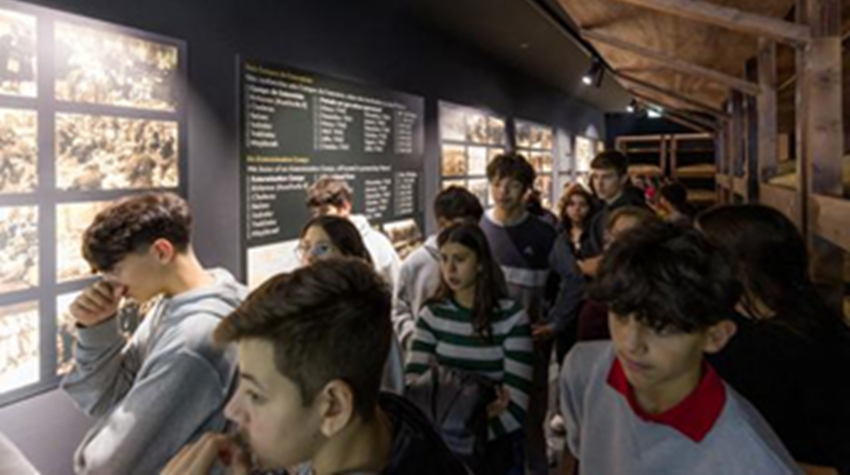
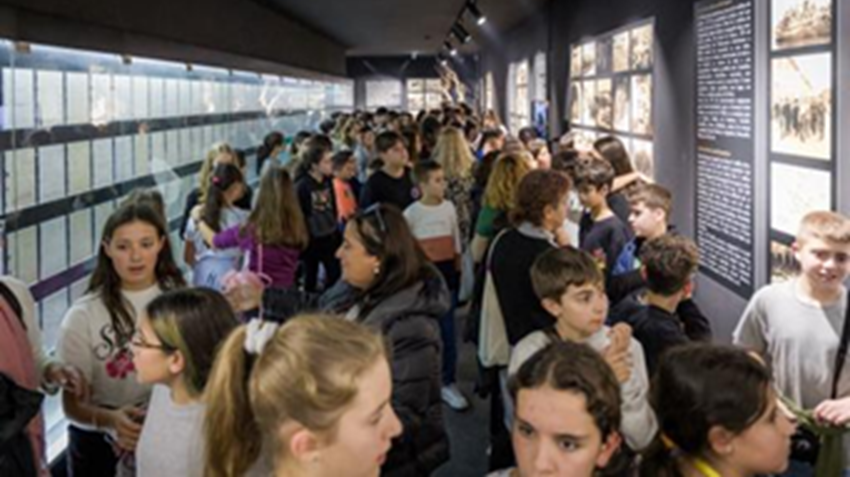
Used to hearing that in the mid-20th century Jews were victims of a crazy Nazi who hated gays and communists, the teenagers who this week visited the Holocaust museum in the city of Porto learned something new. Jews have always been victimized - with physical or psychological violence - by elites of all eras and continents.
In this weekly educational session, the guides at the Porto Holocaust museum went back just one thousand years (and not two, as they could have) and highlighted the following anti-Jewish tragedies as examples:
1) Rhineland Massacres (1096): During the First Crusade, French and German Christian mobs utterly destroyed flourishing Jewish communities in cities like Speyer, Worms, and Mainz. Thousands were murdered or forced to commit mass suicide rather than convert.
2) Massacres of York (1190): Sparked by anti-Jewish riots across England, about 150 Jews in York were trapped in a castle by a violent mob. Many chose to kill their families and themselves rather than face forced conversion.
3) Black Death Persecutions (1348–1350): As the plague ravaged Europe, Jews were scapegoated and falsely accused of poisoning wells. Over 500 Jewish communities were decimated by violence and arson across France, Germany, and the Low Countries.
4) Spanish Massacres (1391): Anti-Jewish preaching ignited riots across Castile and Aragon, culminating in the destruction of Jewish quarters in cities like Barcelona and Seville. Tens of thousands were killed or forcibly baptized.
5) Lisbon Massacre (1506): The Lisbon Genocide, also known as the Lisbon Pogrom, occurred from April 19 to 21, 1506. A mob of Catholic rioters, spurred by Dominican friars, slaughtered about 3,000 "New Christians"—Jews who had been forcibly baptized a decade earlier. The victims were hunted, mutilated, and burned in bonfires across the city.
6) Chmielnicki Uprising (1648–1649): Ukrainian Cossacks led by Bohdan Khmelnytsky staged a massive rebellion against the Polish-Lithuanian Commonwealth. In the process, Cossack forces and peasant mobs systematically destroyed hundreds of Jewish communities, killing an estimated 100,000 to 300,000 Jews.
7) Russian Empire Pogroms (1881–1906): Following the assassination of Tsar Alexander II, waves of state-sanctioned anti-Jewish riots swept through the Pale of Settlement (modern-day Ukraine, Poland, and Russia). The 1903 and 1905 Kishinev pogroms left hundreds of Jews dead and thousands of properties destroyed.
8) Russian Civil War Pogroms (1918–1921): Amidst the chaos of the Russian Civil War, various factions (including White Army forces, Ukrainian nationalists, and bandits) slaughtered an estimated 100,000 Jews in horrific pogroms. The Proskurov pogrom in 1919 alone saw up to 1,500 Jews killed in a single day.
9) The 1929 Hebron massacre occurred on August 24, 1929, during widespread anti-Jewish riots in Mandatory Palestine. Fueled by incitement and false rumors that Jews were trying to seize the Al-Aqsa Mosque, Arab rioters in Hebron attacked and murdered 67 Jewish residents, including women and children.

In short, major massacres of Jews before the Holocaust were frequently driven by economic scapegoating, and state-sponsored pogroms. The most devastating events occurred during the European Middle Ages, the Russian Empire, and the turbulent years following World War I.
The persecution didn't stop there. The Holocaust managed to bring together in a single event much of what the Jewish past already revealed. Even with the defeat of Nazism, the persecution continued unchecked.
1) Early Postwar Pogroms (Europe, 1945–1946)
The Kielce Pogrom (Poland, 1946): Driven by fabricated blood libel accusations, mobs of Polish soldiers, police, and civilians murdered at least 42 Jewish Holocaust survivors and wounded about 50. It is remembered as the worst outburst of anti-Jewish violence in postwar Europe.
2) Eastern Europe & USSR: Between 1945 and 1946, returning Jewish refugees faced violent, anti-Semitic pogroms across regions of Slovakia (e.g., Topoľčany), Hungary (e.g., Miskolc), and Ukraine.
3) The Munich Massacre (1972): Palestinian Black September terrorists attacked and killed 11 Israeli Olympic athletes and coaches in Munich, Germany.
4) The Ma'alot Massacre (1974): The Democratic Front for the Liberation of Palestine (DFLP) seized a school in Ma'alot, Israel, resulting in the deaths of 22 schoolchildren and four adults, with dozens wounded.
5) The Coastal Road Massacre (1978): Palestinian militants hijacked a bus on the highway near Tel Aviv, indiscriminately killing 38 Israeli civilians, including 13 children.
6) The Istanbul Synagogue Massacre (1986): Militants affiliated with the Abu Nidal Organization attacked the Neve Shalom Synagogue in Istanbul, Turkey, killing 22 Jewish worshippers during Shabbat services.
7) The Second Intifada (Israel, 2000–2005)
Events: The region saw a relentless wave of suicide bombings and shootings targeting public buses, restaurants, and markets. These attacks claimed over 1,000 Israeli lives. Major massacres in this period included the Park Hotel Seder bombing in Netanya (30 killed, 2002) and the Dolphinarium disco drone bombing in Tel Aviv (21 killed, 2001).
8) The October 7th Massacre (Israel, 2023)
Event: Infiltrating the Gaza envelope, Hamas militants launched a highly coordinated, multi-front slaughter. The attack claimed the lives of approximately 1,200 people—mostly civilians, including entire families, the elderly, and children. Terrorists also abducted over 250 individuals. This remains the deadliest single massacre of Jewish people since the Holocaust.
In short, the most significant massacres of Jews and Israelis since the Holocaust include the October 7, 2023 assault by Hamas; a series of bombings and shootings during the Second Intifada (2000–2005); high-profile international and local attacks in the 1970s and 80s; and early postwar pogroms in Eastern Europe.


