

Credit: Wikipedia - Angrense
The Ambassador of Israel to Portugal, Oren Rozenblat, paid an official visit to the Azores last week, during which he honored the region’s historic Jewish community and highlighted the economic and cultural ties between Israel and the archipelago.
A key moment of Rozenblat's visit to the Azores was the celebration of Portugal Day in the presence of the President of the Republic, António José Seguro. The ambassador was also received by the Representative of the Republic for the Autonomous Region of the Azores, Susana Goulart Costa.
One of the most symbolic moments of the visit was his stop at the historic Jewish cemetery Campo da Igualdade (Field of Equality), located in Angra do Heroísmo on Terceira Island. At the cemetery, inaugurated in 1832, the diplomat offered prayers in memory of the Jews buried there.
During his stay in Angra do Heroísmo, Rozenblat was also received by the Mayor of Angra do Heroísmo, Fátima Amorim. At the City Hall building, the ambassador drew attention to the stained-glass windows, created in 1912 by the Jewish painter and decorator Abraham Abohbot.
The son of Moroccan Jewish parents, Abraham Abohbot was born in Lisbon in 1871 and later settled in Angra do Heroísmo, where he developed a distinguished artistic career. He passed away in 1959, leaving his mark on numerous public and religious buildings on Terceira Island and becoming an important figure in the Azorean artistic heritage.
In addition to the historical and cultural aspects of the visit, the ambassador addressed economic and commercial matters. Rozenblat emphasized that Israel is a significant importer of beef produced in the Azores, underscoring the importance of trade relations between the two sides.
The diplomat also noted that discussions and decisions regarding the future of economic relations between the European Union and Israel will soon take place in Brussels. In this context, he expressed hope that Portugal will continue to support the strengthening of cooperation between Israel and the European countries.
About the cemetery
The Jewish cemetery in Angra do Heroísmo, inaugurated in 1832 nearly two centuries ago, was given the name Campo da Igualdade (Field of Equality).
The surnames of the Jews buried in this cemetery, as well as in the other Jewish cemeteries of the Azores (on the islands of São Miguel, Terceira, and Faial), are predominantly associated with families that originated in Morocco and Gibraltar.
Listed below, in alphabetical order, are the surnames of Jews of blessed memory buried in the Jewish cemeteries of the Azores: Aló, Acaig, Adrehi, Abecassis, Abeasis, Aflalo, Albo, Amiel, Absidi, Abohbot, Azulay, Bensaude, Bensliman, Ben Sabat, Benayon, Benarus, Bitton, Buzaglo, Delmar, Esayag, Essayag, Levy, Mataná, Nahmias, Pinto, Sabat, Sabath, Zafrany, and Zagury.
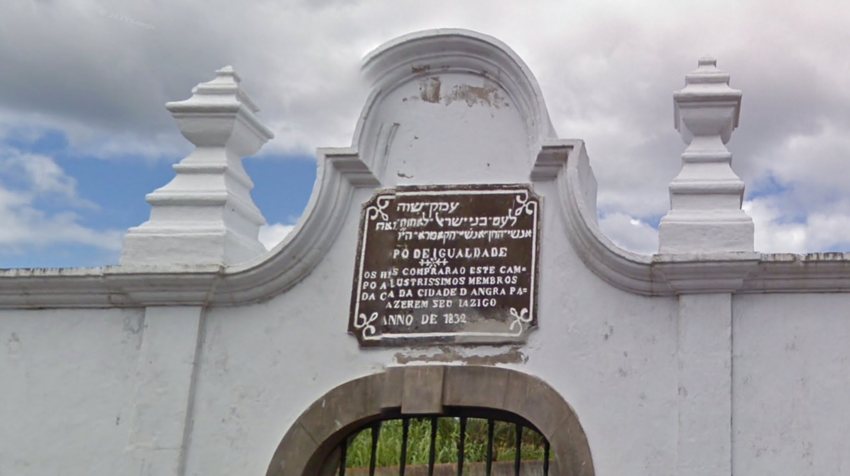
These cemeteries became known as “Fields of Equality” because Jewish tradition teaches that all people are equal in death. Regardless of whether a person was wealthy or poor, famous or unknown during life, Jewish law ensures that no distinction is made at the time of burial.
In ancient times, wealthy individuals were often buried in elaborate garments, a practice that caused embarrassment to those who could not afford such displays. To address this inequality, the sages of the Talmud decreed that all Jews should be buried in simple and identical white shrouds made of linen or cotton. This custom removes visible markers of social or economic status.
Traditional Jewish burial practices also require simplicity in the coffin and grave. Coffins are typically made of plain, biodegradable wood and are free of elaborate ornamentation. Jewish graves traditionally avoid ostentatious monuments, and headstones (matzevot) are generally modest and similar in appearance, helping to ensure that no grave reflects wealth or social standing more than another.


