


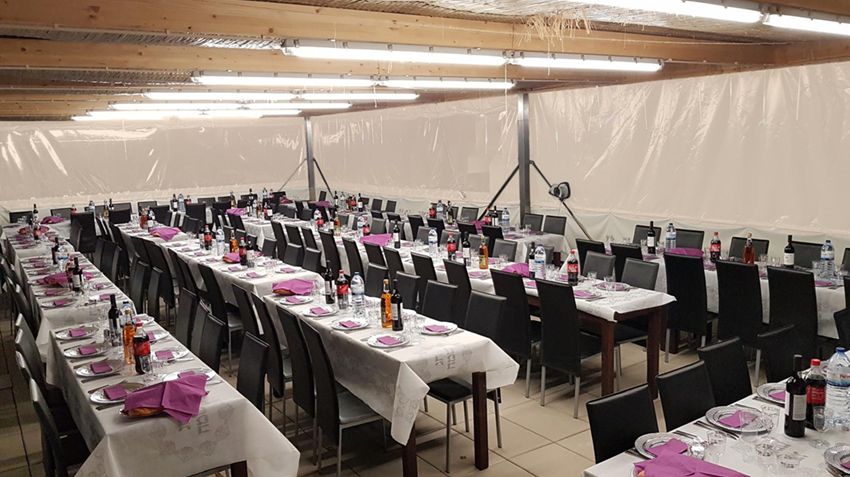
An open space without community use for decades is today a restaurant, an industrial kitchen, and an extensive veranda for the construction of a sukkah. This real estate complex is located at the back of the Kadoorie Mekor Haim synagogue and sheltered by its shade.
When passersby on Rua Guerra Junqueiro look at the synagogue's facade, they have no idea of the building's true size, much less its surrounding grounds, a total of more than 2,500 square meters. There is the front garden, the religious temple with four spacious and divided floors, and finally that land at the back, which is used to serve meals, host community kiddushin in the spring and summer, and also to accommodate 300 people during the annual Sukkot festival.
Those who are new and have the pleasure of seeing that land at the back sometimes think it's always been like that. It hasn't. For decades, that lot was a symbol of death. Useless, dirty, neglected. Even the Kadoorie family was surprised when visiting Porto recently.
It's unknown what plans Barros Basto had for that land in the 1930s, and he probably wanted to keep it with a small garden, given that the synagogue building was already large enough. What is certain is that the land was forgotten. The captain never even managed to produce Jewish life inside the temple, much less outside.
It never hurts to repeat that the corrupt "Portuguese Dreyfus" case, orchestrated by the state in a scheme of anonymous letters from the scum of society, ensured that the entire area of number 340 Rua Guerra Junqueiro dragged on a slumber of inertia year after year, and in this scenario, naturally, the back lot was condemned to pile up garbage and total uselessness.
A little over a decade ago, something new happened. As the synagogue now had a permanent Jewish life, for the first time the backlot attracted the attention of the community. Two months were enough for the necessary revolution. A restaurant, an industrial kitchen and, at the top of the new building, a splendid sukkah were born.
The sukkah is vital in Judaism as a temporary, outdoor booth that commemorates the 40-year journey of the Israelites in the desert after the Exodus. Barros Basto himself built a patio on the top floor of the synagogue to serve this purpose - and such a patio still exists today, while it is not enough to bring together Porto's extensive Jewish community.
With the sukkah, Jews express humility, gratitude to God for protection, and a reminder of divine providence over material wealth. By leaving comfortable homes for a temporary shelter, it acts as a lesson in humility, teaching that true security comes from God rather than wealth or physical structures.
The open, often welcoming nature of the sukkah encourages inviting guests, family, and friends to share meals, fostering community and connection. The roof (s'chach) must be made of organic material and allow stars to be seen, bringing inhabitants closer to nature and the divine.


