

The Kadoorie Mekor Haim Synagogue. Credit: CIP/CJP
Jewish history and culture are part of the formation of European identity. This is the reason for the European Commission's Plan to promote Jewish life by 2030, as well as the European Day of Jewish Culture, which is celebrated throughout Europe on the first Sunday of September each year.
The reader may not be aware that the most complete event of its kind does not take place in Paris, Munich or Brussels, but in Portugal, particularly in the city of Oporto. Admission is free for all those who wish to visit the largest synagogue in the country, the Jewish museum, the Holocaust museum, movie theaters, an art gallery, a Jewish library with 10,000 volumes, a kosher Port wine cellar and community restaurants. The program includes presentations that feature arts as distinct as cinematography, music, painting, literature and gastronomy.
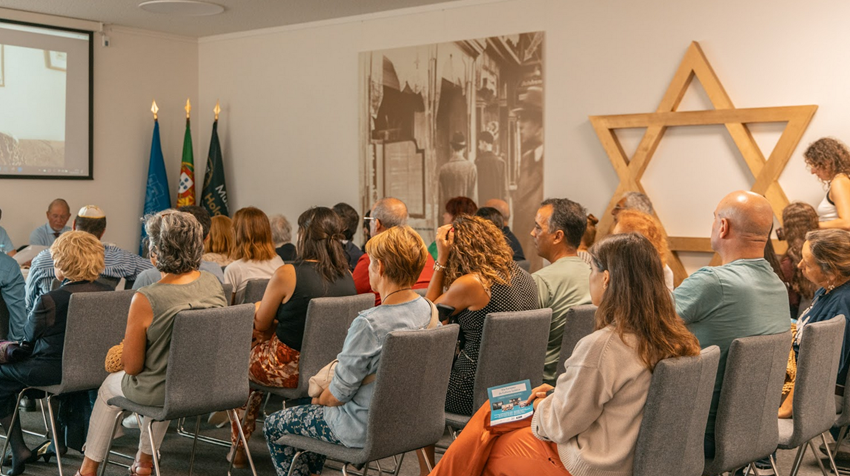
The Holocaust Museum of Oporto. Credit: CIP/CJP
The event held in Oporto in 2024, as in previous years, welcomed thousands of enthusiasts of dialogue, Portuguese culture and peace, in a country increasingly dominated by a "culture" of empty distraction among the masses. Crowds join ambassadors from many prominent nations. From all over the country, interested parties arrive with enthusiasm. They are brothers of centuries. They do not forget that the Jews were storekeepers of the kingdom, treasurers, astronomers, masters of commerce, financiers of the maritime expeditions that allowed the Discoveries and espionage agents to act abroad. They spoke many languages and were willing to risk their lives in the service of the kingdom.
The general public identifies with the Jewish community with a feeling of ancestral connection. A collective identity is celebrated that touches the national soul. The future of Portugal and the world is discussed. Jewish heritage and Jewish life are understood as factors of the intangible power of Portugal, which visitors recognize. Many visitors claim that they may be descendants of Jews. The Jewish population represented a large percentage of the Portuguese population and mixing was inevitable due to intermarriage.
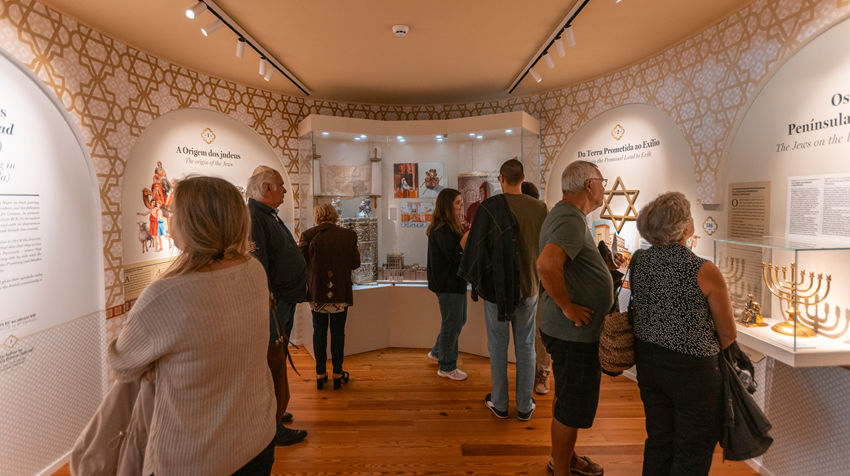
The Jewish Museum of Oporto. Credit: CIP/CJP
The European Day of Jewish Culture marked in is more remarkable for what visitors offer than for the splendor of the community in its cultural space. The genuine social quality of that public makes one wonder what was the miracle that allowed it to escape the culture of fashion, the lack of culture of empty distraction, of what is futile, of the comfort of knowing nothing and of having no high interest, of the fascination with the banal that suffocates the soul, of the desire to seek what is vain, of contempt for a past that became shame and not the master of life.
Families walk through the galleries of the city's central synagogue. When they arrive, some enter in fear. It is not common for a synagogue to open its doors. They ask: "Can we really come in?", "For free?". They thank the staff members as if they were celebrities. They walk into the interior of the synagogue a little unsure, but then they let go, talk, and ask questions. They feel at home because they recognize each other. Portuguese Jewish history is yours too.
The synagogue impresses everyone. It covers 2000 square meters. When it was built in the 1930s, a national newspaper described it as "A piece of Palestine". A man who visited the synagogue at the 2023 event ran out to pick up his whole family in Guimarães, afraid of never having that opportunity again. He had lived in for decades and never thought that one day he would be able to enter a space that he described as "fortified" and "safe". A similar feeling was shared by residents of Rua de Guerra Junqueiro the previous year, some who were octogenarians. Thanks to that celebration they entered the synagogue for the first time.
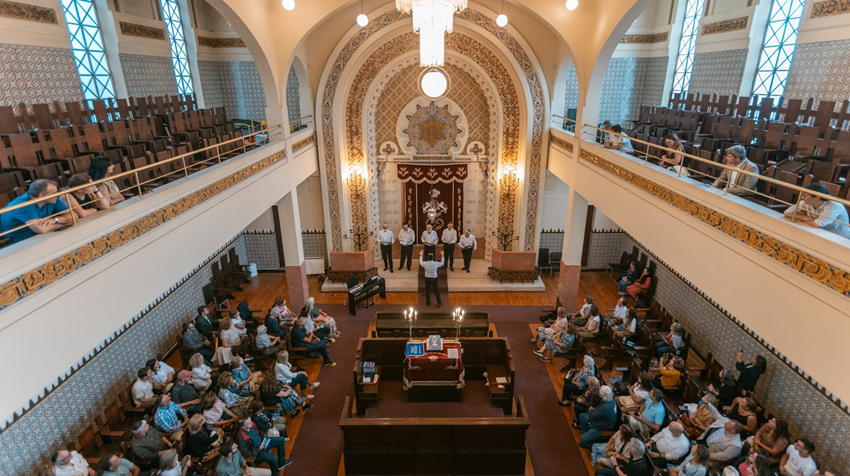
The Kadoorie Mekor Haim Synagogue. Credit: CIP/CJP
In the prayer hall of the central synagogue, there is a concert given by the Mekor Haim Choir, which sings songs in Ladino, Hebrew and Yiddish, among a vast repertoire that has thirty works of great quality. The attention of visitors, the happiness and respect shown, have little to do with the superficiality of lost souls that is shared in the mass media, where it is almost a sin to cultivate depth and where the shallowest is celebrated. The concert ends. The choir receives a standing ovation. Visitors talk to the musicians and find so many points of connection with the community that they do not want to leave the place. Some ask if they can pray. They are Catholics and claim, with good reason, that Jesus was a Jew. They can do it, but they realize that it is more logical to go to the church next door, especially since it is Sunday and the community has good relations with the priest.
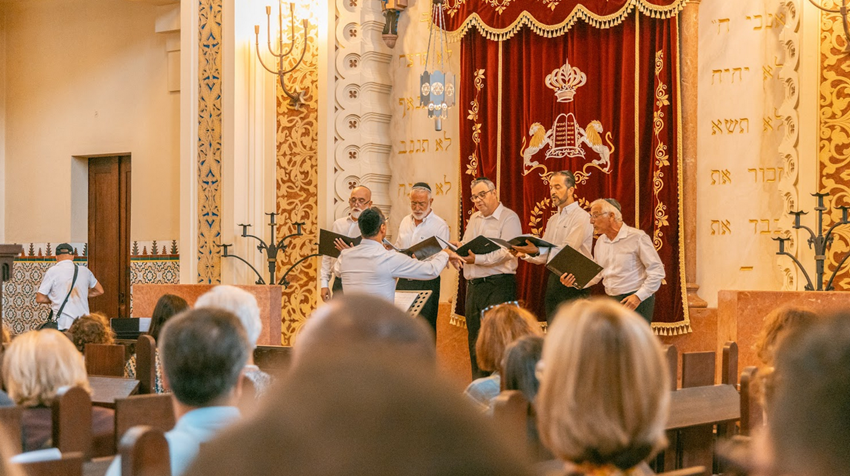
The Mekor Haim Choir. Credit: CIP/CJP
The Jewish Museum of Oporto is an architectural jewel, outside and inside, for its art deco style and for the fact that it shares an ancient history and culture with the most vivid shapes, colors and images. Jewish history in the world is revealed along with two millennia of presence in the land that is now Portugal. Valuable objects, documents and documentaries are dedicated to the good and bad historical moments, the achievements and the disappointments. We can see the decree of expulsion of King D. Manuel, the times of the Inquisition and the return of the community in the nineteenth, twentieth and twenty-first centuries.
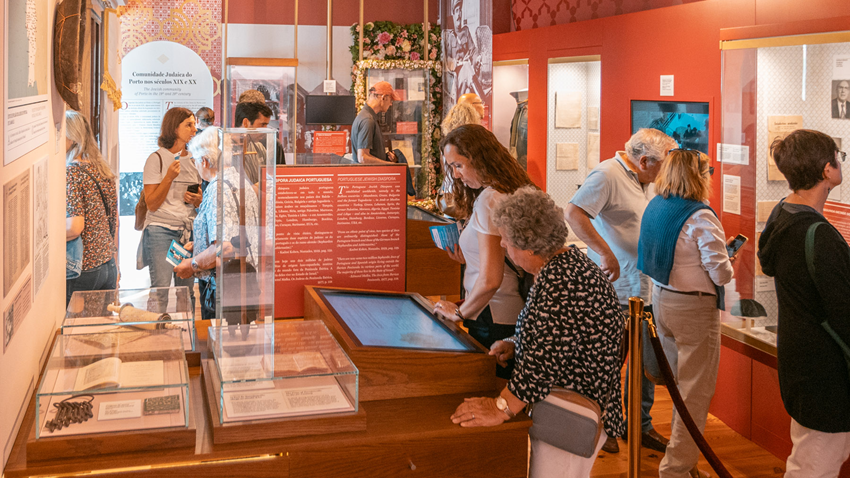
The Jewish Museum of Oporto. Credit: CIP/CJP
Portuguese citizens who visit the museum can see films of the country that was a potentate in courage, commerce, the science of astronomy, cartography and the naval industry, and the first to travel around the world by sea. They can transport themselves to the medieval fairs, the ships on the high seas bound for faraway destinations, the royal palaces where monarchs thought of the world in the way they had studied since childhood. The questions posed by the public are impressive, for their precision and their accuracy, in a society where reflection does not consume even a few minutes of the week and "positive thinking" has become a comfortable formula for not thinking. It is true that many visitors do not reveal a great level of knowledge about the Jewish world, but their interest is obvious. They want clarification on the usual myths. "Are Jews rich? Are they only interested in Israel?" Others focus on religion. "What God do the Jews believe in?" "Why does the synagogue have two security bunkers with gas masks?" And they finish naively: "In churches, we don't have that."
The art gallery, with twenty large paintings, using oil and acrylic techniques, portrays the life of the Jewish community in from the arrival of the first Jews to the present day, passing through periods of apogee and ruin, of life and death, in a clear demonstration that the harvest years are also the years of the plague. It is a surprise that there are so many citizens with a taste and passion for art on canvas. In noisy times, in which the order seems to blacken cultural values, the arts and the history of the collective, elevation is always unexpected.
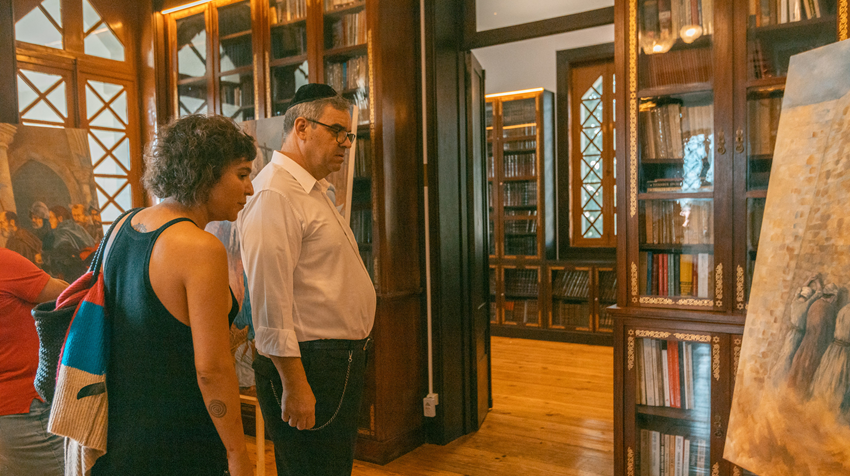
The art gallery at the Rosh Pinah Library. Credit: CIP/CJP
It is also important to highlight the interest of visitors in the Rosh Pinah library, where that exhibition of paintings is located. It is a space for the preservation of memory, history, education and intercultural dialogue that brings together publications in 13 different languages. These reflect the richness of Jewish knowledge in particular and human knowledge in general. The vast collection of Jewish literature that is found there addresses topics as diverse as the law, philosophy, history and culture of an ancient people. This allows us to understand not only the path of the Jews, but also the intertwining of their history with other cultures and civilizations. A Jewish educator once wrote that the Egyptians built pyramids, the Greeks temples, the Romans amphitheaters, the European palaces, as centers of political power, and the Jews schools. The system of universal education began in Judaism two millennia before it arrived in England. Flavius Josephus wrote that asking a Jewish child about Jewish history was the same as asking him his name. Early on, knowing Jewish history meant knowing the history of the world, given the universalist perspective that the exodus offered.

The Rosh Pinah Library. Credit: CIP/CJP
The Holocaust museum is also open free of charge on the European Day of Jewish Culture. During the year, it is open to visits by school children from the north, center and south of the country, as well as islands, There is no shortage of opportunities for visitors to talk to members of the community whose parents, grandparents and family members were victims of that tragedy. Once again, the faces of anonymous citizens stand out for their knowledge on the subject, for the studies carried out anonymously, for the genuine freedom to grow as human beings and to honor millions of people in silence. Unforeseen situations also happen. An elderly man who presented himself with a cane and said he wanted to "see the museum of the 6 million dead Jews and ask the community to send Mr. Abramovich an invitation “to have a drink of red wine and eat good ham", He was told that his request would be forwarded, but that in any circumstance pork was not necessary.
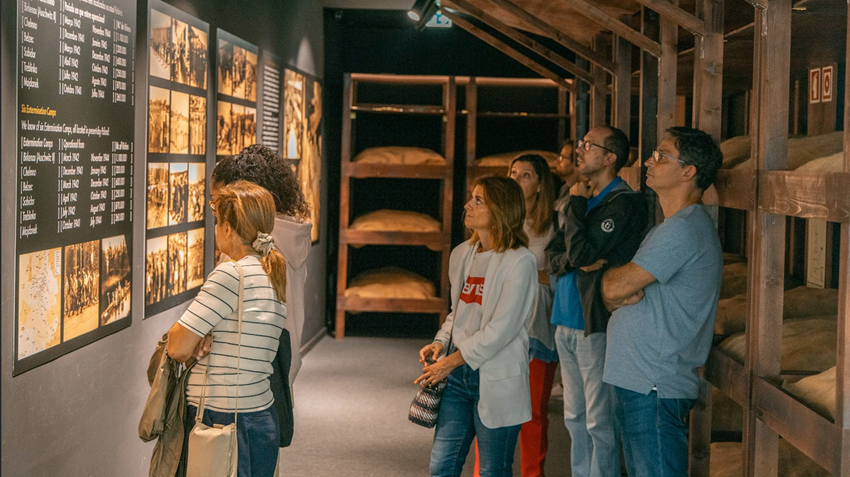
The Holocaust Museum of Oporto. Credit: CIP/CJP
The main cinema of the Jewish community of shows history films throughout the day. They were produced by the community, based on historical sources of great value and reliability. There are visitors who do not leave their place between 10:30 am and 5:00 pm. They do not watch only one film, they watch them all. Hey also participate in the discussions that follow each one. The films include: "The Light of Judah", which makes a historical journey that spans centuries, "The 2000 exiled Jewish children", who were destined for the inhospitable island of São Tomé, 7500 kilometers from Lisbon, "1506 – The Genocide of Lisbon", which recounts a massacre against the Jews that is not included in school curricula, "1618", the most internationally awarded film in the history of Portuguese cinema, which recounts the Inquisition's visitation to in the early seventeenth century and which destroyed the city's own economy, "Sefarad", which tells the story of the "Portuguese Dreyfus", and "The Nun's Kaddish", which reveals a true story of Catholic kindness that occurred in 1982, when a nun observed a Jewish ritual in favor of a deceased Jew, elevating the spirituality of the two religions to a very high feeling of universal brotherhood.
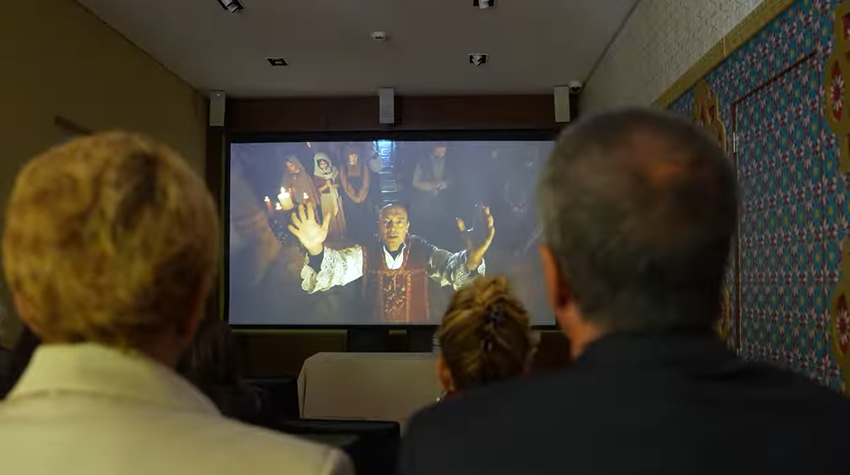
The cinema at the Jewish Museum of Oporto. Credit: CIP/CJP
The European Day of Jewish Culture is a complete program, on a Sunday, morning and afternoon. In the end, visitors thank us repeatedly, for the cultural experience, for the warm welcome and, most of all, for the sense of identity they enjoyed with members of the community. They are careful to see everything. Sometimes they search each space with redoubled attention, as if they fear they could no longer do so. An Israeli television personality who came to Oporto to film the 2024 event, said she was dazzled by the special connection between visitors and hosts and, more than anything, by the "philo-Semitism of many Portuguese, despite centuries of adverse propaganda".
This is Portugal.
These are the Portuguese.
These are the people whose heritage did not come from the Germanic tribes or the Celts, nor from the gulags of Siberia, but from the legal framework of Rome, the philosophy of Athens, and the work with their ancestors in Zion.
The Oporto Jewish community always reminds Bishop Manuel Linda, a dear friend, that the Queen and Patroness of Portugal was Jewish, and that for Portuguese Catholics and Jews, Portugal is their temporal homeland and Israel their spiritual homeland.


