

Portugal celebrates the 25th of April Revolution—known as the Carnation Revolution (Revolução dos Cravos) or Freedom Day (Dia da Liberdade)—every year on April 25th. The annual celebration that unites politicians, media groups, and all sectors of culture in ecstasy is about to happen again. It will be tomorrow. The event will take place on Shabbat of Acharei Mot-Kedoshim.
The Revolution in Portugal of 25 April 1974 ended Marcello Caetano’s “Social State”. Freedom was proclaimed around the country, but not for the Jews in Porto, as they were targets from all sides of the political spectrum. Right-wing forces jeered at Jews as unwanted immigrants. Communists called them owners and imperialists.
The changing social climate produced even more dispersion within the small and divided Jewish community already destroyed by the "Portuguese Dreyfus" affair decades ago. Consisting only of a few dozen people, the community experienced a climate of fear created by the occupations of the business of Ozias Cymerman and Meir Cymerman, the escape to Spain of Henry Tillo’s family, and the threats of arrests by an army commando unit that fell on other Porto Jews.
Paltiel Pressman, president of the community, felt that his freedom was threatened and entered his factory with care. His daughter, Eta Pressman Wright, recalls this moment: "At the time, the workers had generally been indoctrinated that industries should stop belonging to the bosses and it was impossible to foresee what would happen. My parents (my mother, Ida Pressman, was also an active board member) suddenly found themselves facing the loss (as did so many others) of everything they had gained so far. When they entered the factory that first day, they noticed that the workers were present but not working, as if waiting for something to happen. My father then asked who had been chosen to run the factory. As no one stepped forward, everything returned to normal. We were lucky!"
The anti-Jewish climate in Porto continued in the following years. The major bookstores of the city began selling translated editions of "The Protocols of the Elders of Zion," for consumption by communists and nationalists, an alliance that had never been so united in the persecution of Jews.
"You need to stop bothering others"
In July 1975, the Synagogue was pelted with stones for more than an hour and a letter was put in the mailbox addressed to the (nonexistent) “Rabbi”: "The Synagogue was stoned by nationalists, which is unfortunate but it happened. It is not the fault of the nationalists but of certain Jewish people who collaborate with Freemasonry and the Communists. That is what led them to act like this, because among the stone throwers there was no anti-Semitic or pro-Nazi, but as they were all victims of certain Jews, the action was a kind of reprisal. If we have to, we will liquidate all the Jewish collaborators of the Communists. If we ever attack Jews, it will only be those who collaborate with the Communists, and if that’s not enough to have peace, and if we have to, we will eliminate the whole community with a single pogrom more efficiently than Hitler did, and for that we don’t need publicity. It remains to be added that we are Christians and because of this we are not capable. of such carnage. Finally, we mean that the Jews of judgment, the intelligent, the anti-communists, the anti-exploiters have nothing to fear. They are aimless people, capricious and unethical. You need bosses to get in order and stop bothering others."
“Death to the Jews!”
The message “Death to the Jews” with swastikas was written in large letters on the central wall of the Synagogue of Oporto in 1977. Paul Pressman, as an old man, felt powerless to protect the Synagogue and the Jews who were at risk of coming to harm from dangerous extremists. Guilhermino Ranito, a former student of Barros Basto who visited the Synagogue that year, said that one day, he was trapped for hours, because the building was pelted by stones from all sides and its windows were all broken. Police cars passed by and no one wanted to protect the Jews."
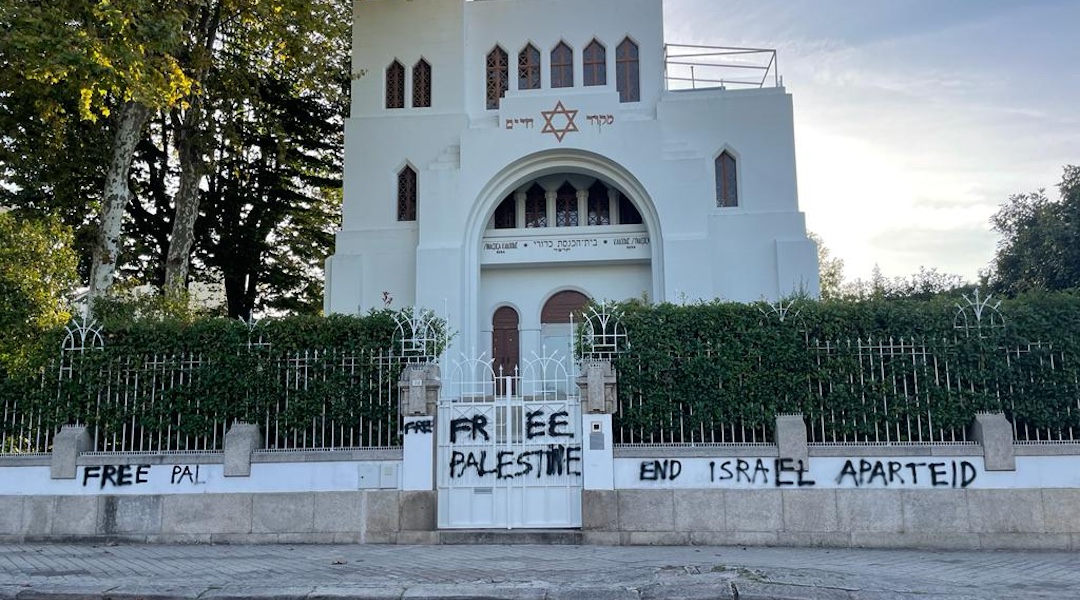
Facade vandalized, without the government condemning the act.
The "opulent" Jewish community
Jewish life always regenerates itself. This happened in Porto in the 21st century. Today, Porto is home to the only Jewish community in Europe that has fully implemented the European Commission's plan to promote Jewish life. The only one that has opened synagogues and a cemetery in recent years. The only one that oversees Jewish and Holocaust museums, having received 300,000 students from schools. The only one that produces award-winning history films on every continent. The only one with a painting gallery that tells its story and is integrated into a Jewish library with ten thousand works. The only one whose YouTube channel far exceeds 3 million views, when communities typically don't even surpass twenty thousand.
Yet, the Portuguese power system apparently didn't like this development, as the 2022 mainstream newspaper editorials described all the work done as "opulence."
Never before had so much nonsense been heard in such a short period of time. Anonymous letters from convicts circulated from hand to hand in circles of political and media power. An attempt was being made to slaughter an organized minority. Leiva da Rocha Abramovich's name was the main flag against the community. Never before had the term "ich" (son of) been so passionately pronounced in television debates. It was a "fraud"—everyone exclaimed. The silence of the system only began when the community accused it of being corrupt itself and of not wanting Jews, nor the rich, nor Israelis, but rather unqualified immigrants. Leiva da Rocha is now the main symbol of a country great in the time of the Jews and which now languishes as if it were a madhouse left to its own devices.
A “Palestinian Question” in Portugal
To understand the "Palestinian question" that guided the entire Portuguese power system in 2022, and which has since led to the inauguration of the Hamas embassy in Lisbon, one only needs to listen to and read the so-called intellectuals with a public voice. Two simple examples condense the fundamental ideas of a vast multitude of liberals and communists roaming the public sphere.
Recently, Miguel Tavares, one of the system's "commentators" made a point of explaining the mainstream trends that today exploit a small country, without weapons and without resources that lives off the charity of others. "I do not accept that Portugal is granting nationality to citizens of Israel at a time when this country denies any rights to the Palestinian population," "Israel voluntarily sacrificed 1,200 of its citizens to carry out the massacre it is carrying out in Gaza," "more than 800,000 Palestinians killed in Gaza," "this will only end when Israel achieves a final solution," "you cannot claim to be the chosen people and victims of the Holocaust when you are promoting one in your own land," "there is a clear element of racism from Israel towards the Palestinians," "Israel is a terrorist state," "a criminal state that no criterion of decency can absolve," "Netanyahu is the greatest criminal on the face of the earth," or even "Europe's leaders are captured by the Israeli lobby," "Israel is at a level of barbarity, madness, insanity," "a state outside the law," "the entire people of Israel, or almost all of them, are in solidarity with them, in solidarity with a government of criminals," "the Holocaust is settled: the Jews of today have settled it, covering the name of Israel with shame."
The "Palestinian question" of the Portuguese liberal and communist nomenklatura did not begin now. Twenty years ago, the Nobel laureate communist José Saramago harshly criticized Israel, comparing the conditions in Palestinian territories to the Nazi concentration camp Auschwitz. He labeled Israeli actions as a "war of extermination," described the state as "totalitarian," and accused it of committing crimes against humanity. "What is happening in Palestine is a crime we can put on the same plane as what happened at Auschwitz," "a totalitarian state that aims only at the extermination of the Palestinians," "a sense of impunity characterises the Israeli people and its army", "these crimes were committed by the government with the applause of the Israeli people".


