


The coordinator of the art gallery, Flor Mizrahi. Credit: CIP/CJP
The art gallery of the Jewish Community of Oporto stands out for the high quality of its paintings and for its ability to bring together, within a single space, different moments from the history of Jews in Portugal and from the trajectory of the Jewish Community of Oporto itself.
Inaugurated in April 2022, the gallery was created under the coordination of the artist Flor Mizrahi, a member of the community, who embraced the challenge of bringing together other artists and turning the project into reality — a task she carried out with excellence.
Flor Mizrahi is a Venezuelan Sephardic Jew who lived in Portugal for six years before returning to Venezuela. Even so, she left an immeasurable legacy for the Jewish Community of Oporto.
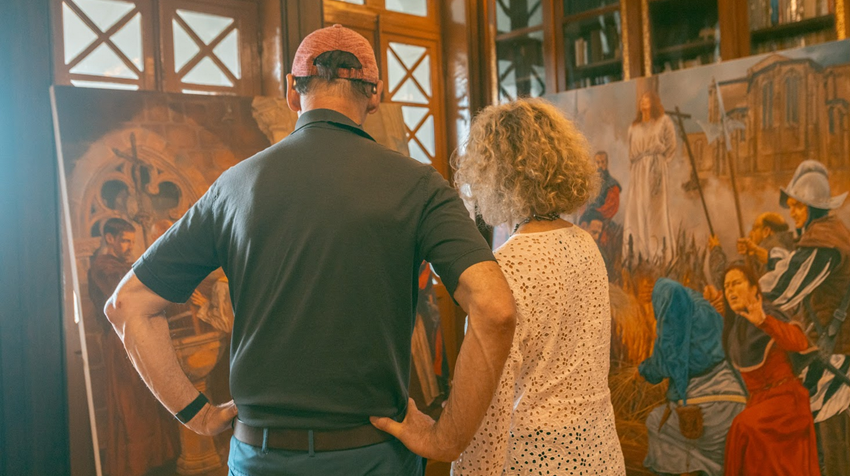
The art gallery is highly regarded at events such as the European Day of Jewish Culture. Credit: CIP/CJP
In an interview with PJN, Flor Mizrahi spoke about her connection to art and Judaism and recalled the process of creating the painting gallery, highlighting the motivations that shaped this initiative.
PJN: Can you tell us a bit about your artistic background and how your journey in Venezuela, and later in Portugal, influenced your perspective as an artist?
FM: I am actually a dentist by profession. Both art and science — as well as my constant desire to learn — led me to choose a career that, while grounded in science, is also deeply connected to art. In parallel, I always painted in oil, worked with ceramics, and laminated glass purely as a hobby.
I arrived in Portugal with my family in 2017, intending to settle there as descendants of a Sephardic family and to feel safe. At that time, my country was experiencing its worst moment: food was scarce, and my daughter had difficulty commuting to school, among many other challenges. Choosing Portugal was a major decision. We were welcomed with great kindness, especially by the Jewish Community of Oporto, and the Portuguese people in general were incredibly warm. It was love at first sight — we fell in love with Oporto, its landscape, and its people. It truly felt like a fairy tale.
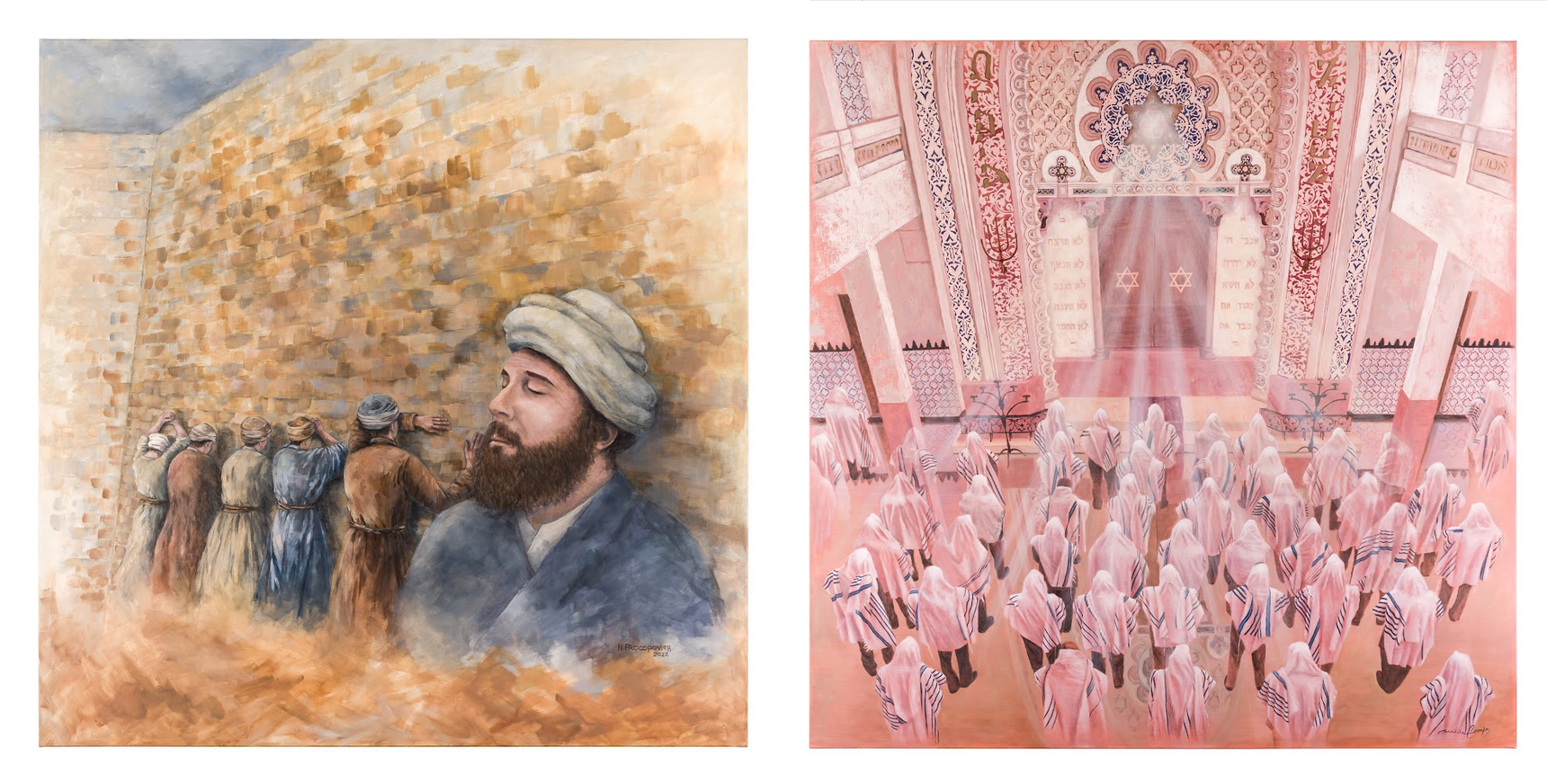
Some paintings from the Oporto Jewish Community gallery. Credit: CIP/CJP
Soon, however, routine set in. This time, fully dedicated to art, I found a studio near our home in Matosinhos that focused on the visual arts, where I worked with the artist Analice Campos. I remained there until the very end, when personal circumstances made it imperative for us to return to Caracas.
PJN: In what ways does your Jewish identity shape your artistic work?
FM: As I mentioned earlier, I am a dentist, a graduate of the Central University of Venezuela, but I must also say that I was born in Caracas into a religion and a way of life that I consider a privilege.
I was born into a traditional Jewish household — an identity that flows through my pores. Without my identity in my daily life, I am not myself. Thus, my creativity and my identity became one when the Jewish Community of Oporto asked me to support them in creating an art gallery.
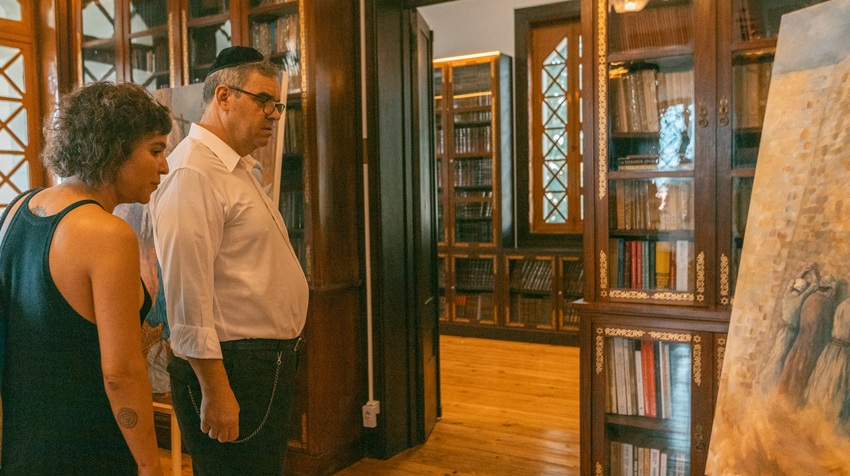
The paintings tell the story of the Jews in Portugal and in Oporto over the centuries. Credit: CIP/CJP
PJN: How did the idea of creating an art gallery with works that portray the history of Jews in Portugal and of the Jewish Community of Oporto come about? And how did you reach the other participating artists?
FM: A beautiful community — small in size but vast in heart and proactivity — that had become my own needed an art gallery. It was a community that already had everything: a synagogue that welcomed us, Hebrew language learning, the celebration of holidays, religious, social, and community-oriented activities for the benefit of both the community and the country.
The community wanted to create a gallery, and so it happened. They defined the dimensions of the artworks and the key themes from each era — spanning 500 years of Jewish history in Portugal — from the Jews’ establishment as merchants, their alliance with the kings, their expulsion and forced conversion to Christianity (the “New Christians”), up to the present day.
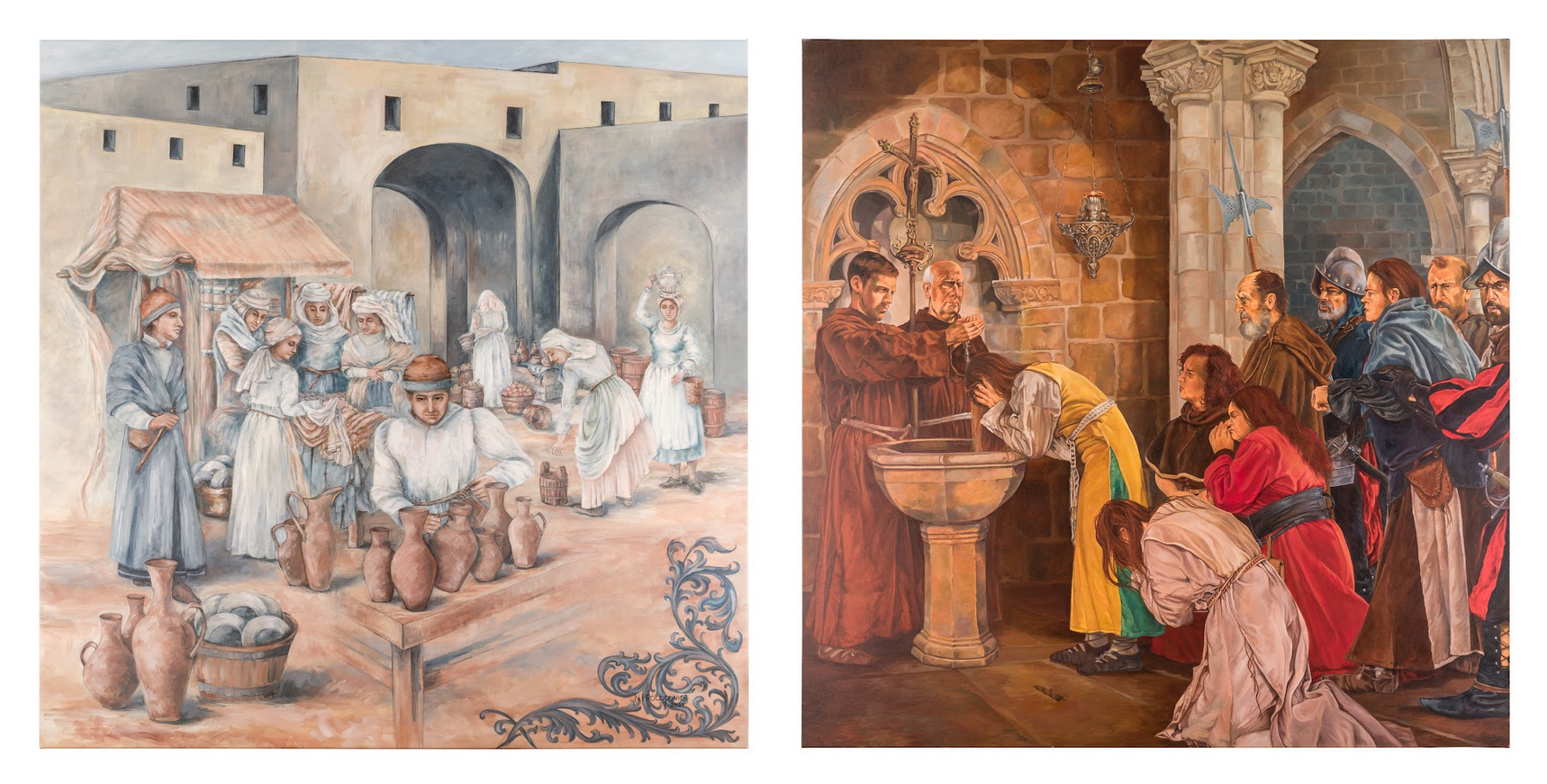
Some paintings from the Oporto Jewish Community gallery. Credit: CIP/CJP
I was deeply moved and began my research. Accompanied by my family, we traveled to every town and village where Jews had lived — Tomar, Belmonte, and others. Immersed in the history of my people in Portugal, I researched topics ranging from crypto-Jews, the actions of Captain Barros Bastos, and the Inquisition, to contemporary times.
One of the most memorable experiences was our visit to Castelo de Vide, where even today one can see the places where Jews were baptized under royal decree, forcibly converted from Judaism to Christianity, giving rise to the so-called New Christians.
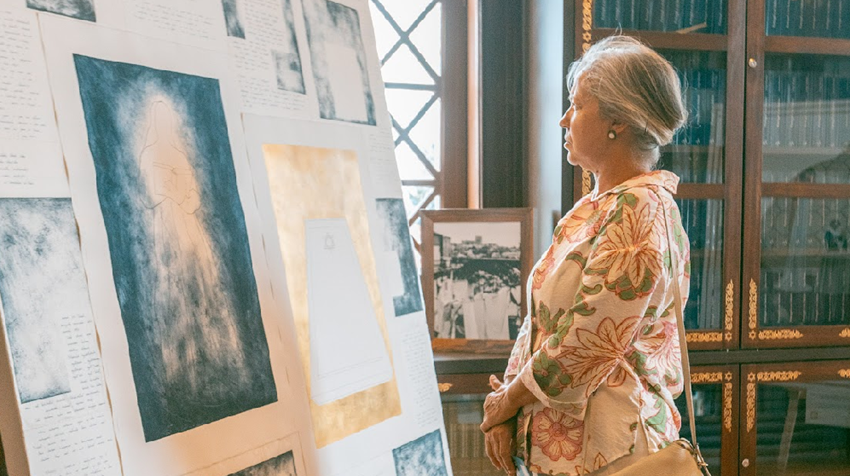
The artists used different materials and painting techniques.
The themes covered in our exhibition were:
-
The Kadoorie Mekor Haim Synagogue in Oporto;
-
A medieval fair depicting Jews as outstanding merchants;
-
Jews praying beside a city wall in Oporto, facing Jerusalem;
-
Religious Jews providing spiritual leadership to the community;
-
Jewish scholars studying in a beit midrash;
-
A ship full of people leaving Portugal at the end of the 15th century;
-
The forced baptism of an adult Jew;
-
An inquisitorial auto-da-fé in Oporto;
-
A map showing the destinations of the Portuguese Jewish diaspora;
-
An Ashkenazi wedding in 1925;
-
An exterior view of the Kadoorie Mekor Haim Synagogue;
-
Holocaust refugees in Oporto;
-
A nun reciting Kaddish for a deceased Jew;
-
A Sephardic wedding;
-
Jews praying while wearing tallitot.
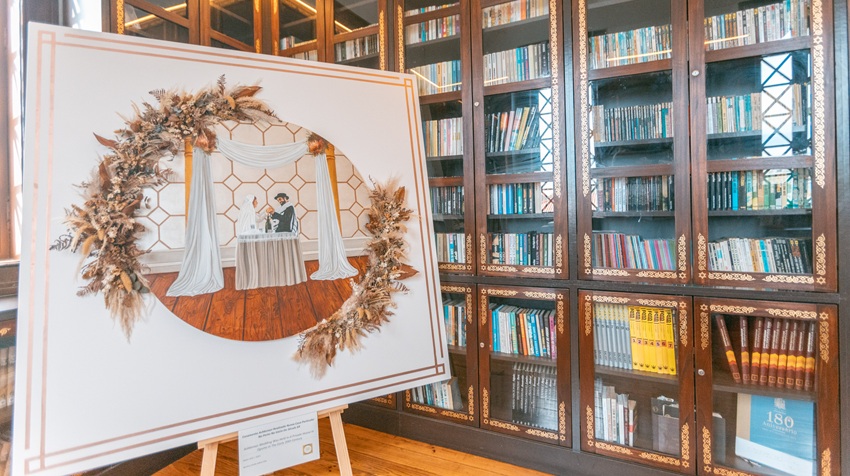
The painting gallery is located at the Rosh Pinah Library. Credit: CIP/CJP
PJN: You not only painted works yourself, but also coordinated the work of other artists. What were the main challenges of both roles?
FM: I devoted myself to researching and seeking local artists who could support me in this endeavor. I knocked on many doors, and surprisingly, everything flowed naturally. I sought contacts in galleries, schools (the University of Porto), and art studios. The synagogue, of course, was a tremendous source of support.
I asked the artists to visit the synagogue and immerse themselves in our history. They had the opportunity to watch the film Sefarad, produced in Oporto, and to visit Jewish museums. At that time, the Holocaust Museum of Oporto had not yet opened, but I spoke to them about that historical moment and the role played by the Oporto synagogue in sheltering Jews expelled from Nazi Germany.
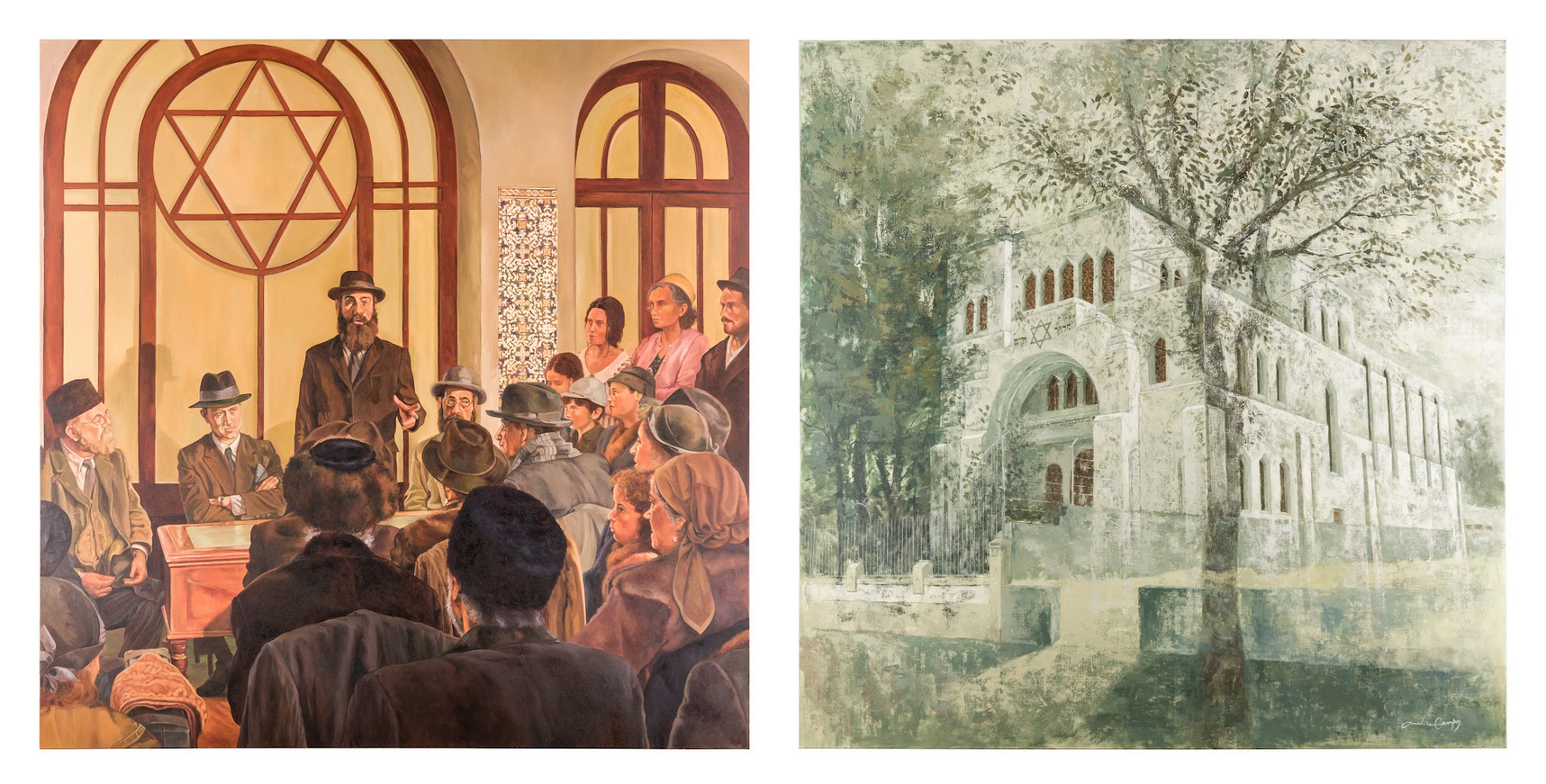
Some paintings from the Oporto Jewish Community gallery. Credit: CIP/CJP
As the work progressed, I stayed closely involved, providing guidance on Jewish religion and ways of life. This came naturally to me, as I was born into a Sephardic Jewish home. Along the way, I encountered extraordinarily kind people — university graduates and visual arts professionals. I made a point of getting to know them and sharing time with them before formally presenting the project. I spoke to them about Jewish life and my own background, and they immediately showed openness and willingness to contribute.
And so, together with the synagogue, we embarked on this adventure. It is worth emphasizing that the Portuguese people are open to living alongside us. Yes, it was a relatively small exhibition, but for me, it represented six years of building a life in a phenomenal country. Although I carried with me the historical memory of expulsion and antisemitism, Portugal taught me that history is never the end of the story. Rather, it is a living reminder that the deepest paradigm shifts are not found in books, but in the streets we walk and in the hands that are extended to us.


