


Credit: The National Library of Israel
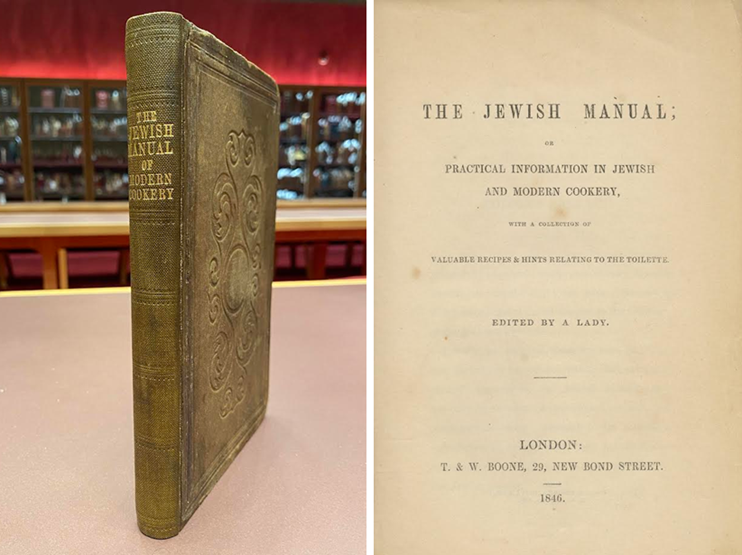
The National Library of Israel announced that it has acquired a rare hard-copy of The Jewish Manual: Practical Information in Jewish and Modern Cookery (with a Collection of Valuable Recipes & Hints Relating to the Toilette), the first-ever Jewish cookbook and housekeeping guide published in England.
Released in 1846, The Jewish Manual listed only “A Lady” as its author, but the book has been attributed to Lady Judith Montefiore. Although there is no documentation or concrete proof, there are a few reasons to support this hypothesis: not many Jewish women in Victorian England held the title of Lady, the book’s recipes correspond to the type of cuisine served in the Montefiore home, the book’s text indicates that the author was a member of the upper class, and – even more telling – seems to have been someone who was well-traveled, including to the Land of Israel. Judith Montefiore visited Israel five times while accompanying her husband.
The Jewish Manual’s recipes range from “Palestine Soup” — (“Stew a knuckle of veal, and a calf's foot, and one pound of chorissa, and a large fowl, in four quarts of water, add a piece of fresh lemon peel, six Jerusalem artichokes, a bunch of sweet herbs, a little salt and white pepper, and a little nutmeg, and a blade of mace…”) ; to “Roasted Chestnuts for Desserts” (“Chestnuts are so frequently sent to table uneatable, that we will give the French receipt [recipe] for them…”).
The book’s chapters cover personal care — “Cosmetic baths, composed of milk… are also in frequent use among the higher classes in the East; and we have been informed that they are gradually gaining favour in France and England,” — and the author also provides advice “to guide the young Jewish housekeeper in the luxury and economy of ‘The Table,’ on which so much of the pleasure of social intercourse depends.”
Credit: The National Library of Israel
“Up until now, the Library’s catalog only had access to the Montefiore Collection’s digital copy of The Jewish Manual,” explains Dr. Chaim Neria, Curator of the Haim and Hanna Solomon Judaica Collection at the National Library of Israel. “It was important to us to have a hard-copy, as acquiring this book – the first-ever Jewish cookbook published in England — is part of our mandate to collect, preserve and share collections of knowledge, heritage, and culture of the Jewish people, the State and the Land of Israel. The Montefiore family heritage is most certainly intertwined with all the above.”
The Jewish Manual joins the Library’s collection of historical and modern cookbooks as well as ephemera covering Jewish and Israeli cuisine. Among the highlights: Dei Yiddishe Kuch (1930) which, although written in Yiddish, includes Middle Eastern recipes; How to Cook in Palestine (1933), an essential guide to acclimating one’s palate to the Land of Israel; community cookbooks and many more. The KTIV manuscript collection even includes a fragment of a Medieval shopping list, with the ingredients for making tahini.
LADY MONTEFIORE'S MILK-BASED RECIPES FOR SHAVUOT
Savoury Cheese Cakes - Grate finely an equal quantity of stale bread and good cheese, season with a little pepper and salt, mix into a batter with eggs, form into thin cakes and fry.
Maccaroni and Cheese - Boil some maccaroni [sic] in milk or water until tender, then drain them and place on a dish with bits of butter and grated Parmesan cheese; when the dish is filled grate more cheese over it and brown before the fire.
Ramakins - Mix together three eggs, one ounce of warmed butter, and two of fine cheese grated, and bake in small patty pans.
Cheesecakes - Warm four ounces of butter, mix it with the same quantity of loaf-sugar sifted, grate in the rind of three lemons, squeeze in the juice of one, add three well-beaten eggs, a little nutmeg, and a spoonful of brandy; put this mixture into small tins lined with a light puff paste, and bake. Cheesecakes can be varied by putting almonds beaten instead of the lemon, or by substituting Seville oranges, and adding a few slices of candied orange and lemon peel.
A Nice Breakfast Cake - Make a paste of half a pound of flour, one ounce of butter, a very little salt, two eggs, and a table-spoonful of milk, roll it out, but first set it to rise before the fire; cut it into cakes the size of small cheese plates, sprinkle with flour, and bake on a tin in a brisk oven, or they may be fried in a clean frying pan; they should be cut in half, buttered hot, and served quickly.
A Fondu - Make into a batter one ounce and a half of potatoe [sic] flour, with the same quantity of grated cheese and of butter, and a quarter of a pint of milk or cream; add a little salt, very little pepper, and the well-beaten yolks of four fine fresh eggs; when all this is well mixed together, pour in the whites of the eggs, well whisked to a froth; pour the mixture into a deep soup plate or dish, used expressly for the purpose, and bake in a moderate oven. The dish should be only half filled with the fondu, as it will rise very high. It must be served the moment it is ready, or it will fall. It is a good plan to hold a salamander (a metal implement used for browning) over it while being brought to table.
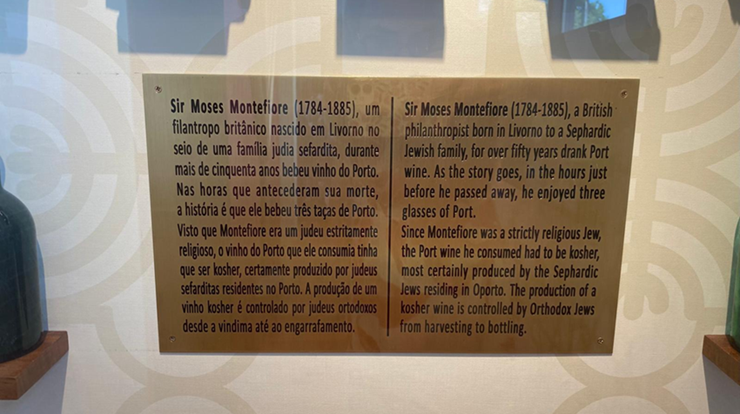
A session held at the Jewish Museum of Oporto focusing on a discovery related to Sir Moses Montefiore. Credit: CIP/CJP
A CURIOSITY: MONTEFIORE AND HIS CONNECTION TO OPORTO
Sir Moses Montefiore — husband of Lady Judith Montefiore — was a deeply observant Jew and consumed kosher Port wine for more than five decades. It is important to emphasize that Montefiore lived in England; his consumption of this wine resulted from international networks of trade and religious certification that allowed him access to kosher products produced in Portugal.
Montefiore became associated with this wine in a context that gains particular relevance in light of a relatively recent discovery by the cultural department of the Jewish Community of Oporto: in the 19th century, there existed in the city a Sephardic Jewish community originating from Morocco and Gibraltar, until recently unknown.
It was precisely this community that ensured the production and supervision of kosher wines in Portugal, such as the Port wine consumed by Montefiore, guaranteeing strict compliance with Jewish dietary laws in its preparation.


