

Michael Rothwell welcoming a school at the Holocaust Museum of Oporto. Credit: CIP/CJP
Inaugurated in 2020, the Holocaust Museum of Oporto is part of the Jewish Community of Oporto’s strategy to combat antisemitism, placing education and the preservation of historical memory at the core of its mission. The museum is primarily aimed at school audiences, promoting awareness of the Holocaust and its consequences, and also receives diplomats and public figures.
Portugal maintained a position of neutrality during the Second World War but played a relevant role by welcoming Jewish refugees holding transit visas. This historical reality was the basis for the creation of the museum. It is estimated that around 400 Jewish refugees passed through Oporto, and the records of these individuals are now on display at the museum, bearing witness to journeys marked by flight, survival, and hope.
Michael Rothwell, who directs both the Holocaust Museum and the Jewish Museum of Oporto, regularly welcomes diplomats, politicians and public figures. Whenever possible, particularly on special commemorative dates, he also meets with students during school visits, which are typically guided by museum docents.
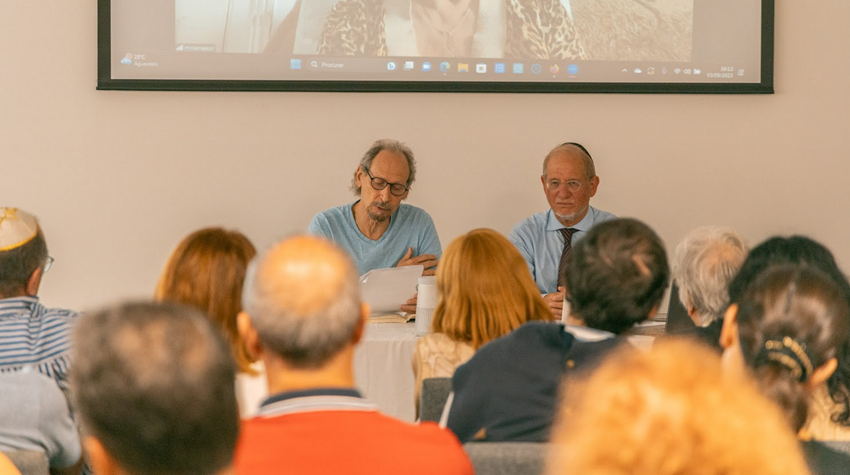
Michael Rothwell with writer Richard Zimler at the Holocaust Museum during the European Day of Jewish Culture. Credit: CIP/CJP
In a conversation with PJN, Michael Rothwell shared his experience as director of the Holocaust Museum of Oporto.
PJN: To begin with, could you share a bit about your connection to Porto and to the Jewish Community of Oporto?
MR: I have lived in Oporto with my family since the 1980s and have been a member of the Jewish Community of Oporto since 1995. I was a member of the Board of Directors in the late 1990s, later a member of the General Assembly, and once again a member of the Board of Directors from 2016. Naturally I have seen many changes both to the city of Oporto and the Jewish Community of Oporto over the decades, and I am proud to belong to a community that has had the courage to create both a Jewish and a Holocaust Museum, probably the only ones in Europe built and run by the local Jewish Community.
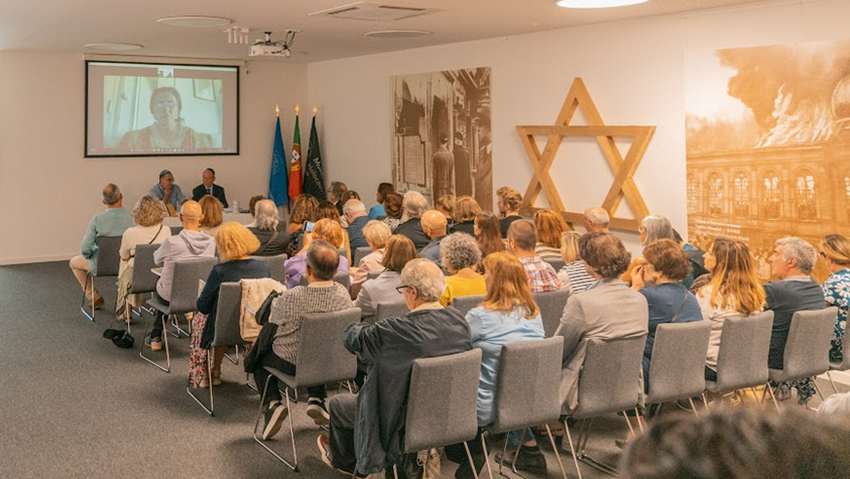
The Holocaust Museum of Oporto. Credit: CIP/CJP
PJN: Many people are surprised to learn that Portugal, a neutral country during World War II, hosts a museum dedicated to the Holocaust. As the director of this museum, could you tell us how this project came about and what the main message the museum seeks to convey is?
MR: That is indeed the case. The key exhibit on display at the museum is the Community’s collection of over 400 registration cards of Jewish refugees from all over Europe who sought to flee through neutral Portugal via ship to other continents – mainly the Americas – and who, in Oporto, requested assistance from the Oporto branch of COMASSIS (Portuguese Commission for Assistance to Jewish Refugees) run by the Jewish Community of Oporto.
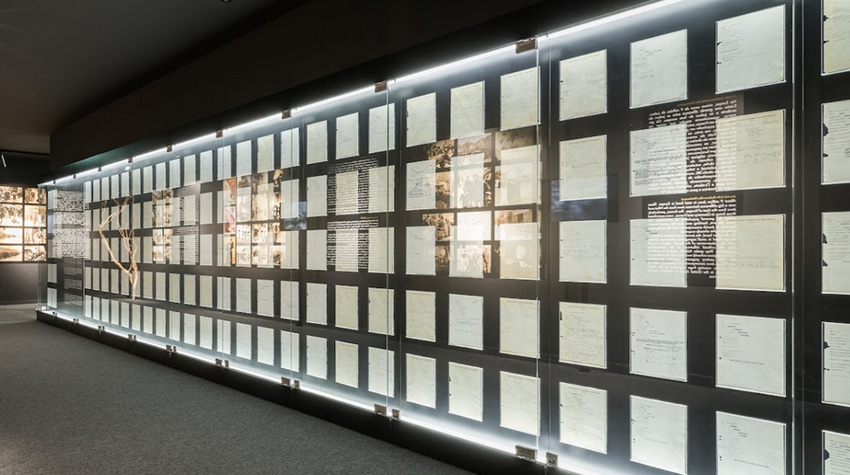
The collection of over 400 registration cards of Jewish refugee. Credit: CIP/CJP
This documentation was a key reason to create the museum. Another factor was the fact that in December 2019 Portugal became a full member of IHRA – International Holocaust Remembrance Alliance, and in that context launched the programme “National Never Forget Program - focusing on Holocaust Remembrance” in June 2020. Following these initiatives by the Portuguese State, the Jewish Community of Oporto, which had already created its Jewish Museum in 2019, decided to create a Holocaust museum in late 2020.
Both our museums have an educational goal: to teach the general public, particularly school students, about Jewish culture and the horrors of the Inquisition and the Holocaust so that the younger generation will grow up with some knowledge of these matters, take the Righteous Among the Nations such as Aristides de Sousa Mendes as role models, and help ensure that nothing like the Holocaust ever happens again.
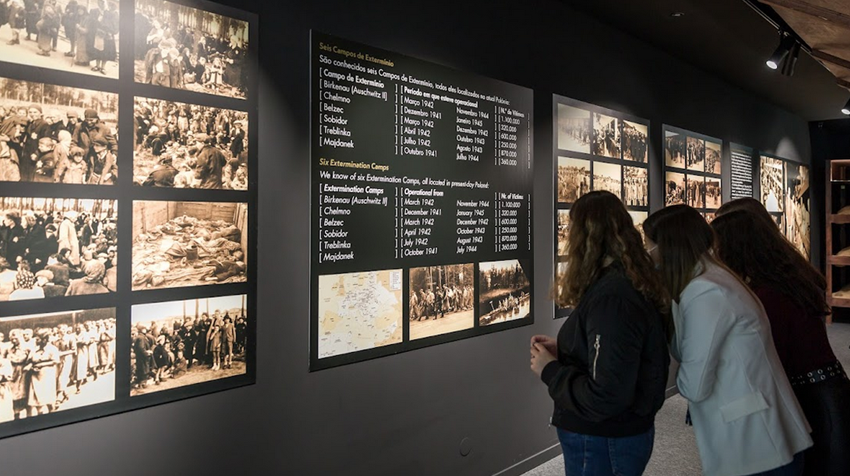
Students visit the Holocaust Museum of Oporto. Credit: CIP/CJP
PJN: The Holocaust Museum of Oporto is known for welcoming thousands of Portuguese students. But in addition, it also receives diplomats and public figures. What is the most common reaction from the visitors when they tour the museum? Do you recall any comment or gesture from these visitors that left a particularly strong impression on you?
MR: Yes, the museum is primarily focussed on welcoming Portuguese school students but has also been visited by many diplomats and public figures. Our main partners are the schoolteachers who, every year, bring classes of students to visit the museum from all over Portugal. Visiting this museum, with its powerful visual tools, has a much greater impact on the students than studying from a textbook.
"Personally, I am always moved to witness the sensitivity of many of our younger visitors, who end the visit visibly touched, often with tears streaming down their faces."
This reaction reveals not only empathy and capacity for reflection, but also the importance of keeping the memory of the Holocaust alive, ensuring that future generations understand the depth of the tragedy and the need to never forget it.
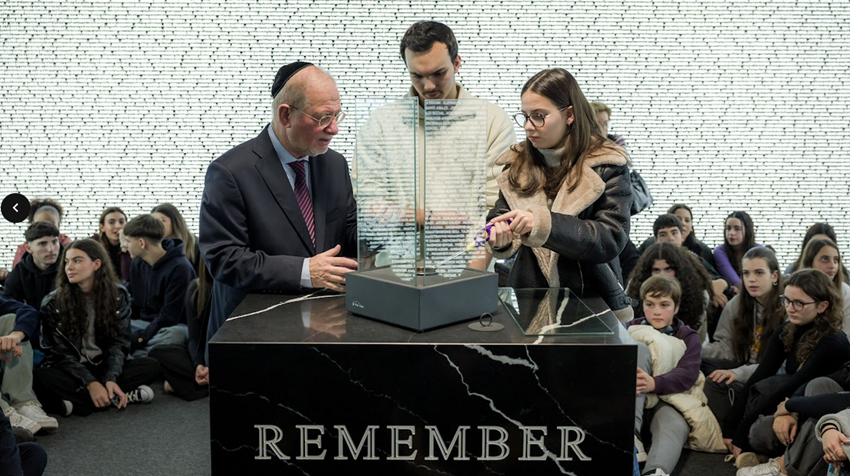
Michael Rothwell with Portuguese students in the Memorial room. Credit: CIP/CJP
PJN: Is there any part of the exhibition that prompts deeper reflection among these visitors? And for you personally, is there a section that is especially meaningful?
MR: I would say that it is the combination of the image of diverse Jewish cultures and life in Europe before the Holocaust, the gradual “dehumanisation” of the Jews through the Nuremberg laws, Kristallnacht, the ghettos and finally the firing squads and ovens of the extermination camps of the “Final Solution”, all these together, convey a clear idea of the Holocaust and have a great impact.
For me, personally, the Memorial room, with over thirty thousand names of victims from many different countries – including those of my own maternal grandparents – is the most moving part of the museum.
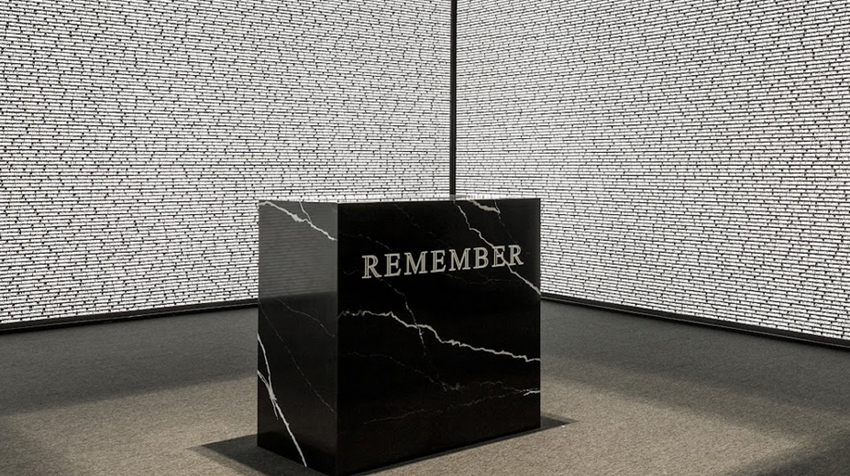
The Memorial room. Credit: CIP/CJP
PJN: The museum also takes part in an exchange program of the Austrian Service Abroad association, which sends young Austrian volunteers for a year of service to institutions dedicated to historical memory. What roles do these young people play in the museum’s day-to-day activities, and what impact do you believe this experience has both on them and on the institution itself?
MR: Yes, Austrian Service Abroad has sent us a young volunteer to work at the museum every year since its opening in 2021, and we currently have with us the fifth volunteer, Lucca Dirsch. All these volunteers, after an initial period of training, are able to give guided tours to visitors to the museum, including school groups when language is not an obstacle. A good example is our last year’s volunteer, Noah Jakovljević, who made a great effort to learn Portuguese as quickly as possible, so that after a few months he was able to guide school visits in Portuguese.
Other work includes translating historic documents from German, and general administrative tasks and help organising events. Once again, Noah was exemplary in that he rose to the challenge of creating a temporary exhibit of great quality entitled "Simon Wiesenthal: Survivor. Witness. Nazi Hunter", much praised by all who saw it. Additionally, the volunteers are encouraged to take part in the Jewish life of the synagogue.
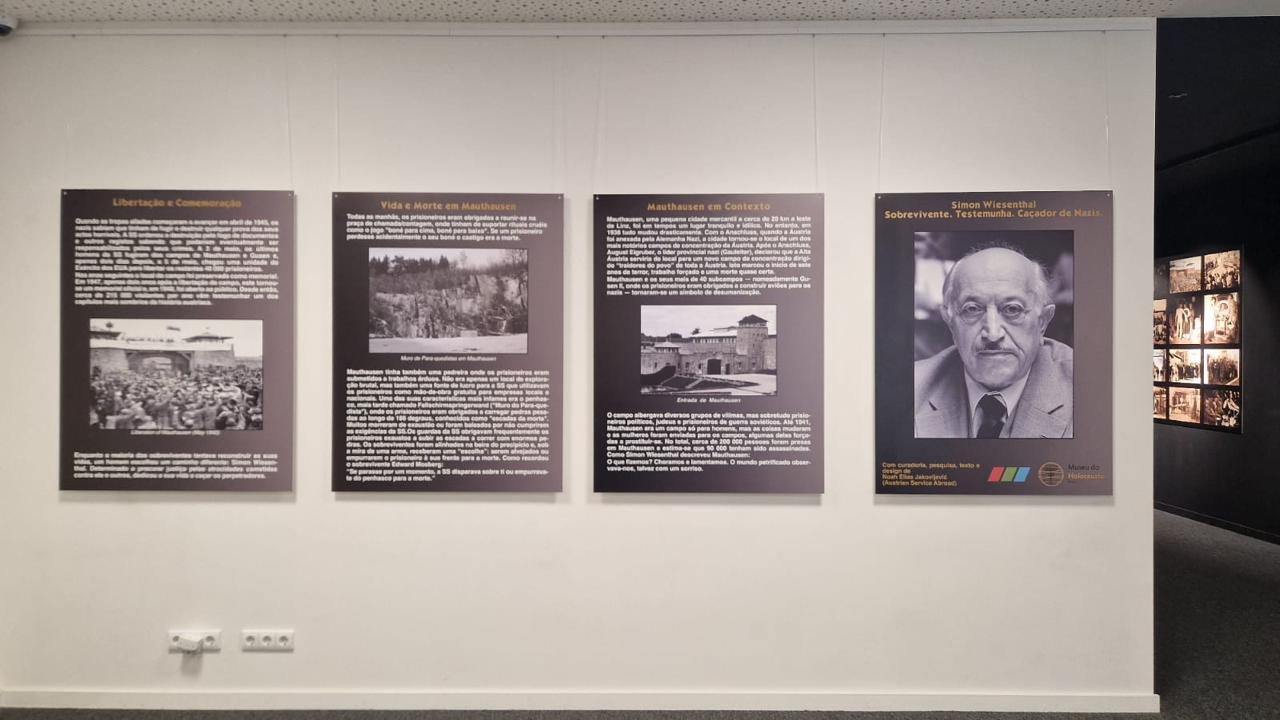
Temporary exhibition “Simon Wiesenthal: Survivor. Witness. Nazi Hunter,” created by volunteer Noah Jakovljević. Credit: Noah Jakovljević
For our museum, the work of these volunteers has been extremely beneficial, both through their friendliness, and from all the tasks they carry out.
All our volunteers leave us with a much deeper knowledge of Judaism and the Holocaust, with improved linguistic and communication skills, and with the satisfaction of knowing that their work has had a positive impact on the education of thousands of Portuguese youngsters and that this will help to ensure that the Holocaust never again happens.
We are proud that our volunteer Noah won the award "Volunteer of the Year" from Austrian Service Abroad.

