

Painting from the collection of the Jewish Community of Porto’s art gallery. Credit: CIP/CJP
The passionate practice of Judaism and the creation of a better world are achieved through the promotion of Jewish culture and history, which, by their very nature, cannot fail to honour the memory of its greatest figures, contributions, and achievements. This was the case in northern Portugal with the Oporto Jewish community, which for 15 years did everything possible to honour and remember the most significant figures, successes, and setbacks in Jewish history in the city and the country, as well as in Jewish communities of Portuguese origin.
The work undertaken aimed to celebrate and raise awareness of legacies, lives, and achievements, a way to extend the existence of those who, individually and collectively, did so much to deserve it and to ensure that their story can serve as inspiration for new generations, aiming to create a more just, cultivated, and humane world. The exaltation of the value of personalities for the history and culture of the Jewish people, film productions, memorials, the collection and preservation of records, the creation of memory spaces, institutions, monuments, museums or memorial plaques, events, lectures and exhibitions, research and studies about their people, the transmission of their values and teachings, the keeping of their traditions, the deepening of knowledge about their importance, all these are genuine acts of recognition, gratitude and respect that help to keep the connection with the past alive, inspiring future generations, a form of respect for those who have contributed significantly to society, through actions, works and ideas.
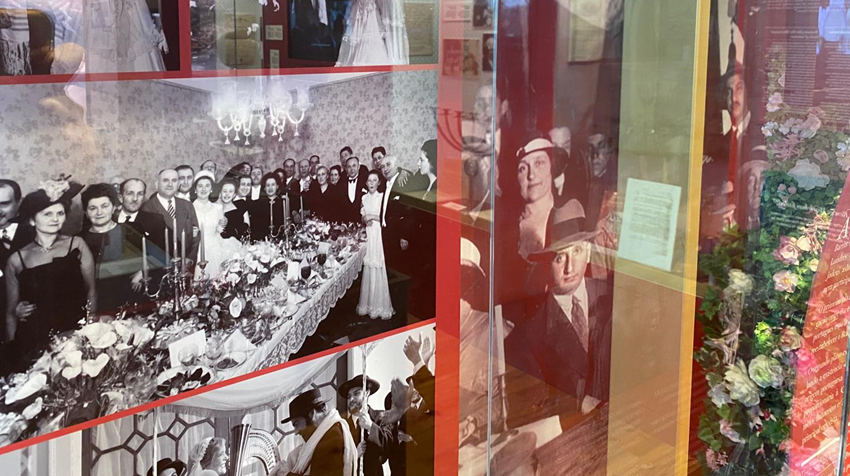
Session at the Jewish Museum of Oporto dedicated to the rebirth of the Jewish community in the 20th century. Credit: PJN
Oporto's Jewish community has dedicated itself to honouring the memory of those who founded, developed, and were expelled and persecuted in Portugal leaving for various parts of the globe, as well as those who returned after the official abolition of the Inquisition and revived Jewish life in the city. Even the Nazi refugees who passed through Oporto had their names praised, given visibility, and their final destinations investigated and discovered. Recorded below the most important tributes, works, and projects that were carried out, and the means by which such an exciting task was accomplished, in the face of a politically dormant country that didn't want to know what the productive Jews were doing here again.
Here is a summary of the main events, productions and achievements dedicated to personalities and entities honoured:
Figures of the Jewish community in medieval Portuguese trade, culture, and navigation
From the set of historical films produced by the Jewish community of Oporto, important realities were covered, such as medieval fairs and the role of Jews in the trade of essential products, the long boat journeys to other worlds, under what conditions and with what instruments, and even how the Torah was studied in the study rooms of the Jewish community at a time when the press did not yet exist or was in its infancy.
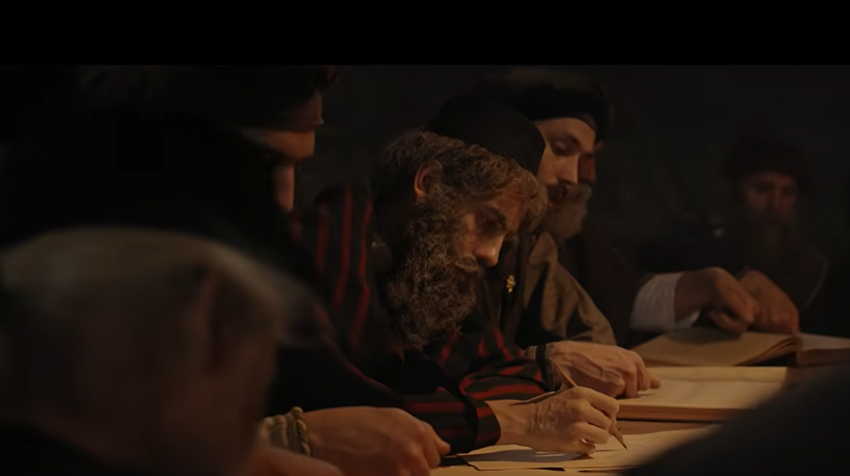
Scene from the film Sefarad
Edict of expulsion in Spain and exodus to Portugal
One of the community's film productions, discussed below, captured this episode, from the moment the edict was posted in the public square to the surroundings, the context in which it occurred, and everything that followed. The haste of departure, the sale of everything cheaply, the farewell to ancestors buried in local Jewish cemeteries, the disconsolate emigration, the hardships of the exodus, the carts, the books, the Sefarim, the old, the young, the beasts of burden, the exploitation they suffered in Portugal, the slavery, the pain, the kidnapping of their children. May the Omnipresent compensate for so much pain among the children of Zion and Jerusalem! The community did everything possible to ensure this episode is always remembered.
The tragic fate of Spanish Jewish children in Portugal
The documentary film on this topic, produced by the Jewish community of Oporto, was not limited to honouring the 2,000 children deported to a savage island 7,500 km from Lisbon, but also aimed to remind us that the Gaza hostage crisis—including the Bibas children—was experienced by Jewish children in many eras and latitudes. May the Omnipresent have graced the souls of those children! May He have comforted their families in Zion and Jerusalem! The community did everything possible to ensure that this long-forgotten episode of inhumanity earns a genuine place in history.
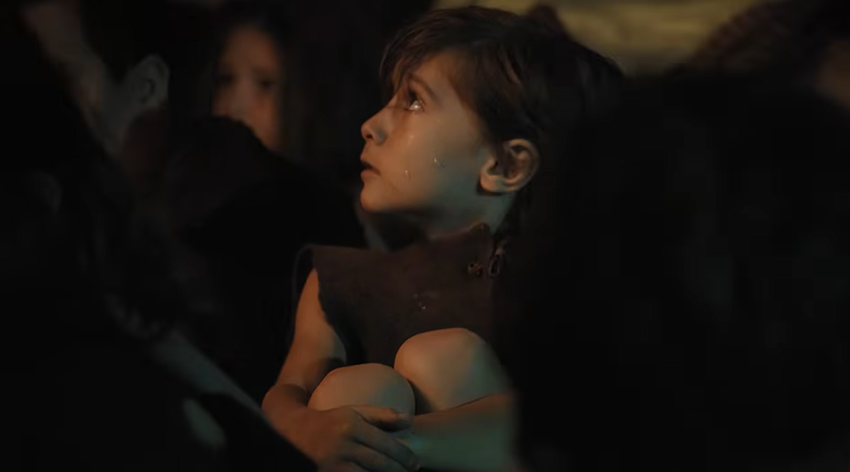
Scene from the film 2000 Kidnapped Jewish Children
Isaac Aboab, Yosef Karo, Isaac Abravanel, Abraham Zacuto, and others
The name of the cemetery of the Jewish community of Oporto, inaugurated in 2023, is "Isaac Aboab," the last Gaon of Castile. A reminder of his passing in the city and his funeral rite, conducted by Rabbi Abraham Zacuto, is the film "The 2,000 Kidnapped Children." The most sought-after object by scholars at the Jewish Museum of Oporto is the Shulchan Aruch by Yosef Karo. Work to restore and republish works by authors such as Rabbis Abravanel and Saba has been carried out by Chabad Portugal, to which the community has contributed financially.
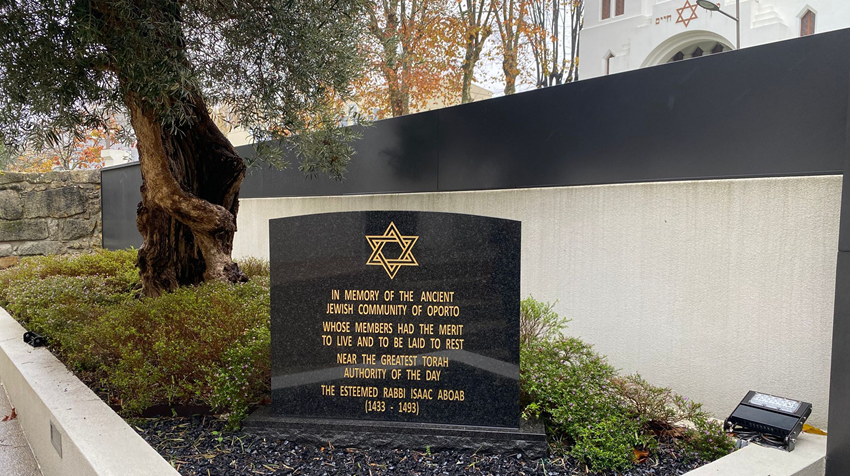
A plaque in front of the Jewish Museum of Oporto honoring Rabbi Isaac Aboab. Credit: PJN
The Edict of Expulsion in Portugal
The community's historical film productions have highlighted this episode, the context in which it occurred, and the way it was felt and experienced by the national Jewish community. While in the Oporto markets, Jews sold all the necessities of life and fed the city, mixing languages, speaking Portuguese, Spanish, and Hebrew, the terrible news reached the rabbi of Oporto, while he was leading the city's Beit Midrash, filled with Talmudic scholars. The impact of the news, the enraged mob banging on the door, the rabbi covered in baptismal water— this was the way the community found to describe in a few minutes what happened. The gratitude owed to the Jews who had inhabited the kingdom since Roman times was thus served. May the Omnipresent have graced the souls of the fatal victims of this unjust decision! May He have spared many of the children of Zion and Jerusalem, leading them to other lands! The community did everything possible to provide a filmed view of one of the most important episodes in Portuguese history, which had never been filmed before, nor has it been filmed again to this day.
The Lisbon Genocide
The documentary film on this topic, produced by the Jewish community of Oporto, is not just a film. It is a way to remember and honour those who received hatred as payment for making Portugal a great nation. Thousands of people were burned in bonfires as tall as houses. Women, children, and babies were not spared. Similar brutalities targeted Jews in many places: Seville, York, Odessa, Paris, and so many others. None of them is on the school curriculum in any country. May the Omnipresent have graced the souls of those who departed in Lisbon! May He have comforted their families in Zion and Jerusalem! The community did everything possible to make that tragic fate known to multitudes around the world.
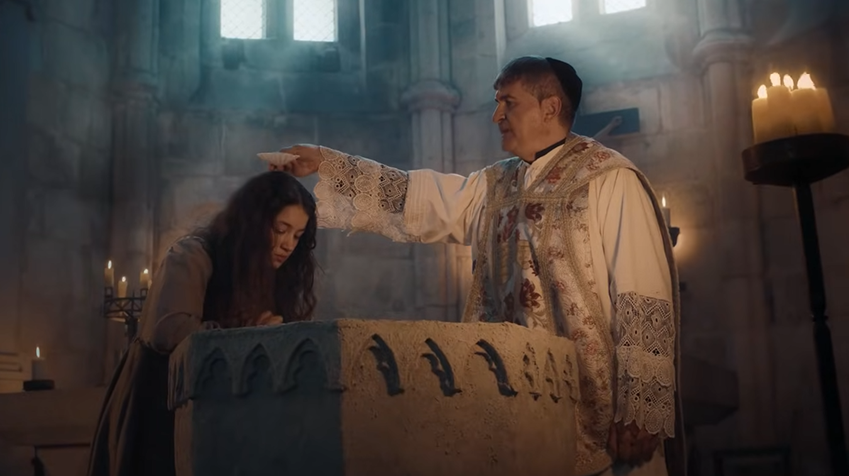
Scene from the film 1506 - The Lisbon Genocide
Forced emigration
Jews of Portuguese origin emigrated throughout the world. A decade ago, the Jewish community of Oporto compiled lists of the names of the founding families of communities in Turkey, Greece, Macedonia, Bulgaria, Syria, Egypt, and many other places in the Ottoman Empire, including the Mediterranean, such as Morocco, Algeria, and Tunisia, and Europe, notably in Amsterdam, London, Hamburg, and others. The main records were shared in 2017 in a book supported by the community and mentioned above. Visitors to the city's Jewish museum are impressed by the fates of Portuguese Jews around the world, marked on a globe there and on interactive screens that display nearly endless lists of names. This research work was also a way to honour those families, and those individuals, not to mention the Hamas hostages—such as Adina Moshe Galante and Ofer Calderon—who likely owe their lives to obtaining Portuguese nationality, to which the community contributed in a small way, by granting them the just certificate of Sephardicism to which they were entitled. Galante, 72, belonged to a traditional Sephardic family in Turkey, and there are records of this family in the Portuguese synagogues and institutions that existed in Izmir, Edirne, and others, such as the "Kahal Kadosh Portugal." Calderon, 52, was from a traditional Sephardic family in Greece, and there are records of this family in the Portuguese synagogues and institutions that existed in Thessaloniki: the "Kahal Kadosh Portugal," the "Kahal Kadosh Lisbon," the "Kahal Kadosh Évora," the "Portugal Velha," and others.
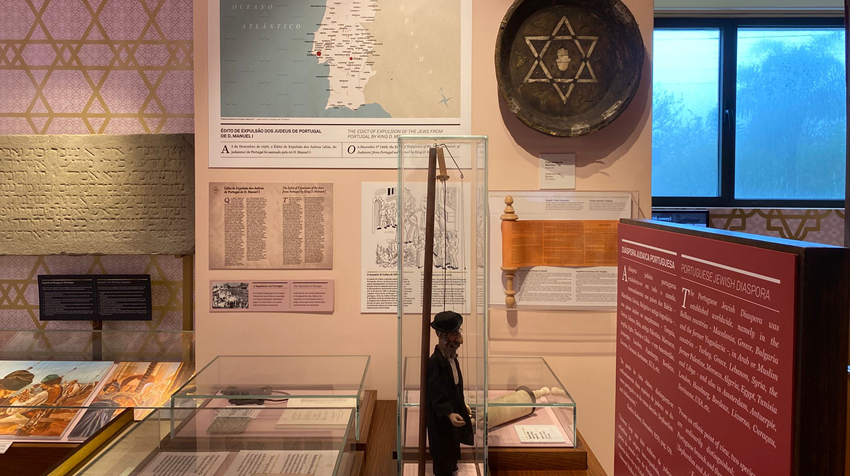
Session at the Jewish Museum of Oporto dedicated to the Jewish diaspora. Credit: PJN
Lists of names in Sephardic communities of Portuguese origin around the world
"The Sephardic Diaspora According to the Archives of the Jewish Community of Oporto." Authored by historian Arthur Villares, this book, published in 2017 and funded by the community, reproduces, in its second part, the main lists of names of Jewish families who were part of Jewish communities and institutions of Portuguese origin around the world, particularly in Europe and its distant colonies, the former Ottoman Empire, and North Africa. These same lists of names are part of the community's archives and are available digitally to visitors of the Jewish Museum of Oporto.
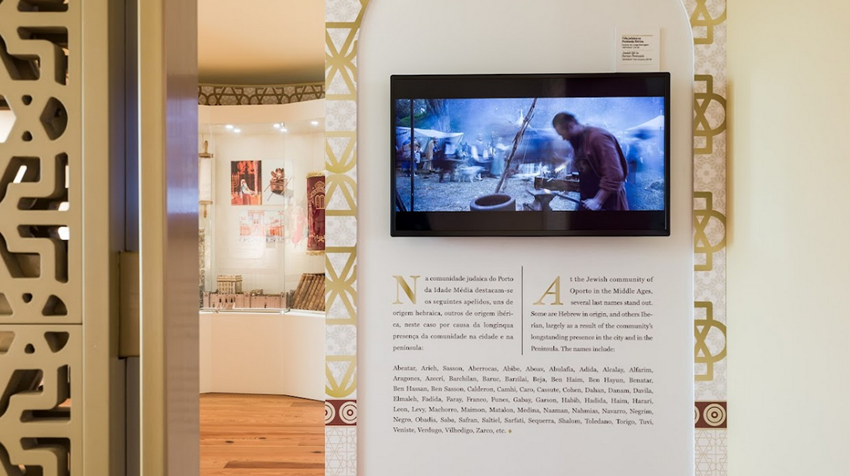
Wall of the Jewish Museum of Oporto with several last names of Hebrew and Iberian origin found in the medieval Jewish community of Oporto. Credit: CIP/CJP
The New Christian community of Oporto and its persecuted members
It was a dark period in Portuguese history. The Holy Office dragged its feet for three centuries. Human history records nothing similar or so long-lasting in terms of the persecution of consciences. But who were the victims born in the city? This question was met with silence when the community began working on the matter. The answer is known today. Five years ago, Oporto's Jewish Museum honoured the names of 842 Oporto victims. A large memorial was created in their memory, four metres wide and two metres high. Cecília Cardoso, at 110, was the oldest Oporto citizen to be persecuted by the Inquisition, which accused her of practicing Judaizing heresies. There were more victims. A 10-year-old child, friars, nuns, nobles, lawyers, market vendors, poor and rich, young and old, all born in Portugal's second-largest city, had their lives destroyed. Three citizens with the surname Espinosa also faced that religious tribunal and its methods of torture in 1544, 1620, and 1624. Shortly thereafter, the famous Jewish philosopher Baruch Espinosa was born in Amsterdam. His parents had fled Portugal for fear of the Inquisition. These are just some of the stories of victims of the Inquisition born in Oporto. Others exist.
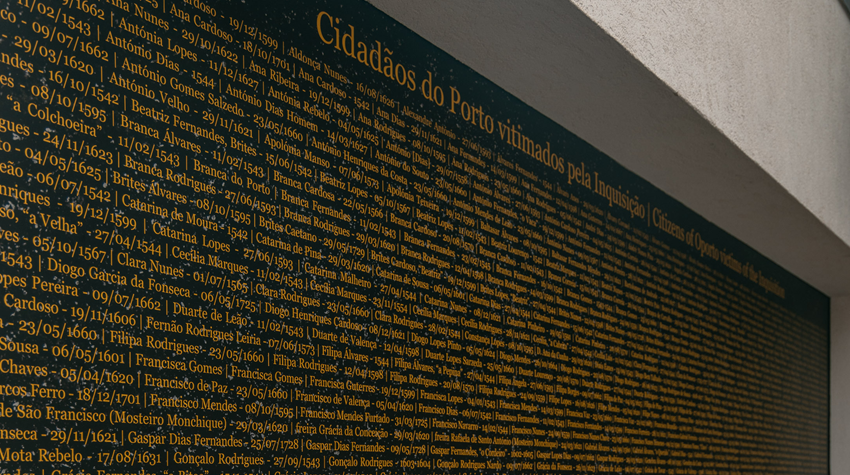
Memorial at the Jewish Museum of Oporto honoring 842 Oporto citizens victimized by the Inquisition. Credit: CIP/CJP
The unfortunate victims of 1618
The film "1618," about an Inquisitorial Visitation that took place in Oporto that fateful year, won the most international awards ever by a Portuguese film. Some of the names, suffering, and fate of those families were revealed in the film. Many fled to Amsterdam, Antwerp, Istanbul, and elsewhere. However, Portugal witnessed something perhaps unique in the world, as there are no records of anything similar in any other country. The president of the Oporto Court of Appeal and the city's chief magistrate decided to quickly remedy the glow of the Inquisition and confronted it with a firm voice, even ordering the siege of the Ecclesiastical Court with mounted guards.
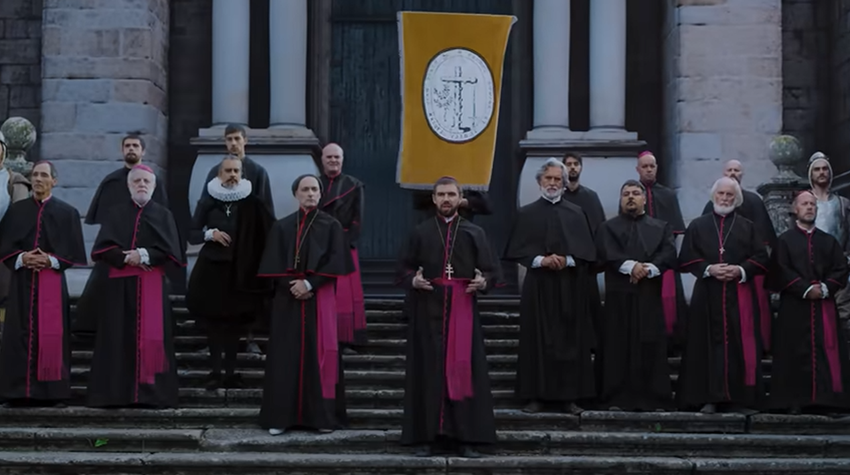
Scene from the film 1618
A country without Jews and where Marranos survive, mixing Christianity and Judaism
No organization can claim to know as much as the Jewish community of Oporto about the Marranism that was still alive in Portugal at the beginning of the last century. As extensively documented in the Oporto organization's archives, library, museum, and history films, it was the responsibility of the organization, and particularly its president, Captain Barros Basto, and his assistant and successor in the record keeping work, Amílcar Paulo, to visit, learn about, and work with the last Marrano communities in the country, in Trás-os-Montes and Beiras. Much work has been carried out by the community over the last decade and a half to gather and share this knowledge, with particular emphasis on the book “Two Millennia of the Jewish Community of Oporto – Chronology 1923-2023”, another (sponsored) book called “Amílcar Paulo, Barros Basto’s successor, His collected works” (author: Elvira Mea), various materials on display at the city’s Jewish museum and the filmic vision of a Marrano community, materialised in the film “Sefarad”.
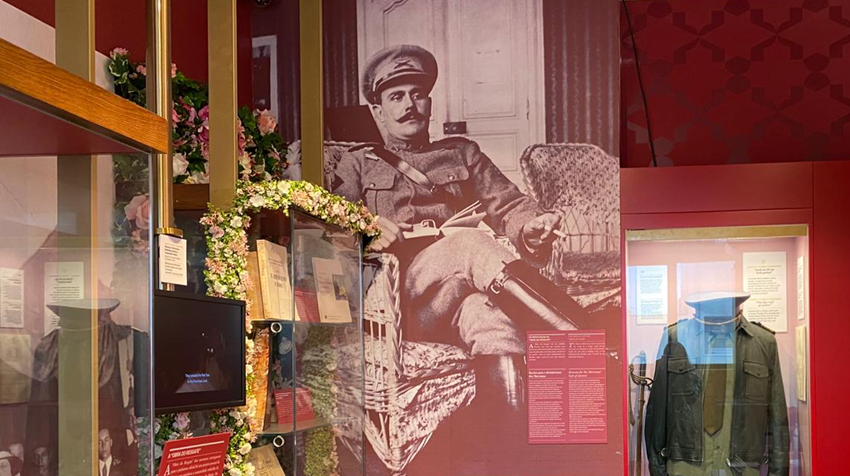
Session of the Jewish community of Oporto dedicated to Barros Basto and the rescue of the crypto-Jews. Credit: PJN
A Sephardic community in Oporto after 1821
It was the cultural department of Oporto's Jewish community that discovered, a decade ago, through intensive research into Jewish history, that a Sephardic community from Morocco and Gibraltar existed in the city, after the official abolition of the Inquisition, in the late 19th century. The work of historians, researchers, and curious onlookers had previously yielded no results, which was strange, to say the least, given that Oporto was the centre of industry and the presence of Sephardic Jews was recorded in Lisbon, Faro, the Azores, and Madeira. Something wasn't right. Nothing was known about Oporto, despite the German historian Meyer Kayserling writing in 1897 that a community existed in the city, and an Azorean newspaper reporting the official construction of a synagogue in 1905. What was discovered was natural, and it's surprising that it had never happened before. Oporto had welcomed the great national polyglot of that era: Jacob Bensabat, born in Gibraltar, supervised English language teaching at the Oporto Central High School and authored a vast body of work that remains a reference today. Grandson of Morocco's greatest rabbinical authority, Bensabat taught that English was the language of business and French that of diplomatic relations. His son, Lieutenant Levy Bensabat, distinguished himself in Oporto during the First Republic. Father and son were just a couple of the city's Jews. There were many more. Even shops bearing the surname Buzaglo sprang up in downtown Oporto. This explained another mystery. Since Sir Moses Montefiore, the British banker and philanthropist, a strictly religious Jew, drank Port wine for over five decades, it had to be kosher, that is, controlled by Orthodox Jews from harvest to bottling. At that time, only the existence of a Jewish community in the city could have ensured this. It existed. It had a Sephardic base.
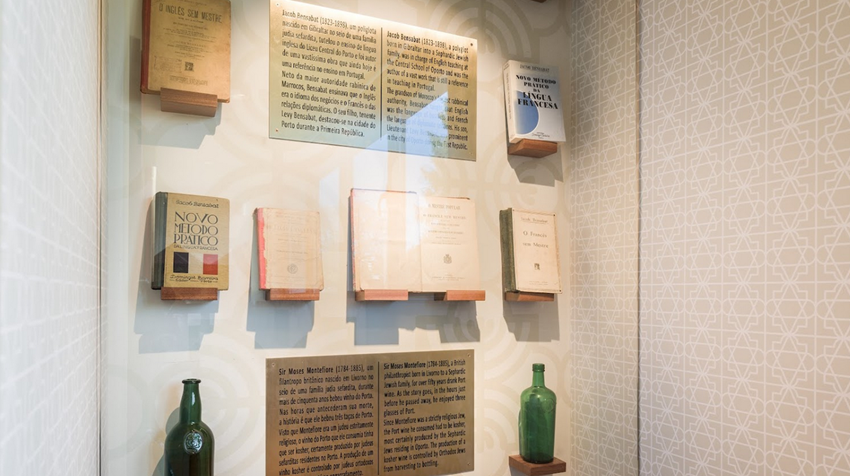
Collection of the Jewish Museum of Porto dedicated to Jacob Bensabat and Sir Moses Montefiore. Credit: CIP/CJP
Lists of names of Sephardim who returned to Portugal after the abolition of the Inquisition
We reiterate what was said above regarding the contents of the Jewish Museum and the book "The Sephardic Diaspora According to the Archives of the Jewish Community of Oporto." These exhibits contain the main lists of names of Jewish families who were part of Jewish communities and institutions of Portuguese origin around the world. But there's more. Also included are the names of the families of megurashim (those expelled from Iberia) from Morocco and Gibraltar who returned to Portugal after the abolition of the Inquisition and are buried in the British cemeteries of Lisbon and Figueira do Foz and in the Jewish cemeteries of Lisbon, Faro, Madeira, and the Azores.
An Ashkenazi community in Oporto welcomed Barros Basto
Today, the Jewish Museum in Oporto commemorates more than thirty names of Ashkenazi families (not individuals) who lived in the city in the late 19th and early 20th centuries. After studying the connections between these families, it was found that they were essentially intermarried. And so another myth passed down through generations was unmasked: the myth that Barros Basto had once brought together a few merchants from Central and Eastern Europe to form a religious legal entity. It was false. The captain and his wife were accepted and greatly honoured within a pre-existing community, which gathered and celebrated among themselves in private homes, because no other explanation can exist for the fact that they all shared a strong sense of identity and were invariably related, in a city where they barely spoke the local language.

Scene from the film Sefarad
The modern Jewish community of Oporto founded in 1923
Honouring people and institutions also means honouring the facts. For a century, many have devoted themselves to writing about the Jewish community of Oporto and its objectives. Unfortunately, much of what has been written is not worth the paper it was written on. The collection of documents that the community has brought together over the last decade and a half has overturned previously accepted theories. Captain Barros Basto was not a Marrano, but a descendant of Jews like all Portuguese, and his own grandfather had kept the memory of these distant origins. The community was not composed of Marranos, but of Ashkenazim, who did not accept the Jewish status of many Portuguese who were becoming involved in synagogue life and in captain's attempt to “rescue” them for Judaism. As explained, it was not Basto who brought together Ashkenazi families scattered throughout the city to give a legal form to a Jewish community. These families already knew each other and, in many cases, intermarried. It was these families who welcomed Barros Basto into their fold, and rightly so, not the other way around.

Screening at the Jewish Museum of Oporto featuring the film Sefarad, which portrays the history of the Oporto’s modern Jewish community. Credit: PJN
Captain Barros Basto
The rehabilitation of the wronged soldier and his work took on different forms, applicable to the case. Parliament officially acknowledged that the captain was the target of antisemitism. The army proclaimed that he would have been promoted to colonel in 1944 had he not been illegally separated from the army. The synagogue he had already built with such dedication was fully rehabilitated, as was the Jewish community he founded. The same happened with the library, which multiplied in size many times over. The community published books about the "Portuguese Dreyfus." All issues of the Ha-Lapid newspaper, which Barros Basto directed, were republished. The films "Sefarad" and, in part, "The Light of Judah" were dedicated to him, documenting his role in the official founding of the community four centuries after its official disappearance, the journeys by train and on horseback he undertook to contact the Marranos who still existed in Portugal at the time, the attentive welcome he provided to refugees from Nazism, and the horrific personal attack he suffered through anonymous letters from the scum of society. Barros Basto's entire family was also rehabilitated, especially his wife Lea and daughter Miriam, as the rehabilitation work was coordinated and monitored in real time by his own granddaughter, Isabel Lopes, who is still today vice-president of the community founded by her grandfather and who, like him, would end up in the clutches of a wretched political persecution, which even sought to strip her of her Jewishness.
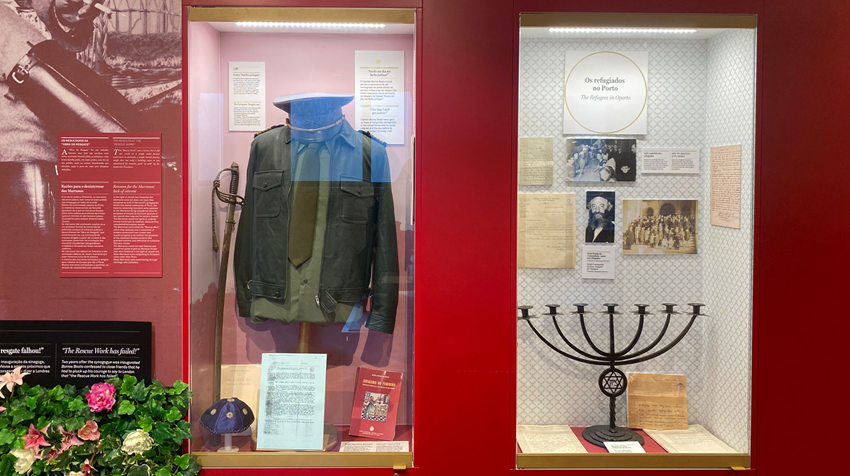
Collection of the Jewish Museum of Oporto, featuring Captain Barros Basto’s uniform and letters from Jewish refugees who passed through Oporto. Credit: PJN
The captain's most worthy colleagues: Menassé Ben Dov, Srul Finkelstein, Emil Oppeneim, and Amílcar Paulo
Menassé Ben Dov deserves not only a prominent place in the Oporto Jewish Museum, or in the community's centennial book, or in the films mentioned above. His children and grandchildren led an international Shabbaton held at the synagogue in 2019. Srul Finkelstein was also rehabilitated. The community's rabbi for decades was honoured as an honorary member, and his personal Jewish objects are displayed around the community museum, a gift from his granddaughter Luísa Finkelstein, a native of Oporto. In the aforementioned films, Srul was remembered for welcoming refugees in Yiddish, as well as praying alone in the temple when the community was reduced to almost nothing after the "Portuguese Dreyfus" affair. Another colleague—Emil Oppenheim—was commemorated in a short community film, as was fellow German Rudolph Lemchen. And finally, Amílcar Paulo, the writer who succeeded Barros and who had helped him greatly since 1946, had his entire work republished by a historian supported by the Jewish community of Oporto, a collection that had never before been produced.
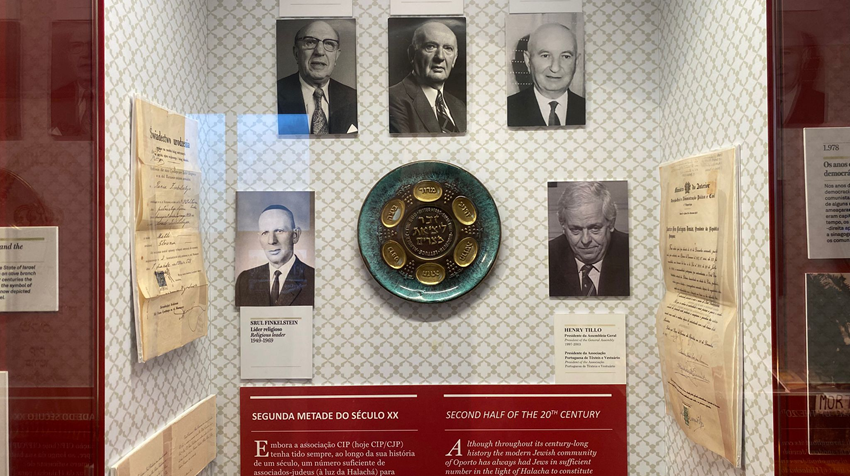
Photographs, documents, and objects displayed at the Jewish Museum of Oporto that belonged to the main members of the Jewish community of Oporto in the second half of the 20th century.
The Kadoorie/Mocatta family of Hong Kong
For the Kadoorie/Mocatta family of Hong Kong, the honour came not only from the rehabilitation and Jewish life that the community has created in the 21st century, with the great synagogue as its headquarters. The film "Sefarad," which tells the community's modern history, dedicates a section to showing who Laura Mocatta was ("the first woman to drive a car in China") and the journey to Oporto of her husband, Sir Eli, and her son, Sir Lawrence. The former became president of the International Marrano Portuguese Committee, based in London.
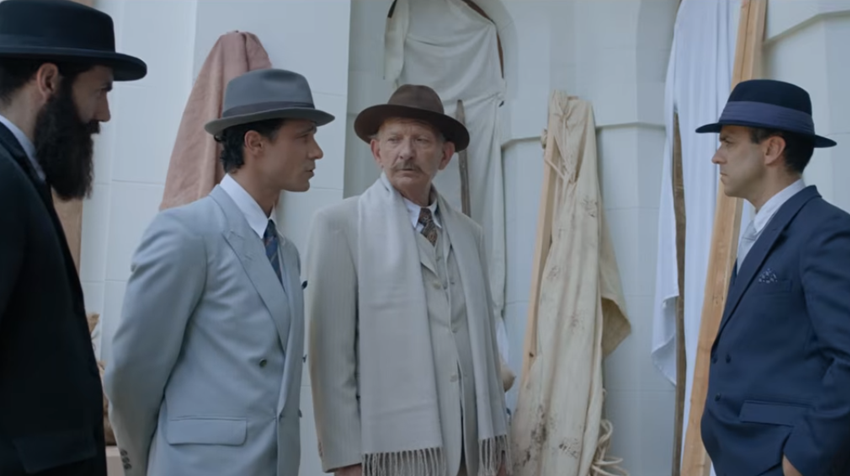
Scene from the film Sefarad
Paul Goodman, the International Portuguese Marrano Committee
The Committee's general secretary, Paul Goodman, was not forgotten. In 2019, his grandson was in Oporto to fulfil a wish his grandfather had expressed in writing more than eight decades earlier: the inauguration of the Paul Goodman Room, on the upper floor of the synagogue. Representatives of Jewish communities from every continent attended the event.
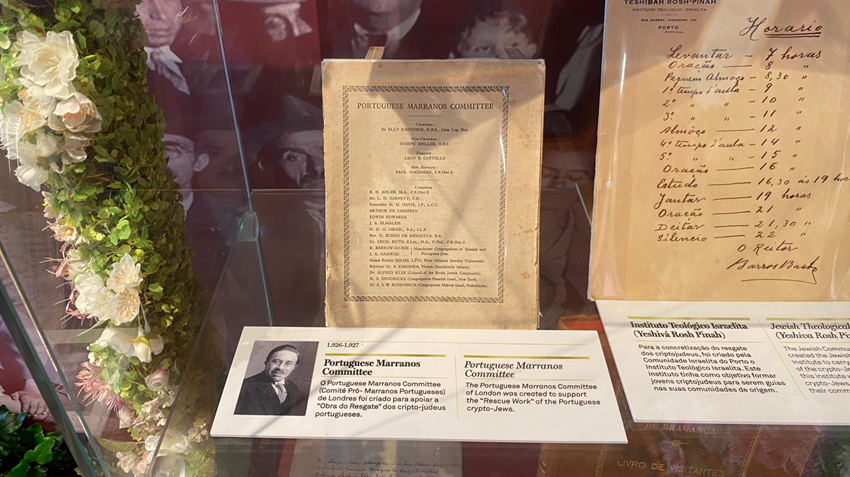
Collection of the Jewish Museum of Oporto. Credit: PJN
Rabbi Baruch Portugali, mastermind of the world's largest religious Jewish organization
This Jewish figure of the utmost importance was and continues to be more than remembered and honoured by the Jewish community of Oporto. It is important to explain first who this figure, born in the 17th century, was, and then describe how his memory has been honoured by the Jewish community of Oporto. Rabbi Baruch Portugali's surname speaks for itself. Few can boast of bearing in their name one of the geographical origins of their ancestors. The human and genealogical life of each individual human being, and of their multiple families, leaves behind the interplay of marriages, travels, and emigration. And yet, the name of Portugal remained alive in that family. On the other hand, the rabbi's role as a man, husband, and spiritual guide extended into the future, in the form of descendants and immortal work. He was the grandfather of the founder of the Chabad Lubavitch movement, fellow Rabbi Schneur Zalman of Liadi, of blessed memory. Chabad is the largest religious Jewish organization in the contemporary world. Headquartered in New York, it has over five thousand emissaries spread across the Americas, Europe, Eurasia, Asia, Africa, and Oceania. As the saying goes within the movement, "where there's Coca-Cola, there's Chabad." The formula isn't exaggerated; rather, it falls short of the truth. Chabad is present in regions where that famous beverage has never entered or even been requested. The global movement focuses on strengthening Jewish identity and observance. Widely associated with the Ashkenazi world, as a branch of Hasidic Judaism, it was founded in Lubavitch, the Yiddish name for the Russian city of Lyubavichi, in the Smolensk Oblast, five thousand kilometres from Portugal. This fact allows us to measure the reach of the Jewry of Portuguese origin, which can now be found in even more distant locations. Now, how has the memory of Baruch Portugali been honoured? In the last decade, Portugal has witnessed the construction of Europe's largest Chabad Center (to which the community was honoured to contribute significantly financially) and the remarkable work the movement has carried out in the country, where it even oversees one of the synagogues of the Jewish community in Oporto. But more than that, the community has implemented a project to distribute Shabbat meals to needy families in 14 countries, a project carried out and implemented with Chabad of Jerusalem, Ashdod, Kfar Saba, Brooklyn, Buenos Aires, Barcelona, London, Hamburg, Johannesburg, New Delhi, Shanghai, Bangkok, Moscow, Odessa, and Sydney.
Holocaust refugees who took shelter in Oporto were honoured with the construction of a museum where they are prominently featured
Oporto Holocaust museum. No other museum of its kind has managed to attract such a large segment of a country's adolescent population. We refer the reader to what is written in the section of this publication dedicated to the topic.
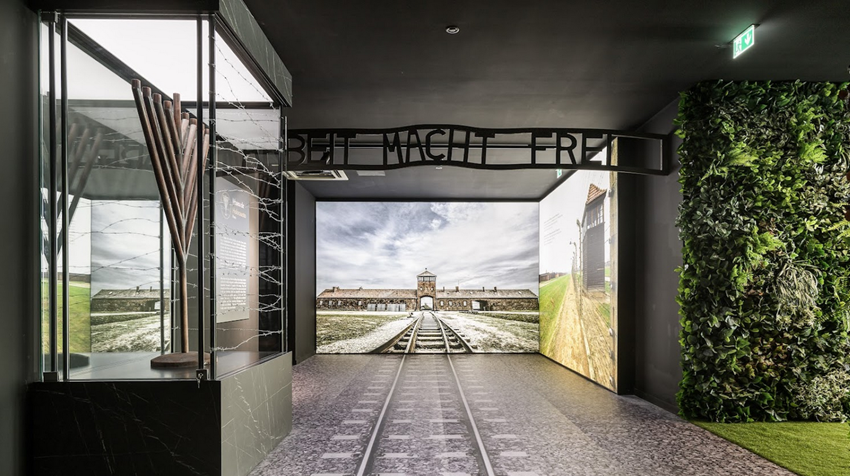
The Holocaust Museum of Oporto holds in its collection the records of Jewish refugees who passed through Porto in the 1940s. Credit: CIP/CJP
Sharing with the world records of 426 refugees from Nazism who took refuge in Oporto
Regarding the refugees who, in 1940, arrived in Oporto with their lives destroyed, records of 426 names were kept in the synagogue's old library. In 2013, these records were processed, digitized, and sent to the Holocaust Museum in Washington. Since 2020, the originals have been on display at the Oporto Holocaust Museum. In the museum's first room, a film produced by the community is shown about the refugees' stay in Oporto, their stories, conversations, concerns, and plans, according to existing records.
Jews of Portuguese Sephardic origin whom the community recognized and honoured
The community did everything possible to honour all Jews of Portuguese origin. This action was accomplished through the recognition and certification of their Portuguese Sephardic origins. This harmed Portugal, which, instead of seizing the opportunity to enhance its role in the concert of nations, became embroiled in a massive corruption scandal involving politicians, the press, and, as a result, the judiciary. All carried out mercilessly (under the slogan "Kill, kill!") and, even more so, with utter stupidity and ignorance, acting with laughter as if, after 1948, such a vile and perverse scheme could not be recorded, dismantled, and eventually served to a shocked world.
Searching for Sewusia Fajwlowicz in DNA databases around the world, an effort by the Oporto Holocaust museum
The Holocaust Museum launched a DNA database-checking project to try to locate the whereabouts of Sewusia Fajwlowicz, the aunt of one of the museum's leaders, who disappeared in Poland during the Nazi era. Coordinated by IPATIMUP, the project was unsuccessful in determining the whereabouts or tragic end of the target, despite all efforts being made to that end.
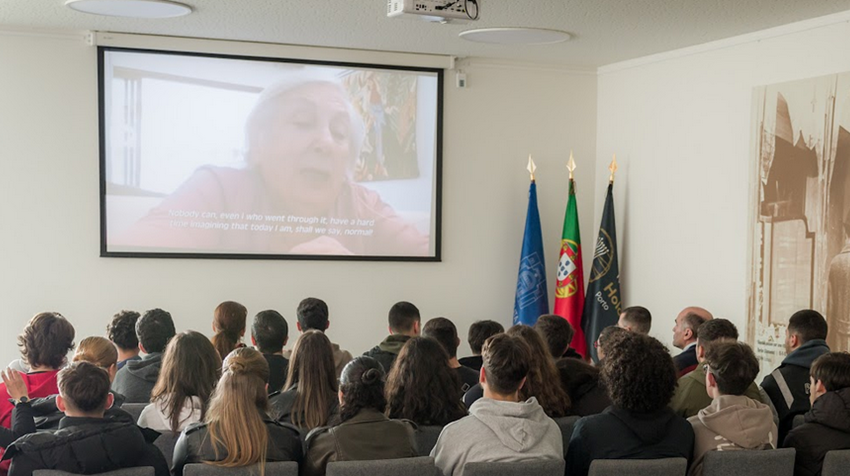
Testimony of Auschwitz survivor Chaja Lassmann (Sewusia Fakwlowicz's sister) is presented to all visitors of the Holocaust Museum of Oporto. Credit: CIP/CJP
The whereabouts of the Dolinger and Tuwim families have been discovered
Brazil was their destination. The first family consisted of Hersch Dolinger (1901), Rosa Ganzarski (1914), and their children Jackie (Jacob, 1935) and Max (1936). In February 1941, they embarked on the Serpa Pinto bound for Brazil, with permanent visas issued by the Brazilian Consulate General in Lisbon. Max became a major benefactor of the Jewish community in Rio de Janeiro. He was president of the Chevra Kadisha and ran a Jewish school for decades. His legacy endures through the philanthropic work of his widow and the continuation of Jewish life among his children and grandchildren. Jacob became a renowned jurist and expert in international law, having taught at universities in Brazil, the United States, and Israel. Julian Tuwim (1894) and his wife Stefania (1897) also made their way to and left their mark on Brazil. A philosopher, jurist, and prominent figure in Polish literature, particularly known for his contributions to poetry and children's literature, Tuwim is a powerful symbol of the dual Polish and Jewish identity. His manifesto, "We, Polish Jews," dedicated to the memory of his mother, murdered by the Nazis, expresses his deep connection to both heritages. In 1946, Julian visited Poland with his wife, and, beyond their shared regret for what had been left behind, they adopted Ewa, a Jewish girl who had lost her parents and was living in an orphanage.
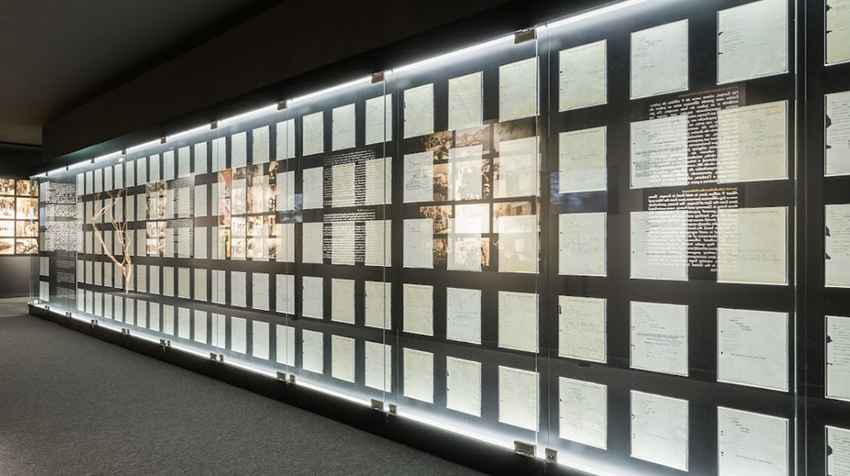
The records of the Jewish refugees who passed through Oporto are on display at the Holocaust Museum of Oporto. Credit: CIP/CJP
Yonathan Netanyahu, an inspiration to the Jewish and Israeli world
The Entebbe Room at the Jewish Museum in Oporto and the tribute by B'nai B'rith Portugal and the International Observatory for Human Rights, which brought together figures from around the world, represent more than deserved honours for Yoni, the eldest brother of Israeli Prime Minister Benjamin Netanyahu. According to the studies of his father, the great historian Benzion Netanyahu, the family was also of Portuguese descent. Commander of the Sayeret Matkal, an elite unit of the Israel Defence Forces, he lost his life fifty years ago in the name of his people, leading the most astonishing rescue operation in modern history. May his memory forever be a blessing to the Jewish people, and may his loved ones find comfort among the many mourners of Zion and Jerusalem and in the unity of the people of Israel.
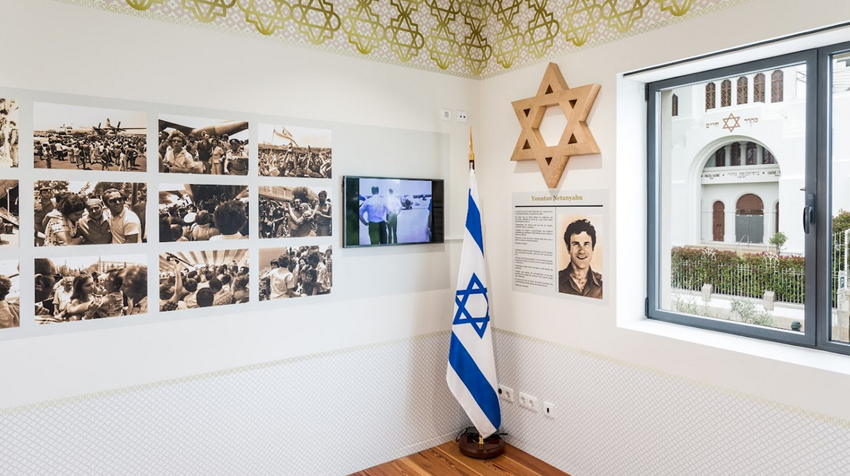
"The Entebbe Room" is a session of the Jewish Museum of Oporto dedicated to Yonathan Netanyahu. Credit: PJN
The massacre of October 7, 2023
The horror of the October 7 attack on southern Israel is surpassed only by what followed on October 8: the cold indifference of most of the international community, followed by the irrational condemnation of Israel and the eruption of well-planned anti-Israeli and anti-Semitic demonstrations on elite university campuses and in the streets of major cities around the world. The most extraordinary community-sponsored documentary about these events was produced by French-Israeli documentary filmmaker Pierre Rehov. "Pogroms" captured what no other similar film has even remotely touched upon: the historical context of the attack, rooted in a culture of Jew-hatred, made possible by makeshift alliances between radical Islamists and KGB-less Soviets, all united in the eradication of what remains of the Jewish people, their culture, and their own state. "Pogroms" connects the dots. No other documentary has done so so genuinely. In Rehov's words, "there is a historical link between the Intifadas, the pro-Palestine movement, and the BDS campaigns. They are all part of a modern, coordinated strategy of disinformation that began in the 20th century with the alliance between Adolf Hitler and the Grand Mufti of Jerusalem and later extended to the clandestine KGB training of Yasser Arafat and PLO leader Mahmoud Abbas. For decades, foreign nations have paid enormous sums to American universities to control the way history and current affairs are presented to impressionable young students. Hence the widespread brainwashing we see in our campuses today, including support for terrorists like Iran, Hamas, and Hezbollah."

Memorial at the Jewish Cemetery of Oporto in honor of the victims of the October 7 massacre. Credit: CIP/CJP
The victims of Hamas
There are over 2,000 names displayed on a memorial in the Jewish cemetery in Oporto. It's a large number. Dead, wounded, hostages, and others. There was no shortage of nationals from Portugal and many other nations. The community welcomed some of these families into the synagogue, in shock and horror. All of Jewish history was remembered simply by analysing the identities and family histories of the victims—all of them. Almost none were nationals of Israel alone. Dual or triple nationality marked the nature of each. Victims of a massacre similar to those their ancestors experienced in so many different parts of the world for two thousand years. The inscription in their memory was inaugurated by one hundred and fifty rabbis from Europe and Israel, including those who had seen their own children murdered by the terrorist movement that rules Palestine by force of arms. May the memory of the victims forever be a blessing to the Jewish people, and may their loved ones find comfort among the many mourners of Zion and Jerusalem and in the unity of the people of Israel!


