


Credit: Israel to Portugal
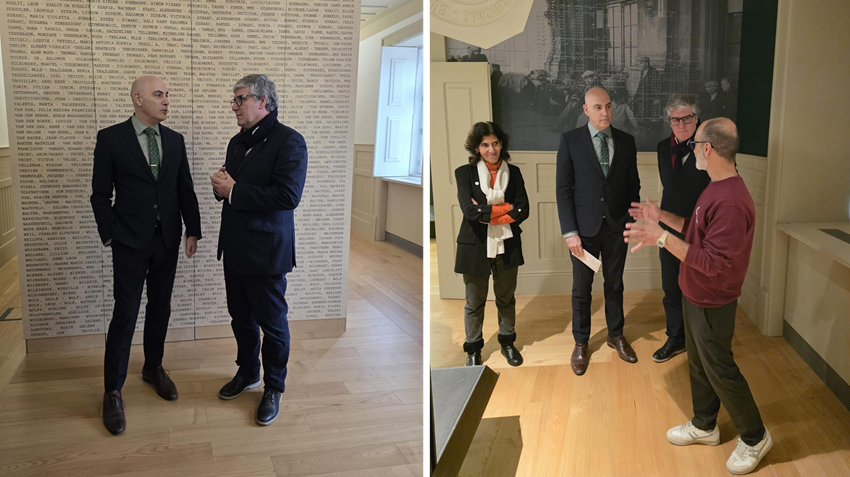
The Ambassador of Israel to Portugal, Oren Rozenblat, visited the Aristides de Sousa Mendes Museum, located in the town of Carregal do Sal. During the visit, the diplomat met with the Mayor, Paulo Catalino, and held meetings with the museum team and its director, Dr. Joana Pais.
On the occasion, Oren Rozenblat emphasized the historical and moral importance of Aristides de Sousa Mendes’ actions, stating that the Jewish people owe a profound debt of gratitude to the former Portuguese consul for having saved approximately 30,000 Jews during the Holocaust. The ambassador also stressed that the mission and legacy of Aristides de Sousa Mendes are a source of pride not only for Portugal, but for all Humanity.
The museum is housed in the Casa do Passal, the former residence of the Aristides de Sousa Mendes family. Through its various exhibition spaces, the museum reveals the multiple dimensions of the life and work of the diplomat who, while serving as Portugal’s Consul in Bordeaux, carried out one of the largest individual rescue actions of the Second World War. For this act, he was later recognized by Yad Vashem as Righteous Among the Nations.
Credit: Israel to Portugal
Between May and June 1940, Aristides de Sousa Mendes was confronted with the despair of thousands of people fleeing persecution by the Nazi regime and seeking visas to cross France, Spain, and Portugal on their way to freedom. By granting these visas, he directly defied the orders of the Salazar regime, imposed through the so-called “Circular 14,” which prohibited the issuance of visas to refugees.
As a consequence of his decision, Aristides de Sousa Mendes was severely punished by the Estado Novo: he was suspended from diplomatic service, barred from working, and deprived of the means to support his family. He lived in precarious conditions until his death in 1954.
Public recognition would only come decades later. In 1986, then President of the Republic Mário Soares awarded him the first posthumous honor, initiating the process of restoring his name and honor. In 2021, Aristides de Sousa Mendes received the highest honors of the nation when he was laid to rest in the National Pantheon, being consecrated as one of the greatest Portuguese figures in history.
Some of the Jews who received visas granted by Aristides de Sousa Mendes took refuge in northern Portugal, remaining in the country before departing for other destinations where they rebuilt their lives; their records are now on display at the Holocaust Museum of Oporto, an institution that carries out important educational work on the Holocaust and on the prevention and fight against antisemitism.


