

Credit: CIP/CJP
When, in May 2014, the Kadoorie synagogue hosted the presentation of the book "The Jews of Porto," a work written by historian Cesar Santos Silva and sponsored by the local Jewish community, few imagined that this organization could become one of the most important in the country in terms of culture. It's not just the educational work carried out in two museums and aimed at all schools in Portugal. It's not just the most internationally awarded Portuguese history film ever in a country with a film industry for two centuries. It's not just a painting gallery. It's not just a Jewish library with books in thirteen languages. It's not just a musical choir that sings in four languages. It's not just a YouTube channel with 3 million views that far surpasses all other cultural organizations in the country. The fact that most reveals the value of this cultural work is the silence and hatred it has aroused in the face of the mediocre elites who provisionally oversee Portugal.
The general public relates Jewish communities to synagogue life, forgetting that it is their duty, especially outside Israel, to promote Jewish culture and history. The European Day of Jewish Culture, which is celebrated annually, has had the participation of the Jewish community in Oporto. The event mixes arts as diverse as Jewish cinema, painting, music, literature, videography and gastronomy, opening new horizons for culture lovers. Nowhere in Europe does a Jewish organization provide the public with such a complete event.
Credit: CIP/CJP
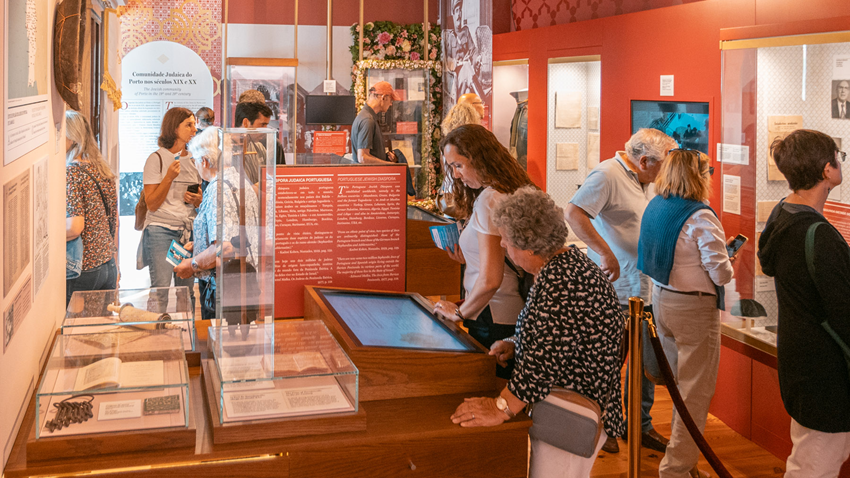
The Jewish Museum - This extraordinary and very beautiful facility, inaugurated in 2019 (replacing another, smaller and more limited museum designed five years earlier, which existed on the 1st floor of the synagogue), is dedicated to the history of the Jews in Portugal and in the diaspora. The museum's resources can be explained briefly through its most representative rooms and spaces, but just outside, among gardens and olive trees, two significant memorials stand out: one that recalls the last Gaon of Castile, who died in the city at the end of the fifteenth century, and one that recalls the names of the 842 New Christians from who were persecuted by the Inquisition. A prison wagon from inquisitorial times is also exhibited.
At the entrance to the museum is the welcoming figure of the rabbi, astronomer and mathematician Abraham Zacuto. In the oval room that follows, a journey is made from Abraham and the Seven Noahide Laws to the arrival of the Jews in the Iberian Peninsula, with emphasis on a replica of the Temple of Jerusalem and the Magen David, a Sefer Torah, a chanukiah produced in Toledo based on the ancient art of iron and gold, a statue of Maimonides and the two writings of the great poskim (codifiers) of the Jewish people to this day: precisely the Rambam (from Córdoba) and Yosef Karo (from Lisbon).
In the next space, the names, the fairs and everything that involved in the period before the Manueline edict are exhibited on screens with films, including a huge screen on which the image of what would have been the city then surrounded by walls and which included the old Jewish quarter of Olival is spread. There is also a replica of the epigraph that was once affixed to the synagogue of Monchique. The text clearly reveals the security and trust of the Jewish community in the country's authorities.
Paintings of superb quality, relating to the foundation, development and decay of the kingdom, are part of the museum collection, highlighting the role of the Jews in the administration of the country that transformed Portugal from a small county to an Empire with 13 million km2. Science, ingenuity, economic resources and an intelligence network abroad were some of the Jewish skills that are highlighted there.
In the part concerning the period of the persecution of the Jews, the visitor can see paintings, books, a globe and a monitor with the destinies of the Jews, as well as the Inquisition they faced throughout the country and in as well. In a large canvas showing the Lisbon massacre of 1506, it was possible to see a wide variety of details: the Convent of São Domingos, a burning pyre burning human remains, the population enraged and armed with sickles as if going to war, Jewish mothers holding their babies before being thrown with them into the bonfires, mutilated bodies on the ground or transported in carts, heads on spearheads, and much more.
On the consequences of the expulsion of the Jews and the Inquisition to Portugal, the museum exhibition not only addresses the violence that occurred and the aggrandizement of the competing nations to which they went, but also one of the reasons for the tragic defeat of Dom Sebastião in Alcácer-Qibir, well expressed in a rare object exhibited there, called Megillah Purim Sebastiano.
The next part reports on the official abolition of the Inquisition and the immediate arrival in of Sephardic Jews from Morocco and Gibraltar. An emblematic figure of this exhibition is Jacob Bensabat, the great polyglot of the second largest city in the country at that time. The names of those returned families and the reason why the British banker Moses Montefiori drank kosher Port wine daily until the moment of his death are revealed, as it was certainly produced by that same community.
In the following exhibition, it is revealed how the Ashkenazi community of the city appeared in the late nineteenth and early twentieth centuries and what role was played, in its official recognition, by an officer of the Portuguese army, a hero of the First World War, Captain Barros Basto. The work of rescuing Portuguese marranos attempted by the captain occupies two showcases of the museum, full of information and documents about the living situation and in the light of Jewish law of the Portuguese marranos. A monitor shows part of a community film - "Sefarad" - where the practice of an ancient Marrano ritual is watched in Vilarinho dos Galegos.
The construction of the synagogue and the visit of the Kadoorie family to the city occupy an important part of the museum It displays a perfect model of the synagogue whose construction began in 1929, and which was inaugurated in 1938. This was one year after the perverse sentence that created the "Portuguese Dreyfus" case. This has its own showcase, with a uniform with the rank of colonel to which Basto would have been entitled if he had not been illegally removed from service. The official documents that prove this well-deserved and never awarded rank (issued by the army in 2013) are also exhibited there.
The role of Srul Finkelstein (rabbi of the community), Meir Cymerman and Nathan Beigel (presidents of the board) and Henry Tillo (president of the general assembly) are highlighted and remembered in another window, designed for this purpose. Similarly, the role of the directors Emil Oppenheim and Rodolf Lemchen is highlighted in the next part of the museum, based on the incredible story surrounding the death of the former and the kaddish that, in the presence of the latter, a Catholic nun uttered in his memory.
The arrival of refugees from Nazism is also explained in the museum, with images from a film produced by the community, various official documents and a special highlight for Menassé Ben Dov, the leader of the community who supervised the department called "Support to the Exiles".
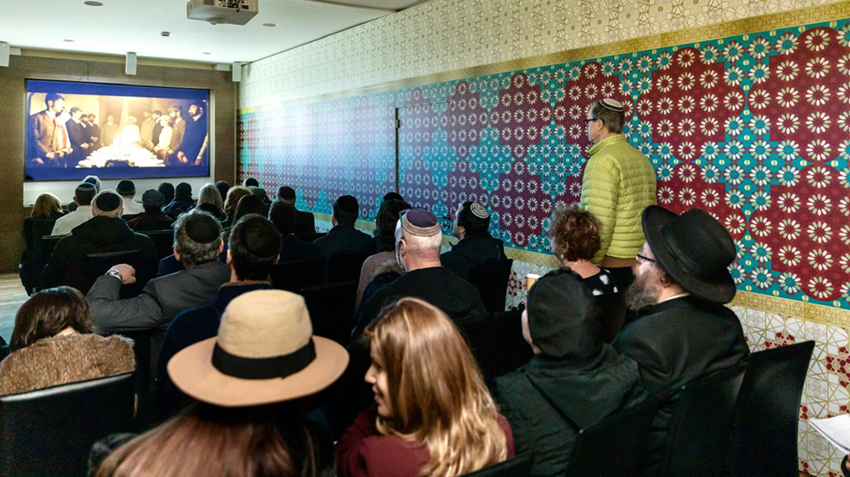
The museum is not extensive, but it has a collection of information and documentation that is impressive. There is a movie theater, a kosher Port wine cellar, a room where some of the awards that films produced by the community have received from international festivals are shown, and a room dedicated to the Entebbe operation, which showed the world that, after 2000 years, the Jews once again had a state that could defend them and ensure their safety.
For many reasons, the museum has been described as a work of art. On important dates, the museum has already managed to receive 1000 students from schools at the same time. Ultra-modern in appearance, despite having been built by a private individual in the 1930s, just like the synagogue, that space has not forgotten the development of the Jewish community in the 21st century and its action to promote religion, culture and material support to communities in 14 cities around the world.
Credit: CIP/CJP
History films - There can be nothing greater in terms of preserving Jewish memory, which is an integral part of Judaism, than the production of films and documentaries based on historical sources of great value and reliability. The Jewish community produced a series of documentaries about Jewish history in Portugal. None of the films were interrupted by artistic notes or inventions, since the objective was to portray historical events. The scripts were written by members of the community, namely David Garrett and Hugo Vaz. Let's see what those films were and give a brief description of each one.
"The Light of Judah" – This film takes a historical journey that spans centuries. From the medieval fairs to the environment of the study rooms of the most cultivated Jews, from the edict of expulsion to the violence of the departure and dispossession of goods and property, from the Inquisition to the rebirth of the Jewish community of in the twentieth century, from the Ashkenazi Jew who founded an association with Captain Barros Basto and officially reestablished a Jewish community in the city until the attempt to rescue the Portuguese Marranos by the captain and the Sephardic diaspora, from the cooperation with the Portuguese-Spanish congregation in London to the construction of the largest synagogue in the Iberian Peninsula, from the "Portuguese Dreyfus" case to the arrival and reception of refugees from Nazism, from the decades of emptiness faced by the community to its revitalization in the 21st century, this extremely complete film ends with a mention of the protocol of friendship celebrated between the community and the Catholic diocese in 2018. It is a historical journey.
"The 2000 Jewish children exiled" - The film documentary recounts the tragic fate of two thousand Jewish children who, by order of Dom João II, were exiled to the distant and inhospitable island of São Tomé, 7500 kilometers from Lisbon, after the Expulsion from Spain in 1492. The film recounts the miseries of the exodus, the entry of 120,000 refugees into Portugal, the death of Isaac Aboab in , his funeral given by rabbi and astronomer Abraão Zacuto, the atmosphere in the city, the old synagogue, the exorbitant demands of the monarch to make the hospitality of the Spanish community profitable and the drastic actions he took towards the defaulters. The dangers and nightmares of the boat trip are narrated, as well as the arrival on the island populated by wild animals that, according to chroniclers of the time, swallowed people alive.
"1506 – The Genocide of Lisbon" – This is another documentary of great quality. It recounts a massacre against the Jews that has been forgotten in history and that is still not integrated into school curricula. For three days, between two and four thousand Jews were murdered in Lisbon. The bonfires were as high as houses, in a city full of dismembered bodies and where heads were paraded on the tips of spears. It was a time of the Black Death and so the city was unguarded in terms of security, since the king and the nobility had chosen to remain on the periphery. Ancient anti-Semitic myths led to disaster. All it took was a small spotlight, literally, to light the fuse that generated so much perdition. It was a popular initiative. The king severely repressed the guilty and the city itself withdrew all privileges.
"1618" - This documentary film has become the most internationally awarded in the history of Portuguese cinema. More than a hundred New Christians were arrested, causing terror in the New Christian community, mass emigration and the almost total destruction of the city's economy. The Inquisition is faithfully portrayed: its philosophy, the exhortation to denounce, the hatred and envy of the people as the engines of the accusations, the collaborators of the Inquisition, the prison carriages, the ghastly prisons, the life in the cells, the false prisoners who spied on other detainees, the secret crevices through which the jailer observed what was done and said, the fate of the prisoners, the torture, the public humiliation, the garroteting, the stake, the threatened future of so many innocents. A curious detail in this real story was the friction between the judicial authorities of and the inquisitorial visit. The relationship between these entities became so extreme that guards on horseback surrounded the ecclesiastical court. The Inquisitor, feeling disregarded, traveled to Spain to complain to King Dom Filipe, but did not hear what he wanted. The Justice of the time was independent and in that specific case it proved to be.
"Sefarad" – This tells the story of Jews from 1923, when Barros Basto, a Portuguese army captain converted to Judaism, and about twenty Jewish merchants from Central and Eastern Europe officially founded the Jewish community in a city that had not heard about Jews for centuries. Soon the community found itself persecuted by Lisbon elites who made use of anonymous letters from outlaws to prosecute the captain, expel him from the army and destroy the community. The ‘Portuguese Dreyfus’ case, as it became known abroad, is shown in this film in some detail, as is the officer's trial. The film ends with the community that had been silent for many decades, when it finally rises again in the twenty-first century.
"The Nun's Kaddish" - This short film produced by the community portrays a true story of interfaith kindness that occurred in 1982, when a nun observed a Jewish memorial ritual on behalf of a deceased Jew, Emil Oppeneim, elevating the spirituality of the two religions to a higher feeling of universal brotherhood. The Jewish community of Oporto , persecuted and destroyed by the State in the 1930s, was then practically non-existent. None of its members were present at the burial of Oppenheim, a renowned German jurist, who arrived in the city during the Nazi persecution. He remained in until the end of his life working in a small laundry. The kind nun, who had treated him when he was sick, promised to read the kaddish prayer in his and so she did.
Credit: CIP/CJP
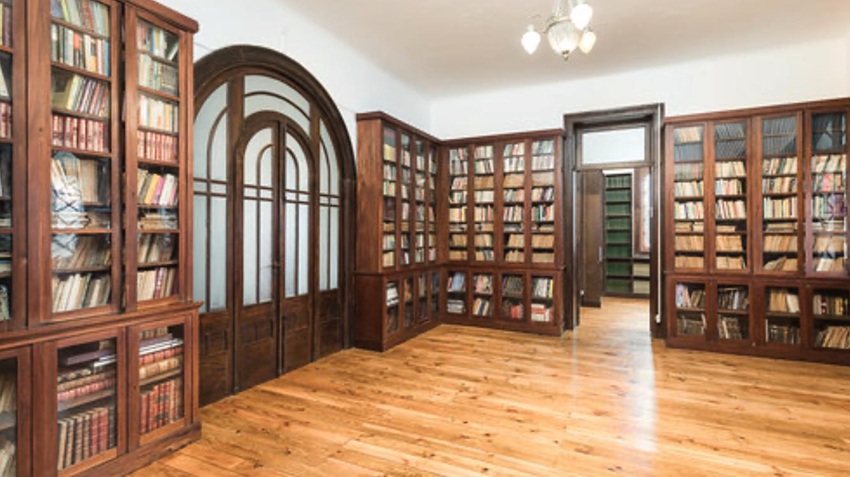
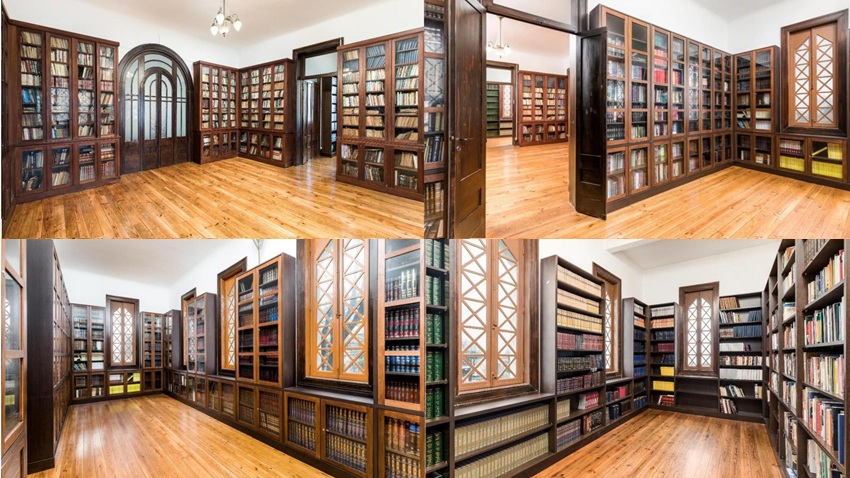
The Rosh Pinah library – This is a space for the preservation of memory, the promotion of history, education and intercultural dialogue that brings together tens of thousands of publications, in 13 different languages, which span the centuries and reflect the richness of Jewish knowledge in particular and human knowledge in general. In a library that in 2012 had no more than three dozen damaged and uncatalogued books, today the vast collection of Jewish literature that is there is impressive, on topics as diverse as halakha (law), philosophy, history and culture of a people over three millennia, which allows us to understand not only the path of the Jews, but also the intertwining of its history and basic norms with other cultures, legislations and civilizations.
More than five hundred books, many of which are rare, deal with Jewish history in Portugal and offer an in-depth look at the experience, heritage and contributions of the Jewish people over the centuries. Even the history of Portugal since April 25, 1974, in everything that directly or indirectly involves Jewish and Israeli realities, can be consulted there through compendiums with newspaper clippings, a collection perhaps unpublished in the country, and full of surprises for any reader.
The history of Portugal and world history are equally well represented, with an even more extensive number of publications, tracing the great events, characters and transformations that shaped the world and the country. In the field of literature, the collection is particularly impressive, with about two thousand books that include works of Portuguese and world literature, children's literature, the great classics, as well as Jewish literature, reflecting the diversity of voices and styles that mark the global literary panorama. The library also preserves a remarkable collection of great classics of literature, as well as important titles on world history, the history of Portugal and, with special emphasis, Jewish history, both Portuguese and worldwide.
Fundamental works of Portuguese literature, the great names of international literature, and everything that allows the reader to explore the foundational texts, the great thinkers and the contemporary production of the Jewish world are present. A thousand journals offer a dynamic snapshot of current affairs and critical perspectives over time. This collection is complemented by more than 1500 publications covering a wide range of areas of knowledge: social sciences and humanities, art, architecture, geography, as well as encyclopedias, dictionaries and other essential reference works.
The bibliographic collection also includes works on world religions, theology, Jewish culture, arts, architecture, linguistics, as well as important contributions in the areas of social sciences and humanities. More than a simple repository of books, the Rosh Pinah library is a meeting point between the past and the present, between different cultures and knowledge, playing a vital role in the preservation of Jewish heritage and the promotion of knowledge.
Credit: CIP/CJP
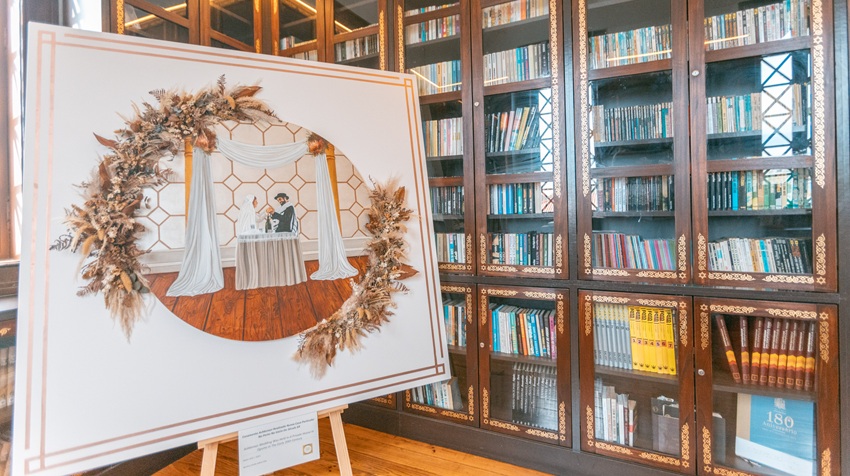
Painting – Painting is an artistic manifestation that uses coloring techniques with liquid pigments, powder, charcoal or paste. The Jewish community of Oporto produced and created an art gallery, with paintings of great quality, using oil and acrylic techniques. They portray Jewish history in the city from the arrival of the first Jews to the present day. The paintings are 1.5 m high and 1.5 m wide. They portray the life of the Jewish community in, from the arrival of the first Jews to the present day, passing through periods of decline and ruin, of life and death. They show that the harvest years are also the years of the plague. The project was led by a Venezuelan artist from the community, Flor Mizhahi. She coordinated a team of Portuguese and foreign colleagues (Natalia Procopovich Bagur, Helen Doc, Analice Campos, Jorge Marinho and Adélia Costa), who were given the mission of carrying out that very special work. The paintings are exhibited in chronological order. Let us make a brief description of each one, with their titles.
- The role of the Jews in the founding of the kingdom and their friendship with the monarchs.
- A market of the time, where Jews were prominent merchants.
- Religious Jews rule the community spiritually.
- The community prayed next to the walls of Porto, facing Jerusalem.
- The role of the Jews in the development of the kingdom into a world power.
- At a Beit Midrash dozens of men study the Torah.
- A ship full of Jews victimized by the edict of expulsion departs from Portugal in the fifteenth century.
- The forced baptism of adult Jews.
- The genocide of Lisbon.
- The decadence of Portugal after the anti-Jewish persecution.
- An auto-da-fé of the Inquisition in .
- A map showing the fates of the Portuguese Jewish diaspora.
- An Ashkenazi wedding at the beginning of the twentieth century.
- The exterior image of the Kadoorie Mekor Haim synagogue in 1938.
- The community welcomes refugees from the Holocaust in 1940.
- A nun prays the Kaddish for a Jew who died in 1982.
- The President of the Portuguese Republic visits the great synagogue of Porto in 2019.
- Greetings between the Bishop of and the president of the community in 2020.
- A Sephardic wedding in the year 2021.
- The community prays in the synagogue during Yom Kippur.
Credit: CIP/CJP
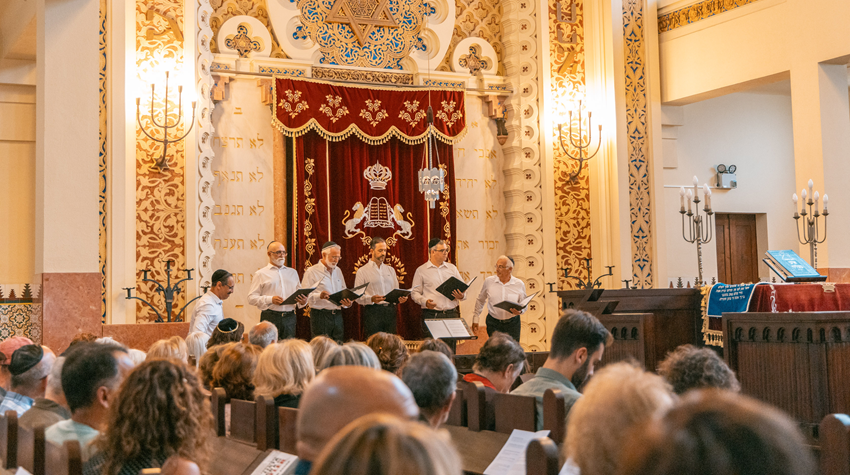
Music – The Mekor Haim Choir performs Jewish music. Co-founded by community members Yonah Yaphe and Luciano Moura, and directed by award-winning conductor and composer Leonardo Mendonça, the choir has a repertoire that includes songs in Ladino, Yiddish, German, songs related to the Holocaust, and especially songs from the Jewish liturgy in Hebrew. This includes works by Salomone Rossi, who composed in the Baroque period, nineteenth-century melodies from the Spanish and Portuguese synagogue in London, compositions by Ernest Bloch from the twentieth century, and others by modern Israeli composers. Let's take a closer look at this repertoire composed of three dozen songs of great quality.
- Fifteen Jewish Baroque Songs
1. Barechu – Lyrics: Psalm 134, Music: Salomone Rossi XVII C
Blessed be the Lord, the Blessed for ever and ever.
2. Kaddish Shalem – Lyrics: Prayer century. I, Music: Salomone Rossi XVII C
Make peace above, He in His mercy will make peace upon us and upon all Israel Amen.
3. Hallelujah Halleli Nafshi – Lyrics: Psalm 146, S. Rossi XVII C
The Lord protects the stranger and sustains the fatherless and the widow but frustrates the purpose of the wicked.
4. Shir Hama'alot – Lyrics: Psalm 128, S. Rossi XVII C
Your wife shall be as a fruitful vine in your house; Your children will be like olive shoots around your table.
5. Mizmor LeAssaf – Lyrics: Psalm 82. S. Rossi 17th C
God is in the congregation of the mighty, judge in the midst of the gods. How long will you judge unjustly, and accept the people of the wicked? (Selah.) Do justice to the poor and the orphan; justify the afflicted and the needy. Deliver the poor and the needy; take them out of the hands of the wicked.
6. Al Naharot Bavel – Lyrics: Psalm 137 S. Rossi XVII C
By the rivers of Babylon, we sat there and wept when we remembered Zion
7. Adon Olam - Shabbat Hymn, XIV century S. Rossi XVII C
The Lord of the Universe who reigned before anything was created. /When everything was done by his will, He was recognized as King.
8. Hishki Hizki - Lyrics: Isaac Aboab de Fonseca, Music: Abraham Casseres, XVII C
My Beloved, strengthen me every day, quickly illuminate my darkness, my King. O night, my sun will not yet be extinguished. Enlighten me with the light of your sun, my King.
Shabbat Songs
9. Lecha Dodi, Letra XVI C, Music: M. Zeira XX C
Come, my friend, to meet the bride, Peace of the Sabbath I bless.
10. Shalom Aleichem Lyrics: XVI C, Music: I. Goldfarb, Arr. G. Aldema XX C
Peace be with you, Angels of heaven, Angels of the Most High, Of the King, of the King of kings, The Holy One, blessed be He.
11. Veshomeru Lyrics: Exodus 31:16, Music: L. Lewandoski XIX C
And the children of Israel shall keep the Sabbath, keeping the Sabbath throughout their generations, for an everlasting covenant.
12. Magen Avot Lyrics: Y. Kimhi XII C Arr. Y. Braun XX C
Shield of the fathers, with his word, he raises the dead with his words, the holy God there is none like him.
13. Adon Olam - Lyrics: S. Ibn Gabirol. XI C, Music: David Aaron de Sola XVIII C
The Lord of the Universe who reigned, before anything was created. When everything was done by His will, He was recognized as King.
14. Kol Berue Letter: S. Ibn Gabirol XI C, Music: E. Aguillar XIX C
All creatures, above and below, testify and proclaim as one; "God is one and His Name is one." From them, they know that everything is yours,You are God, majestic.
15. Ma Tovu Lyrics: Numbers 24:5, Psalms 5:8 Music: L. Lewandowski XIX C
How beautiful are thy tents, and thy tabernacles Israel.
- Three psalms
16. Yhiyu Leratzon – Lyrics: Psalm 19:14 Music: Ernest Bloch XX C
May the words of my mouth and the meditation of my heart be acceptable to You, O Lord, my Rock and my Redeemer.
17. Tzadik K'Tamar Yifrach Lyrics: Psalm 92:13-16 Music: L. Lewandowski XIX C
The righteous will blossom like a palm tree and grow like a cedar in Lebanon, planted in the house of the Lord,
18. Hallel – Lyrics Psalm 117 Music: E. Aguillar XIX C
Praise all nations, praise all peoples. For his lovingkindness is great toward us, and God's truth endures forever. Hallelujah.
- Three songs in Ladino
19. Avraham Avinu - Lyrics: XVIII century, Music: XIX century
Abraham Avinu, dear father, blessed father, light of Israel.
20. Tzur Mishelo/La Rosa Enflorece (Shabbat Hymn, XIV C, Music: Ladino melody)
We eat until we are satisfied and there is still food left, according to the word of God.
21. Mama yo no tengo visto/Hitrag'ut Hebrew letter: Yehuda Karni, Arr. Paul Ben Haim XX C
Mother, I have never seen a bird with blue eyes, with red hair like cinnamon and white skin like jasmine.
Three songs in Yiddish
22. Rozhinkes mit Mandlen (Raisins and Almonds)– Lyrics and music: Avraham Goldfadden, Arr. Schreibman/Verkaik XIX C
In the Temple, in a corner of a room, the widow Bat-Zion sits alone. She lulls her only son, Yidele, to put him to sleep with a sweet song.
23. Oyfn Pripichok (By the Hearth) – Lyrics and Music M. Warshavsky XIX C Arr A. Levanon
In the fireplace, a fire burns, and in the house it is hot. The rabbi is teaching the little children the alphabet.
Three songs about Jewish celebrations
24. Eliyahu Hanavi – Lyrics: Haggadah of Pesach, Music: Trans. Arr. Y. Braun XX C
The prophet Elijah will come quickly to us with the Messiah, son of David.
25. MaozTzur Hanukkah Hymn, XIII C, Music: Benedetto Marcello XVII C
My Refuge, my Rock of Salvation! It is good to sing Your praises.
26. Avinu Malkenu Lyrics: Yom Kippur prayers, Music: Trans., Arr.: David Ben Or
May our Father our King have mercy on us and answer us, for we have no meritorious deeds; deal with us in a charitable and kind manner and deliver us.
- Four Songs of Memory
27. Hayedu Hadmaot – Lyrics: Yehuda Halevi XII C, Music: C. Karchevski, XIX C, Arr: Y. Sharett/U. Givon/S. Giverman
Do our tears know who shed them? Do our hearts know who turned them over? They were turned over when their light was buried in the earth.
28. Wiegala - Lyrics and music: Ilse Weber XX C
Wiegala, wiegala, how quiet the world is! No sound disturbs the sweet rest, sleep, my son, sleep you too. Wiegala, wiegala, how quiet the world is!
29. Ani Ma'amin – Lyrics: Maimonides, XII C, Music: Azriel Fastag, Arr. Seth Wohl XX C
I believe with total faith in the coming of the Messiah, I believe. And even though he may tarry, I will wait for him. I believe.
30. Hatikvah - Lyrics: Naftali Imber XIX C, Music: Cenci XVI C
While within the heart, the soul of a Jew still yearns, and onward, towards the ends of the east, an eye still beholds Zion; our hope is not yet lost, the hope of two thousand years, of being a free nation in our land, the land of Zion and Jerusalem.
Credit: CIP/CJP
Jewish literature – The Jewish community of Oporto, founded in the twentieth century, essentially had two authors of books on the Jewish world. They were also early contributors to the community newspaper Ha-Lapid. Their names: Barros Basto and Amílcar Paulo, who died respectively in 1961 and 1983. Both the publications and the organization connected to it disappeared. The newspaper was closed and the Rosh Pinah library, in the Kadoorie synagogue, founded with so much taste and care by the captain, was stripped of books. In the twenty-first century it was in a state of deplorable emptiness, after decades of emptiness and looting in the old building.
In the last decade and a half, the library was fully rehabilitated. Today it has 10,000 books on Jewish themes, and several publications were promoted, with the organization's own stamp or by its leaders. Other works were sponsored, invariably linked to themes on Portuguese Jews in general and Jews in particular. Let's see what happened chronologically, with mention of other activities along with the increase in new books and research.
2012 – Acquisition of hundreds of books on Jews and Jewish history for the then-bare Rosh Pinah library. Publications were also produced in the scientific Journal For the Study of Antisemitism by the delegate of the community's directorate, David Garrett.
2013 – Acquisition of hundreds of books on Jewish philosophy for the Rosh Pinah library and publications in the Journal For the Study of Antisemitism by the delegate of the directorate.
2014 – Acquisition of hundreds of books on Jewish themes for the Rosh Pinah library and publication, by the community, of the bilingual book (Portuguese and English) "The Oporto Synagogue". This year, the books "On the route of Oporto's Jews", by historian César Santos Silva, and "The Illustrious Jews of Portugal", by journalist Miriam Assor, were also published. They had the support and sponsorship of the community.
2015 – Acquisition of hundreds of books of the same kind mentioned above for the Rosh Pinah library and compilation and publication of lists of names of traditional Sephardic families in communities of Portuguese origin, as well as of the deceased in Jewish cemeteries founded in the nineteenth century in Portugal. At the same time, a small Jewish museum was established on the 1st floor of the central synagogue.
2016 – Acquisition of thousands of books for the Rosh Pinah library. To strengthen the museum, and based on acquired publications and other research carried out in Torre do Tombo, the files of the 842 Jews victimized by the inquisition and the names of families residing in until the fifteenth century were compiled and published.
2017 – The acquisition of a large number of books for the Rosh Pinah library continued and the work "The Portuguese Sephardic Diaspora in the light of the Archives of the Jewish community of Oporto" by Arthur Villares was published. It was sponsored by the community.
2018 – Acquisition of hundreds of books for the Rosh Pinah library and publication of the books "Jewish Voices of Portugal – Commentaries on the Torah", by Eli Rosenfeld and Shlomo Pereira, and "Collection of the Work of Amílcar Paulo", by Elvira Mea, which were sponsored by the community.
2019 – The acquisition in Israel of more books on Jewish law increased the synagogue library to ten thousand publications. The small Jewish museum abandoned this space to make way for the inauguration of a dignified Jewish museum located in a building in front of the synagogue.
2020 – Inauguration of the Holocaust museum on Rua do Campo Alegre, acquisition of a library for this space, and creation of an official community newspaper – Mazal News – to share inspiring actions based on solidarity and love that encourage the construction of a fairer world.
2021 – Foundation of the community newspaper The Portuguese Jewish News and sponsorship of the works "Ten Myths about the Jews", by Maria Tucci Carneiro, and "Brief History of the Jews of Portugal", by Jorge Martins.
2022 – Publication by the organization of the books "Jewish Community of Oporto, Leader in Europe in the Promotion of Jewish Life and Culture and the Fight against Antisemitism" and "The First Great Antisemitic Conspiracy in the XXI Century" [by Lisbon elites to destroy the community].
2023 – Publication by the organization of the book "Two Millenniums of Jewish Community of Oporto, Chronology 1923-2023". [Never before had the history of the modern community been written in any decade.]
2024 – Republication, by the community, of the newspaper Ha-Lapid, formerly directed by Barros Basto, and publication of the books "The Plan!" [of Lisbon elites to destroy the community] and "Journalistic corruption in Portugal" [with the same purpose], to which are added two other publications, linked to the same theme, by Board member David Garrett, entitled "He Made the Law! - Campaign Against the Jews" and "Good Jew/Bad Jew Strategy"
2025 – Publication by the community of the book "Inquisitorial Process in the XXI Century – Portugal" and also the book “Scheme to Silence and Persecute: Jewish Works in Portugal”. The newspaper The Portuguese Jewish News reached the figure of 1500 published news items this year.
Credit: CIP/CJP
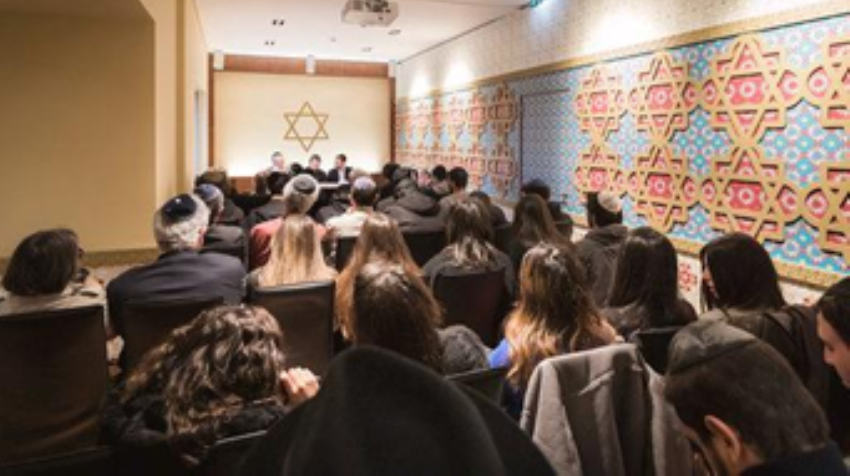
Videography – Videography is a form of culture that encompasses the production of videos and films, which are means of artistic expression, communication and historical and cultural record. The community has produced forty videos in the last decade and a half. On Youtube, where the organization created an account, such videos were posted, which, as a whole, already have more than 3 million views. Here is the list of videos produced by the community over the years in reference:
2012: Kadoorie Mekor Haim Synagogue (English, Spanish and Hebrew).
2013: 75th anniversary of the Kadoorie Mekor Haim Synagogue
2015: Jewish Museum of Oporto (the first).
2017: Sephardic Memory Concert - "Tradition and Modernity", with Turkish singers.
2018: Sefarad (trailer and film)
2019: Jewish Museum of Oporto / "1618" (trailer)
2020: Holocaust Museum of Oporto/ Testimony of a Holocaust survivor / Holocaust Museum – Testimonies / Operation Entebbe Room
2021: Brief history of the Jews of Sepharad / The Nun's Kaddish / David D'Or in Oporto, Portugal / II Course of the Jewish Education Center of
2022: European Day of Jewish Culture in Portugal / Commendation of Merit of King D. Pedro I of Brazil / Kristallnacht Exhibition - Holocaust Museum of Oporto/ Mekor Haim Choir / How to Destroy a Jewish Community
2023: European Day of Jewish Culture in Oporto / Jewish Community of Oporto - A Centenary Institution / Event of the European Jewish Association / Soviet-Style Antisemitism in Portugal / Inauguration of the Jewish Cemetery of Oporto / Painting Gallery of the Jewish Community of Oporto / Concert on International Holocaust Remembrance Day / The history of the Jewish Community of Oporto from 1923 to 2018 / Interviewing Marilyn, the "boss".
2024: European Day of Jewish Culture in Oporto / Memorial to the victims of the "7th of October" inaugurated in the cemetery of the Jewish community of Oporto by 150 rabbis / National Day of Remembrance of the Victims of the Inquisition at the Jewish museum / The Genocide of Lisbon (trailer and film) / Jewish Community of Oporto announces that it has appointed the World Jewish Agency as its legal heir / 86th anniversary of Kristallnacht / Thousands of teenagers comemmorate the Edict of Expulsion at the Jewish Museum.
2025: European Day of Jewish Culture in Oporto / "The 2000 kidnapped children" (trailer and film) / Centuries of Jewish success in the midst of mediocrity.
2026: Jewish Museum displays letter to "Mr. Abel Benjamin Rocha da Leiva Leja Rosa Abramovich", denouncing corrupt political system.


