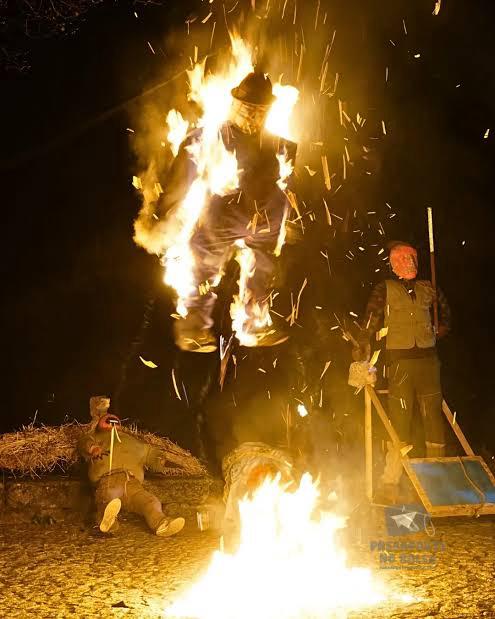


To commemorate the Christian holiday of Easter, some Portuguese cities usually burn a Jew in effigy. The local townspeople, many of them children, gathered in the town squares and a doll, dressed to look like a bearded hassid – complete with a long, hooked nose, sidelocks and a black hat is burned. The doll is supposed to symbolize Judas Iscariot, a Jew who, according to the Christian Bible, betrayed Jesus.
The Burning of Judas in Portugal is a vibrant tradition where a large puppet, often made of straw and rags, is hanged from a tree or pole and then burned in public squares, symbolizing the purging of betrayal and negativity, with major celebrations in places like Montalegre, Aveiro, Coimbra, Tondela, Palmela, and also Vila do Conde and Póvoa de Varzim, mixing pagan elements with religious solemnity.
Montalegre, 150 kilometers from Porto, is known for its elaborate "Queima do Judas" as a major cultural event that is joyfully shared on YouTube by the Municipality. In practical terms, the Jews - now in the form of effigies - meet the same fate as when they were condemned to die by fire during the Inquisition. These medieval-sounding scenes aren’t anecdotes from Europe’s rich history of antisemitism: Both are contemporary, yearly Easter events.
The World Zionist Organization has repeatedly declared that it does not accept the maintenance of these events that theatricalize an antisemitic cruelty in Europe, like in Portugal, Spain, Poland, Greece, Czech Republic and England. Burning Judas is a blend of religious narrative and older, pre-Christian customs, where communities symbolically cleanse themselves of negativity. It is a folk tradition where effigies of Judas are constructed, often with satirical or critical elements reflecting local issues, then publicly destroyed by fire. It's a symbolic act to get rid of betrayal, sin, and bad feelings before Easter Sunday.
A testament to the deep, abiding roots of Jew-hatred on the continent, these events are among several traditions that persist in 21st-century Europe, despite repeated protests by Jewish and other critics. In 2019, Amichai Chikli, Israel’s minister for Diaspora affairs and combating antisemitism, protested the effigy burning in Poland, stating that "such events “have led throughout history to blood libels, discrimination and pogroms against innocent Jewish people and other bystanders”.
Although these rituals are essentially popular, and the Portuguese population tends to associate Jews with the word money, practice has shown that antisemitism does not come from citizens in general, but from their elites, who serve ideological interests hostile to Jews and the Jewish state. It wasn't the general public who published a list of Jewish businessmen from Oporto in a newspaper in 2024, nor were they the ones who inaugurated the Hamas embassy in 2025, nor were they the ones who rushed to Qatar and Guinea to take money, and even less were they the ones who used all means to destroy a law in favor of Jews of Portuguese origin. Jews don't count. What interests them is importing millions of radical Muslims and uprooted people from Latin America who are part of groups with political leftist acronyms, and sponsored by Lebanon, such as the "PCC" and the "Comando Vermelho" (Red Command). All of these migrants are rewarded with access to the ballot box and social assistance programs.