

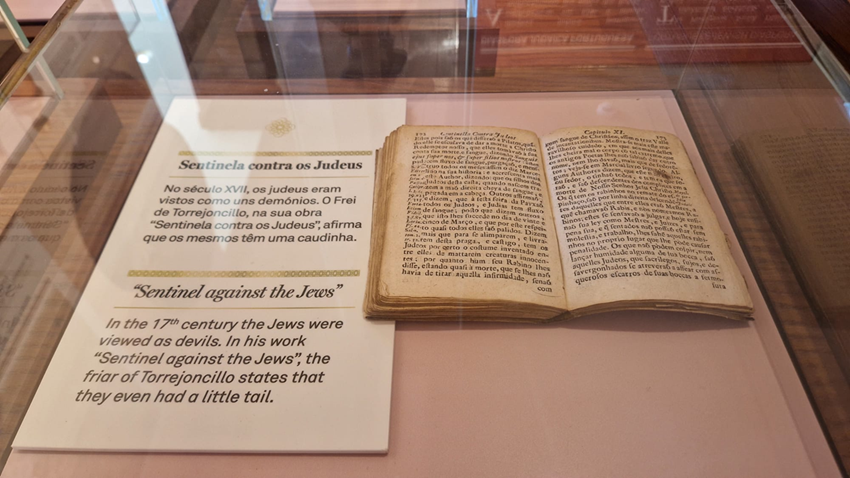
Out of more than ten thousand books that the Jewish Community of Porto possesses, one was chosen as the most attractive and historically rare book, "Watchtower Against the Jews". The criterion for the election was based on the interest generally shown by Jewish tourists, especially by Israeli and North American historians, when visiting the Jewish museum and library.
The alarming descriptions contained in that literary work could never leave anyone indifferent. Jews were even accused of having a tail. The impact of Torrejoncillo's book on the Iberian Peninsula was so extensive that, a few years ago, in 2018, an elderly woman from Mogadouro wanted to convince the directors of the Jewish community of Porto that she had met some Jews who had tails. This remarkable episode occurred during the filming of the movie Sefarad in a location near Vilarinho dos Galegos.
Although books relating to halakha (Jewish law) are the most important part of the collection belonging to the Community, tourists and historians are generally more interested in history books. "Watchtower Against the Jews" was donated to the museum in 2019 by board member David Garrett, who retrieved it from his personal library. It is the first edition of the book, in Spanish.
Credit: The Jewish Museum of Oporto
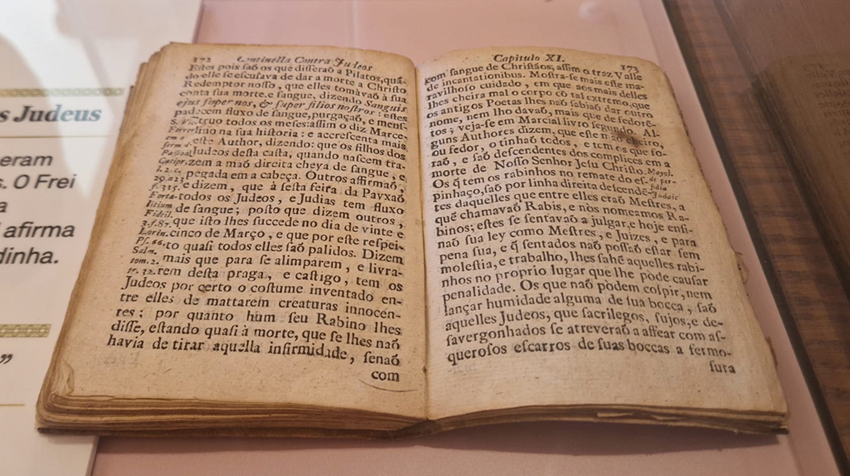
"Watchtower Against the Jews"
It is a notorious antisemitic book published in 1674 by Fray Torrejoncillo, a Spanish Franciscan monk. It is widely considered one of the most vitriolic and influential anti-Jewish works of the early modern period in the Hispanic world. The book was a massive success, going through nine editions in Spanish and four in Portuguese. Originally, it was written in the vernacular (Castilian Spanish) and priced affordably, specifically aiming to popularize antisemitic ideas among the lay public. While the title mentions "Jews," the book's primary targets were the descendants of Jews who had converted to Christianity. Torrejoncillo argued that even remote Jewish ancestry meant an individual held secret, "heretical" beliefs.
The work served as an official "apology" or defense of the Spanish Inquisition and its methods.It strongly advocated for racial statutes that discriminated against those with "Jewish blood," claiming they were inherently treacherous and enemies of Christianity. The author portrayed Jews and conversos as a "fifth column" conspiring with Spain's Protestant and Muslim enemies to destroy the nation.
Historians note it helped shift the focus from religious opposition (anti-Judaism) to a more racialized form of prejudice (antisemitism). Today, the work is studied by scholars as a primary source for understanding the roots of modern racism and the "purity of blood" obsession in 17th-century Spain.
Credit: The Jewish Museum of Oporto
The Rosh Pinah library
It's not just the Jewish museum that displays rare or valuable books. The Rosh Pinah Library is a place of magic and literary culture. Although at the beginning of the 21st century it was practically empty - after years of disarray and near abandonment of the synagogue building, today it is a space for the preservation of memory, the promotion of history, education and intercultural dialogue that brings together tens of thousands of publications, in 13 different languages, which span the centuries and reflect the richness of Jewish knowledge in particular and human knowledge in general. Today the vast collection of Jewish literature that is there is impressive, on topics as diverse as halakha (law), philosophy, history and culture of a people over three millennia, which allows us to understand not only the path of the Jews, but also the intertwining of its history and basic norms with other cultures, legislations and civilizations.
More than five hundred books, many of which are rare, deal with Jewish history in Portugal and offer an in-depth look at the experience, heritage and contributions of the Jewish people over the centuries. Even the history of Portugal since April 25, 1974, in everything that directly or indirectly involves Jewish and Israeli realities, can be consulted there through compendiums with newspaper clippings, a collection perhaps unpublished in the country, and full of surprises for any reader.
The history of Portugal and world history are equally well represented, with an even more extensive number of publications, tracing the great events, characters and transformations that shaped the world and the country. In the field of literature, the collection is particularly impressive, with about two thousand books that include works of Portuguese and world literature, children's literature, the great classics, as well as Jewish literature, reflecting the diversity of voices and styles that mark the global literary panorama. The library also preserves a remarkable collection of great classics of literature, as well as important titles on world history, the history of Portugal and, with special emphasis, Jewish history, both Portuguese and worldwide.
Fundamental works of Portuguese literature, the great names of international literature, and everything that allows the reader to explore the foundational texts, the great thinkers and the contemporary production of the Jewish world are present. A thousand journals offer a dynamic snapshot of current affairs and critical perspectives over time. This collection is complemented by more than 1500 publications covering a wide range of areas of knowledge: social sciences and humanities, art, architecture, geography, as well as encyclopedias, dictionaries and other essential reference works.
The bibliographic collection also includes works on world religions, theology, Jewish culture, arts, architecture, linguistics, as well as important contributions in the areas of social sciences and humanities. More than a simple repository of books, the Rosh Pinah library is a meeting point between the past and the present, between different cultures and knowledge, playing a vital role in the preservation of Jewish heritage and the promotion of knowledge.


