


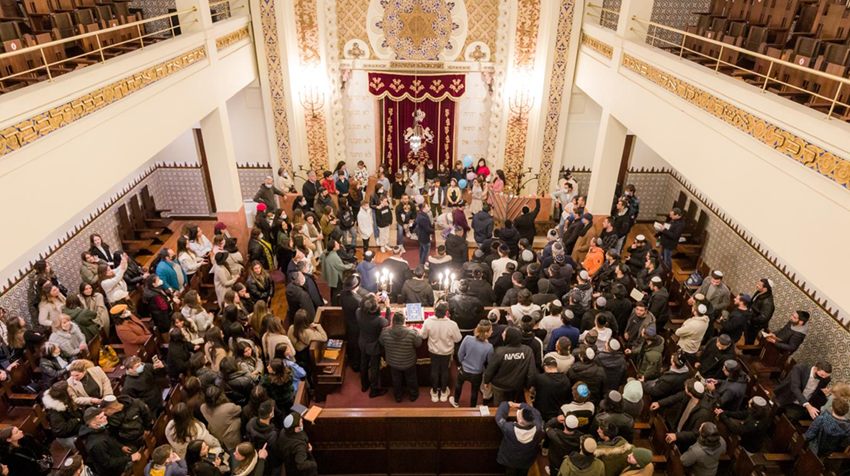
Approaching its 11th uninterrupted year of readings with a minyan on Shabbat and Yom Tov – something truly uncommon in most European Jewish congregations today – the Jewish Community of Porto is preparing to begin the Book of Leviticus. The reading is starting on March 21, and continuing through May, as part of the 5786 annual Torah cycle.
Vayikra (Leviticus) consists of 10 weekly Torah portions, or parashot. Vayikra, Tzav, Shemini, Tazria, Metzora, Acharei Mot, Kedoshim, Emor, Behar and Bechukotai, these portions are read weekly over the course of the Hebrew calendar year, though they are sometimes combined in the synagogue to fit the schedule.
Leviticus principles are viewed as enduring moral and spiritual guidelines that promote not only a strong Jewish congregation but also a just society. For instance, the parashat Metzora (Leviticus 14:1–15:33) strongly condemns any kind of slander that could harm social coexistence. This is a very useful teaching in modern societies, which often have turned this deadly sin into a profession.
The Talmudic sages read the word Metzora (the afflicted one) as a contraction of Motzi Ra—meaning "one who brings forth evil" (slander). The parashah teaches the purification process for a person afflicted with tzara'at (often translated as leprosy), a supernatural skin condition that the Sages and traditional commentaries define as a direct punishment for lashon hara (malicious speech or gossip). The connection between the biblical malady and the sin of gossip is a core theme in Jewish tradition.
The Torah describes tzara'at appearing on the walls of houses. Tradition explains this as a warning for gossip that takes place within the home, with the disease appearing on walls, then clothing, and finally skin if the person does not repent. The metzora was required to live outside the community, which is seen as "measure for measure" (middah k'neged middah) punishment.

Because they used their words to cause division and isolate people, they were forced to be isolated themselves. The punishment of Miriam (Numbers 12), who was stricken with tzara'at after speaking negatively about Moses, is interpreted as the quintessential example of tzara'at being the penalty for gossip.
In general, the book of Leviticus is central to the Torah, focusing on the pursuit of holiness (kedushah) and the mechanisms for maintaining a relationship with a holy God. It acts as a guide for transforming the Jews into a holy nation, detailing how to live a sanctified life through rituals, purity, and ethical behavior.


