

An unusually high number of Jewish tourists from many nations have signed up to visit the Porto Jewish Museum during the month of Nissan. The museum always provides special activities during this month essential to the Jewish story. It is the month of redemption, miracles, and the birth of the Jewish nation.
The Talmud states that in Nissan the Jewish people were redeemed, and in Nissan they will be redeemed in the future. While the name Nissan is of Babylonian origin, it is associated with the Hebrew word nissim, meaning "miracles". Many defining miracles occurred in this month, including the destruction of the Assyrian army of Sancherev, serving as an annual reminder of the Jewish capacity for resilience and spiritual renewal.
The Jewish Museum in Porto can be explained briefly through its most representative rooms and spaces. At the entrance is the welcoming figure of the rabbi, astronomer and mathematician Abraham Zacuto. In the oval room that follows, a journey is made from Abraham and the Seven Noahide Laws to the arrival of the Jews in the Iberian Peninsula, with emphasis on a replica of the Temple of Jerusalem and the Magen David, a Sefer Torah, a chanukiah produced in Toledo based on the ancient art of iron and gold, a statue of Maimonides and the two writings of the great poskim (codifiers) of the Jewish people to this day, precisely the Rambam (from Córdoba) and Yosef Karo (from Lisbon).
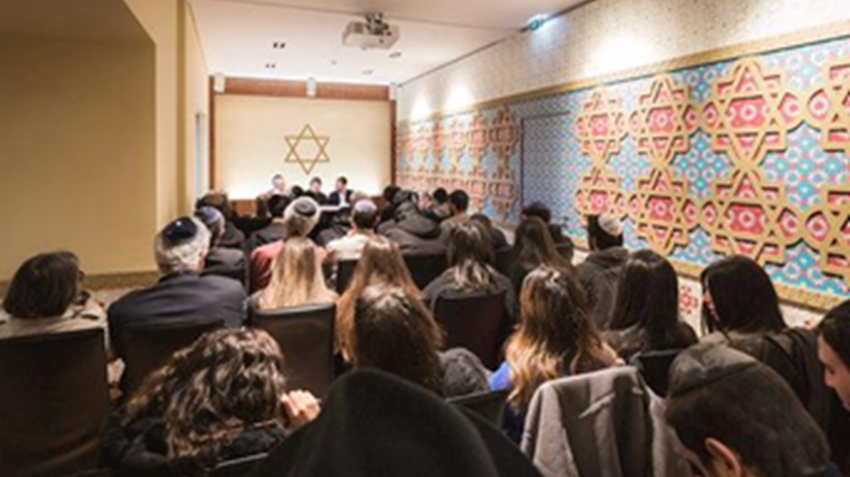
In the next space, the names, the fairs and everything that involved in the period before the Manueline edict are exhibited on screens with films, including a huge screen on which the image of what would have been the city then surrounded by walls and which included the old Jewish quarter of Olival is spread. There is also a replica of the epigraph that was once affixed to the synagogue of Monchique.
Paintings of superb quality, relating to the foundation, development and decay of the kingdom, are part of the museum collection, highlighting the role of theJews in the administration of the country that transformed Portugal from a small county to an Empire with 13 million km2. Science, ingenuity, economic resources and an intelligence network abroad were some of the Jewish skills that are highlighted there. On the consequences of the expulsion of the Jews and the Inquisition to Portugal, the museum exhibition not only addresses the violence that occurred and the aggrandizement of the competing nations to which they went, but also one of the reasons for the tragic defeat of Dom Sebastião in Alcácer-Qibir, well expressed in a rare object exhibited there, called Megillah Purim Sebastiano.
The Porto Jewish museum is not extensive, but it has a collection of information and documentation that is impressive. There is a movie theater, a kosher Port wine cellar, a room where some of the awards that films produced by the community have received from international festivals are shown, and a room dedicated to the Entebbe operation, which showed the world that, after 2000 years, the Jews once again had a state that could defend them and ensure their safety.
The museum has been described as a work of art. On important dates, the museum has already managed to receive 1000 students from schools at the same time. Ultra-modern in appearance, despite having been built by a private individual in the 1930s, just like the synagogue, that space has not forgotten the development of the Jewish community in the 21st century and its action to promote religion, culture and material support to communities in 14 cities around the world.


