

The Belmonte Synagogue
Belmonte, located in central Portugal, was historically an isolated village. It still is. The Jewish Community of Belmonte has only a few dozen members, but it remains alive. At the end of each day, Rabbi Eliahu Schefer manages to gather the local minyan in the Beit Eliahu synagogue. About two dozen men are present in the temple named after the father of the patron who made its construction possible, Salomon Azulay, a philanthropist born in Morocco. Shabbat and Hagiim are equally celebrated with all prayers.
In that small village, cold in winter and affected by high temperatures in summer, the native Jews of Belmonte are joined by foreign Jews who have chosen the land to reside in Portugal, and also Jewish tourists who come and go from the village every day. There are tens of thousands of tourists at the end of each year.
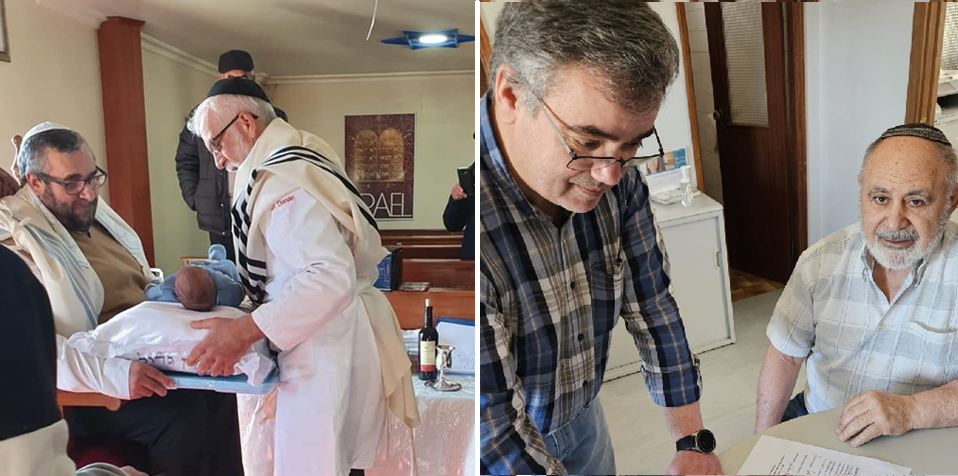
Two significant moments in the community life: a brit milah and the sale of chametz
Rabbi Schefer and Rafael Diogo
It wasn't only the community's famous benefactor who was born in Morocco. The current Rabbi, Eliahu Schefer, is also a native of Mazagan. He is now 81 years old. As a young man, he was part of the massive immigration of Moroccan Jews to Israel. He studied at all the higher religious institutions. He was a rabbi at a secondary school yeshiva and directed a religious school for especially gifted students. His studies never slowed down. He holds an academic degree in Hebrew language studies and a doctorate in the sociology of the Jewish people. He was an educational consultant in Jewish schools in France and today is determined not to let the Jewish community of Belmonte die.
When he arrived in the village in 2021, Rabbi Schefer committed himself to trying to revive a community with customs, prayers, and chants that span over five centuries. And that's what he's been doing. His effort and dedication to ensuring the community's continuity have borne fruit and the religious leader organizes annual Torah knowledge contests. The winner of the last contest had the honor of being received at the Israeli Embassy in Lisbon and acted as "ambassador for a day."
Rafael Diogo is probably the community's greatest hope. The perspective of a promising young man from the community on community reality is less poetic. Rafael Diogo is 17 years old and possesses a rare lucidity. He is the son of the community president, Pedro Diogo, and grandson of the late João Diogo, who also led the organization. What motivated him to study Judaism and help Rabbi Eliahu Shefer is called love, love for religion.
Rafael, "an excellent student," as defined by his teacher Isaac Assor, has always felt a strong connection to the Jewish faith and a desire to actively contribute to the religious life of the community.
Asked how he sees the future of the Jewish community of Belmonte, the young man is direct. "The community is small and I believe that, over time, it may disappear due to a lack of generational renewal."
The young man's plans involve leaving Belmonte. The State of Israel is a possible destination, very possible. In his baggage is the desire to live in an environment with a larger and more active community, where he can deepen his religious experience and have open windows of opportunity.
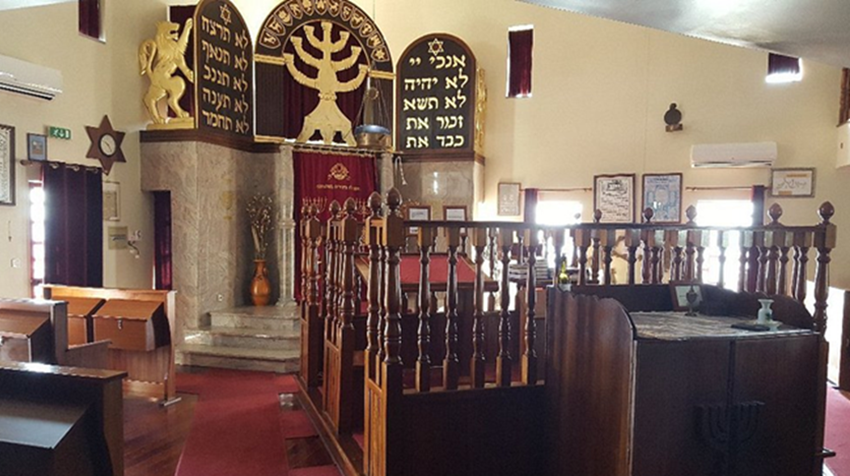
The Belmonte Synagogue
The conversions to Judaism in 1991
In 1991, something unusual happened in Belmonte. The Marrano community split. Among about two hundred people who practiced Marranism, 85 converted to official Judaism and were registered in the conversion book. These people and their descendants make up the congregation that meets in the synagogue.
The Jewish Museum of Belmonte
The Jewish Museum in the city of Belmonte has allowed the small Jewish community to build bridges of encounter with national and international society, reinforcing the educational and touristic relevance of the region, and attracting a large number of visitors. The Jewish community of Belmonte contributes continuously to Portuguese cultural diversity, promoting interreligious dialogue and historical knowledge. The local Jews are not only a witness to the past, but also active elements in the construction of a plural society aware of its Judeo-Christian roots.


