

Credit: CIP/CJP
Many claim that antisemitism is not a problem in Portugal, citing what happens in countries with populations of millions of Jews. This is illogical. Theodor Herzl long ago wrote that the Jewish community is only not persecuted where it does not exist and while it remains invisible. The prevailing axiological framework in Portugal tends to despise the observant Jew, the Jewish businessman, and the successful Jew, that is, the traditional Jew, as well as the Jewish community that is by far the strongest in numerical, religious, and cultural terms. All of this is compounded by a hostile feeling toward the Jew of nations (the State of Israel). Thus, the conditions are created for the antisemitic radicalization of anyone in Portugal, of any family, leading to insane actions, either at the gate of a Jewish temple or at the music festival of Idanha-a-Nova. This is the “Jewish question” in Portugal, an issue that precedes problems that may arise with radical Muslims and movements of the right, left, or political center.
The Antisemitism Department of the Oporto Jewish Community, created in 2014, was established to catalog hostile behavior towards Jews and find ways to diminish it. Today, the community integrates international networks to combat antisemitism – anti-Judaism, anti-Jewish tradition, anti-Jewish success, and anti-Israelism – but in the early years, its reports were exclusively intended for the Portuguese authorities, especially the political class, to achieve cooperation thought to be possible and desired by all. The silence and apathy demonstrated by these authorities in the early years were an unpleasant surprise, and over time, we concluded that we had to seek support elsewhere. It is worth providing a brief overview of what the department has documented over the years, to better understand how we got here.
2014. There were no antisemitic incidents, because nothing justified them. The national Jewish community of around 300 assimilated individuals was irrelevant. That said, a study by the Anti-Defamation League (ADL) revealed that 1.8 million Portuguese held antisemitic feelings: Jews are hated for their behavior (25%), Jews care only about themselves (26%), Jews consider themselves superior to others (21%), Jews are very powerful (43%), Jews have influence over financial markets (43%), Jews control world business (21%), Jews control the government of the United States (23%), Jews control the media (17%), Jews are responsible for most wars (15%), Jews are more loyal to Israel than Portugal (56%), Jews talk too much about the Holocaust (49%), Jews exaggerate the number of deaths (10%) and the Holocaust is a myth (1%).
2015. Because of the 2013/2015 legislation that granted nationality to Jews of Sephardic origin, news items about Jews began to fill the infosphere. There followed an exponential growth of antisemitism on Facebook and in the newsrooms of newspapers, expressed in thousands of violent and aggressive messages against “the Jews” as an individualized people: “the worst race on earth”, “foreigners”, “want to divide the Portuguese”, “go to Israel”, “dominate the world”, etc. In response, the community erected fences around its synagogue and signed a protocol of friendship and cooperation with the Muslim community, which could harbor a potential threat from radicalized individuals.

The Kadoorie Mekor Haim. Credit: PJN
2016. The online messages continued as harsh and relentless as in the prior year and the community told the government, suggesting that the Ministry of Education invest efforts to “educate the new generations about the Holocaust” and to ensure that “educational manuals included the presence of Jews in the Iberian Peninsula in general and in Portugal in particular.” The community observed that “the country of Dom Afonso Henriques, Yaish Ben Yahia and the descendants of both” was an empire that in its heyday corresponded to the United States, the “country of George Washington and Haim Salomon, of Portuguese origin and who spoke Ladino.”
2017. One night, stones were thrown at the windows of the north façade of the synagogue, breaking thirteen panes of glass. After this incident, security cameras were installed around the building to avoid similar acts or identify future perpetrators of such offenses. At around the same time, a community partner – the Chabad of Lubavitch – sought to build a synagogue in Cascais, and the project was largely contested by noisy neighbors, who wanted the land to be transformed into a garden (even though it had been merely a construction site). In addition, the residents of Alfama challenged the creation of the Jewish Museum of Lisbon, which was to be built in São Miguel square (a “symbolic place” for Judaism, because it is the site of the old Jewish quarter of Alfama). They claimed that “would break with the tradition of the neighborhood” and “disfigure the São Miguel square”.
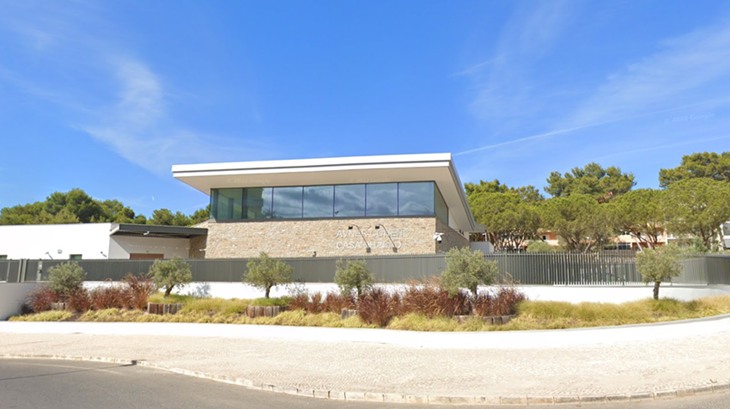
The Chabad Center Cascais
2018. The community alerted the government about the rising animosity towards Jews, warning that if no action was taken, violence would be inevitable. They also offered to help develop a national strategy to combat antisemitism and protect Portuguese Jewish communities. Unfortunately, their pleas went unanswered. Similarly, their request to Parliament to amend the legal definition of the crime of “discrimination and incitement to hatred and violence” to include antisemitism was ignored. Hate messages proliferated on social media, and a socialist member of the European Parliament vehemently criticized the “very perverse lobby of Israel,” referring to international Jewish organizations. Even in the quiet village of Mogadouro, where the community was shooting a movie, an elderly lady shocked everyone by claiming that the Jews she once knew of in Vilarinho dos Galegos “had a tail.” This slander dates back to the 17th century, originating from the work of the Friar of Torrejoncillo, “Watchtower against the Jews.”
2019. With the government taking no action in education, the community inaugurated the Jewish Museum of Oporto. The museum aimed to educate schools about the historical coexistence of Catholics and Jews in Portuguese lands before the kingdom’s official foundation. It highlighted the contributions of Jews to the First Dynasty in all important areas of governance, the remarkable cultural work of Dom Dinis and Rabbi-Mor Guedelha (who were close friends and both literate intellectuals), the financial expertise of Moses de Navarro (the wealthiest Jew of his time) as almoxarife (Treasurer) under Dom Pedro, and the involvement of the Navarro family as almoxarifes under Dom Fernando. It also emphasized how John I launched the Age of Discovery with the nation’s leading forces in science and finance. Despite its noble intentions, the museum has never been able to open to the public because the Public Security Police has refused to provide security, even if paid for by the community, citing no security risks to a Jewish museum located in front of the country’s largest synagogue.

The Jewish Museum of Oporto. Credit: CIP/CJP
2020. The community inaugurated the Holocaust Museum of Oporto in response to the government’s inaction on education. Instead, the government focused on instructing a member of Parliament to effectively dismantle the law granting nationality to Jews of Portuguese origin. This marked the beginning of a campaign of defamation and the spread of stereotypes against Portuguese Jewish communities, including accusations of “material interests,” “business,” “money,” and suspicions of “passports of convenience,” exaggerations about “tens of millions of candidates,” anti-Jewish sentiment (“and they also have children, who also ask for nationality”), and slander suggesting that “all that is required is to pay thousands of euros to genealogists, lawyers, and communities.” Anti-Israel sentiment also surfaced, condemning tasteless advertising in Israel while ignoring similar advertising in Brazil, Angola, Goa, and other places. Faced with this overwhelming tide, the community realized the urgent need to act. It was an unequal struggle: on one side, the elites of the country; on the other, a community representing just 0.01% of the Portuguese population, often labeled as foreign. The hatred stemmed not from the general population but from politicians, media oligarchs, and influencers who thrived on such gamesmanship. In response, the community established the Holocaust Museum to engage with teenagers and created a B’nai B’rith to address political games by seeking help from abroad, monitoring harmful trajectories, and promoting Jewish human rights, especially culturally, with official recognition of the merits of the just among nations and support from the world Jewish press.
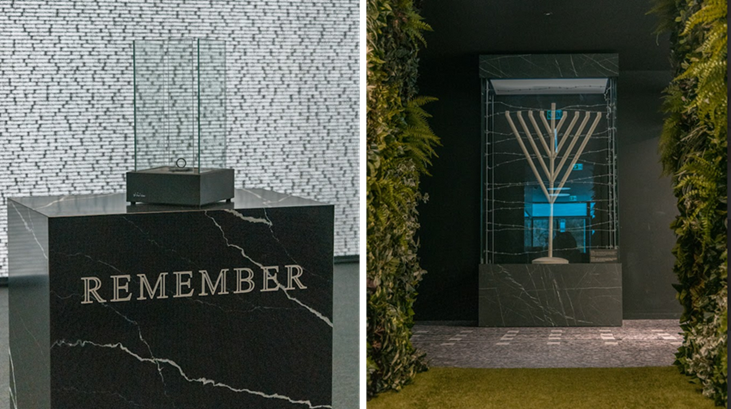
The Holocaust Museum of Oporto. Credit: CIP/CJP
2021. The German anti-fascist organization “Anti Faschistishche Aktion” pasted stickers at the gate of the Oporto synagogue, associating it with fascism. The group also planned to vandalize the Holocaust Museum, as some members were identified inside the museum a day before the attack on the central synagogue. A Jewish French university student was threatened by an Arab colleague, accompanied by a pit bull, near another synagogue in the community. Meanwhile, the façade of a prominent Jewish family’s house was vandalized with red paint, including the mezuza. The couple's daughter wanted to leave the country after hearing from an angry colleague that “Jews are killing children in Palestine.” This hostility spread to other schools, worsening daily. A captain from the 25th of April wrote on Twitter: “Since they dominate world finances, Jews bought and own the vaccines they want. It is a kind of historical revenge. And I will say nothing else, lest the Zionist bulldogs react.” The political establishment remained silent.
2022. A year of shame. Political, economic, and media elites in Lisbon, along with night robbers, saboteurs, and convicted individuals specializing in anonymous slander, orchestrated a scheme to kill the hated law restoring nationality to Jews of Sephardic origin, decapitate the leadership of the largest community, and drive away wealthy Jews from Portugal. This was done without fear of consequences, as if nothing could be monitored or discovered in the 21st century. The government began by usurping Parliament’s functions to kill the law. The community challenged this, and the executive responded with a callous media campaign. The insane asylum was placed at the service of the State, with delirious anonymous letters. The media oligarchs’ servants launched attacks with fake news stories from dusk til dawn, describing the community as “nothing,” “opulent,” and “barking,” while delegitimizing and dishonoring its leaders. The Soviet antisemitic technique was revived, targeting the strongest communities while idolizing those in decline to avoid accusations of antisemitism. In the same vein, the old antisemitic scheme of the “good Jew/bad Jew” was used, labeling productive Jews as “bad” and innocuous ones as “good.” This mirrored the worst of Portuguese history. Night robbers burglarized law firms and the former SIRESP president to steal computers and servers, seeking evidence of alleged crimes. The car of a young French Jewish leader was sabotaged, nearly causing a serious accident after he signed a petition to Parliament in defense of the community. These “coincidences” created an atmosphere of intentional social alarm, pushing the skeleton of “Justice” into the game. Government appointees violated laws, invading the synagogue and private homes, and arresting the rabbi, who was assaulted by angry people in a supermarket after being released from jail, having spent 36 hours without eating. The community faced an inquisitorial “purification,” targeting its religious leader, presidents, vice-presidents, treasurer, secretaries, board members, and even the museologist. This abnormal persecution, rooted in state agents’ antisemitism, led to physical aggression and hate messages in newsrooms, labeling the community as a “Mafia organization,” “corrupt,” “gang of traitors,” schemes”, “these people have never been trusted”, “history speaks for itself”, “even religion”, “An Israeli prefers to lose a friend to lose a euro”, “Weren’t the Jews always like that?”, “cast out from everywhere”, “the rabbi is corrupt”, “This extends from the rabbi to the owners of Chelsea and Altice”, “They are what they have always been: criminals”, “even the creation of Israel is based on the same imaginary assumption that they have the right to land”, “Israel has carte blanche to do whatever it wants in Palestine”, “it has always confused me that a Portuguese community should adopt as its name a foreign, Israeli community”.
2023. The façade of the central synagogue of Oporto was defaced with graffiti bearing the word “Apartheid.” The silence from political leaders in parliament was notable, as their lack of condemnation seemed to grant a form of antisemitic license to everyone. Jewish restaurants and businesses with ties to Israel were vandalized. In schools attended by Jewish children, teachers labeled Israel a “racist state.” An oligarch-owned television station aired a program titled “Passports,” using anonymous sources to claim the “mercantilism of the Israelis,” denigrate the targeted law, and suppress any contradictory evidence, such as synagogues filled with congregants, museums bustling with children, and history films produced by the community. This was all labeled as “opulence” and “crimes in Oporto” by the oligarch group and similar media outlets.

The facade of the Kadoorie Mekor Haim Synagogue. Credit: CIP/CJP
2024. A housing demonstration in Oporto featured posters condemning “Zionist Assassins” and “Zionist Landlords,” specifically targeting the Boavista area, where the central synagogue is located. The same business owners were targeted in another protest with the slogan “neither bombs in Palestine, nor evictions in Oporto,” and their names and companies were exposed in a political newspaper, without clarifying that they represented only a small fraction of Oporto’s real estate businesses. Discrimination also occurred in the south, where a music festival announced that “Zionists” were banned from participating. Portuguese political leaders remained silent. Yet Parliament swiftly passed a discriminatory law with retroactive effect, requiring descendants of Portuguese Jews seeking nationality to reside in Portugal for three years, a requirement not imposed on other Portuguese descendants, who do not have to reside in the country for even one day.
2025. A plan to poison Israelis at a music festival in Portugal was widely reported in Israel. This did not surprise the Jewish community of Oporto, who had seen the signs for over a decade. Year by year, antisemitism has been growing. The historical, symbolic, cultural, and human heritage of Oporto’s Jewish community had been ridiculed and dishonored. Constitutional prohibitions on such actions by public or private entities were ignored. There was no respect for history or the philosophy of law—only total shame and absolute crimes.
The 2022 campaign was so coordinated and vile that it did indeed cause terror and gave every citizen the right to persecute Jews, as even the country’s elites were doing so in the most blatant way. In the midst of this atmosphere of terror, people in the community were astonished to see how politicians and journalists laughed at the suffering they caused, with new verbal aggressions and sarcasm in the media, within a context of impunity and collective idiocy. Given modern technology where recording capabilities are so widespread, it is foolish indeed for them to have thought they could not be exposed.
Soviet style antisemitism is unmasked
The actions of the Portuguese Socialist Party in government between 2015 and 2023 were imbued with an anti-Jewish spirit much like what existed in the Soviet Union, which crushed local Jewish life, even though Judaism was never officially prohibited and the doors of major synagogues remained open. Everything described below occurred in both the Soviet Union and Portugal.
The government, with its materialistic ideological basis, was excessively involved with the interests of Arab countries. The Jewish world was thus seen as a threat to official ideology, state business, and elite positions, for which Jews were serious competitors. Their intelligence and agility functioned as a lubricant in the creaking gears of the state apparatus.
Jewish life was reduced to a skeleton adapted to the government’s interests. All that was good in Jewish religion, culture, and daring was described as bad, as an “immoral business,” while everything innocuous or inconsistent with Jewish values was described as good and treated well.
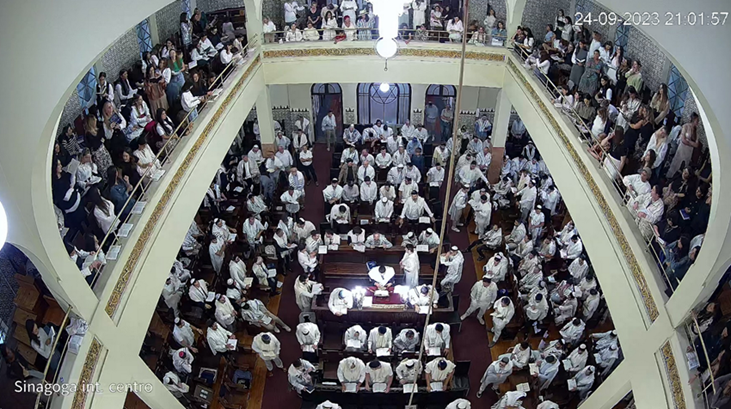
Hundreds of people gathered at the Kadoorie Mekor Haim Synagogue to celebrate Yom Kippur. Credit: CIP/CJP
The government made no investment in Jewish communities and institutions, including their security, nor did it willingly accept international Jewish institutions’ support. Close contacts with Jewish organizations abroad were seen as threats, as they could fuel natural trends of success.
The government constantly disseminated the message that there was no room for Nazism, no Jewish problem in the country, and that it worked tirelessly to perfect a system that fought discrimination of all kinds. These were empty words, with no bearing on the actual facts. Nothing was done to help communities promote Jewish life, and the so-called fight against antisemitism was reduced to useless ceremonies and pure propaganda.
The government was skillful in putting Jews in the spotlight as speculators, parasites, cheaters, corrupt rabbis, or a mixture of all these, and proved to be expert in using leading newspapers to turn Jews into stereotypes under the protection of freedom of expression.
The government was very skilled in avoiding accusations of antisemitism, as it did not want to attract negative publicity at the international level. Therefore, it concentrated its bad-faith actions exclusively on the destruction of the most significant Jewish realities, however beautiful their achievements in terms of religion, education, history, entrepreneurship, music, literature, cinema, art, and so on.
The government carried out the destruction of any organized Jewish community it considered “bad” in three stages: defamation of the synagogue’s structure and its leaders; mobilization of public opinion against the censured reality; and then character and institutional assassinations using the justice apparatus. Invariably, the main synagogue of the community to be destroyed was seen as a black market, not as a temple, causing individual neuroses throughout the national Jewish community, even though the attack was aimed at only a few chosen to die.

More than 100 rabbis from Israel and Europe visited the Kadoorie Mekor Haim Synagogue in 2024. Credit: CIP/CJP
The government had its own channels to encourage journalists, prosecutors, and police to carry out the inevitable devastation. Jewish institutions, their rabbis, and leaders were so successively slandered and assaulted that they lost their creative ability, spirit, and inspiration to continue producing Jewish life, much less to create a solid generation of continuators.
The government used anonymous letters, either that it received or were produced at the request of people attracted by sensationalist news, who sought to speculate on absurdities or exact personal revenge. These anonymous letters were then sent by the government to the Public Prosecutor’s Office and the police, whose leaders it had appointed. This marked the beginning of the final slaughter of the most influential synagogues and their so-called “illegal” activities under the guise of economic crimes investigations.
The press, under the government’s influence, used these anonymous accusations by the lowest elements of society and provided a platform for professional slanderers, regardless of their criminal backgrounds. These individuals, historically rejected and punished by all civilizations, eagerly connected institutions with immoral business practices, mobilized public opinion against allegedly disloyal individuals, and incited the police to act against them in a massive and scandalous campaign.
The government exploited the usual conflicts within different Jewish communities, or even within each community, often inviting individuals or groups of a faction to “tell everything” about their rivals, preferably in the form of anonymous letters addressed to newspapers and the police.
The government gave voice to the Jews of the capital city with connections to the party, or even to officials of the ruling political apparatus, placing in the mouths of these individuals that “there is no antisemitism” and that “to say the opposite is a slander to the Jews themselves.” This tactic confused international Judaism and hindered the arrival of any help from abroad. “Good” Jews were used as a showcase for the world and as a means to legitimize the persecution of Jewish institutions that had been marked for destruction.

Rabbis visited the Oporto Jewish Cemitery. Credit: CIP/CJP
The government had extensive experience in destroying groups or individuals deemed necessary to eradicate, often using stereotypes of fraud and corruption. It knew very well that by targeting a Jewish community, it effectively tainted all Jews. The press, closely tied to political elites, published the real names of the targeted individuals, and woe to them or their institutions if journalists took aim at them.
The government and the press, involved in commitments and financing with Arab countries, undermined everything that is Jewish and productive. The State of Israel has also been a constant target, to the point that most national Jews have lost interest in the small state. No other country, as small in size but large in achievements, has ever been subjected to such an enormous dose of adverse and even lethal propaganda.
The government did everything it could to keep the Israeli embassy under control, taking with one hand what it gives with the other. It participated with a huge smile in its celebrations while voting against Israel at the United Nations, promoting hope and serving disillusionment, to ensure the embassy remained silent in the face of persecution of the Jewish community and the benefactors of the Jewish people and the State of Israel.
The government consisted of individuals who were unaware of history and did not come from elite families with long lineages. Therefore, its psychological motivations derived from the lowest layers of society and from foreign policy reasons that have a completely negative bias toward international Judaism and the State of Israel.
The government implemented an anti-Jewish policy hidden behind empty formulas, although this policy was not monolithic and caused differences of opinion. The trumpets of propaganda clamored about treason and the sale of the homeland, amplifying the stereotype of the cunning and sneaky Jew.
This was the case for decades in the USSR, and in Portugal between 2020 and 2023. In both countries, the populations who witnessed all this never rose against government policy, either because they never understood it or because they had absorbed from their mother’s womb the idea that Jews are linked to money and cheating.
An unequal struggle.
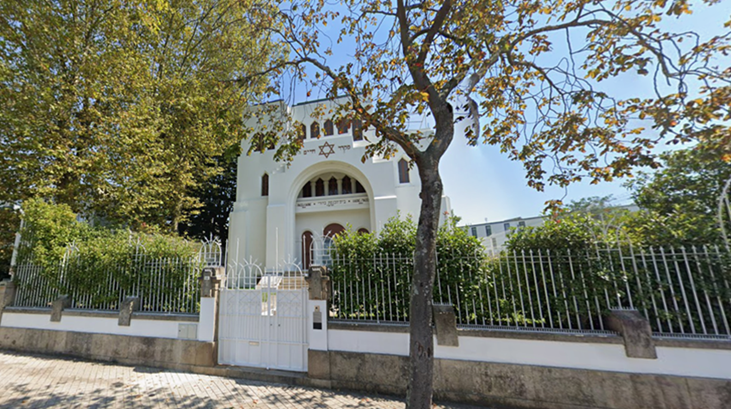
The Kadoorie Mekor Haim Synagogue
Israeli security authorities
It became evident that the prevailing axiological framework in Portugal, widely disseminated in the media, tends to despise the observant Jew, the Jewish businessman, and the successful Jew—the traditional Jew—as well as the community that had grown the most in numerical, religious, and cultural terms. This was compounded by a hostile sentiment towards the Jew of the nations. Conditions are ripe for the antisemitic radicalization of anyone, leading to insane actions, whether at the gate of a Jewish temple or at the Idanha-a-Nova music festival. This is the “Jewish question” in Portugal today, an issue that precedes potential problems with radical Muslims and movements from the right, left, or political center.
Israeli security authorities fear a likely terrorist attack against the Jewish community of Oporto. The community’s significant infrastructure, through which thousands of people circulate monthly, combined with the negative image based on ancient antisemitic myths (money, tricks, betrayal of the homeland), has greatly increased the risk of an attack. We will see what happens and who the community itself declares guilty.


