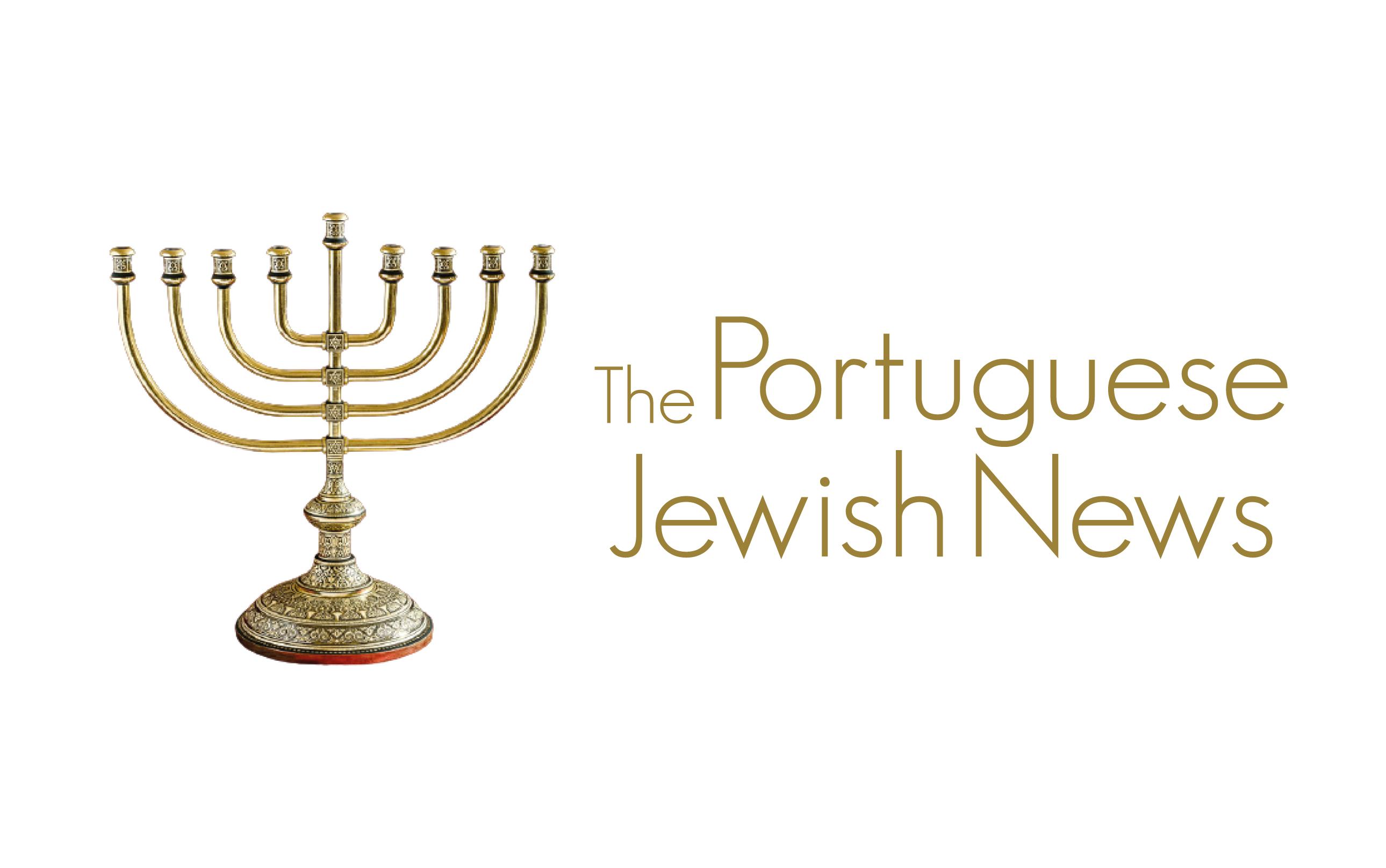


When, in 2018, the U.S. Ambassador to Portugal, George Edward Glass, received a chanukiah from the Jewish Community of Porto to be delivered to the White House, then under the first term of President Donald Trump, the initiative aimed to honor a nation that was founded according to the noblest moral principles and that has done everything to honor them decade after decade.
In Jewish tradition, the Sheva Mitzvot known as the Seven Laws of Noah, are considered to be the foundational universal human duties binding on all humanity, acting as the minimum ethical and legal requirements for a just and civilized society, ie, for a natural, rational morality that apply to all human beings regardless of religious affiliation.
The US Congress
An important official legislative recognition took place in the early 1990s. The US Congress formally acknowledged the Sheva Mitzvot as foundational ethical principles for society. Both houses of Congress passed a joint resolution, which was signed into law by President George H.W. Bush (Public Law 102-14, H.J.Res.104), recognizing the seven laws as the "bedrock of society from the dawn of civilization" and the ethical foundation upon which the United States was founded.
Preceding the Congressional act, President Ronald Reagan issued the famous Proclamation 4921, affirming the "eternal validity of the Seven Noahide Laws" as a moral code for all people regardless of faith.
Chabad Lubavitch
The Sheva Mitzvot have gained renewed attention, with Chabad Lubavicth, based in New York, encouraging non-Jews to adopt them, as they are recognized as a foundational, historically significant ethical code, ie, a biblical formulation of "natural law"—moral principles that are self-evident to human reason.
The US legislative act used the occasion of Education Day, in honor of Rabbi Menachem Schneerson (who was the Rebbe of Chabad Lubavitch) stated that these seven universal moral laws are relevant to contemporary American society and that their neglect threatens the fabric of civilization.
Even today, the Sheva Mitzvot continues to be mentioned in the Congressional Record, sometimes as part of opening prayers or as a reference to maintaining a moral, just society.
The Talmudic tradition
According to Talmudic tradition, non-Jews who uphold the Seven Laws are regarded as "Righteous Gentiles" or "Noahides." They are not required to convert to Judaism, but by following these laws, they are considered to be engaging in righteous, moral behavior and are assured a place in the "world to come".
There is a special connection between the Sheva Mitzvot and universal human duties, as they constitute a core ethical code that prohibits actions considered universally detrimental to civilization, including idolatry, murder, theft, sexual immorality, and cruelty to animals, while mandating the establishment of courts of justice.
This last command enshrines that every man or woman is an agent of Justice. Honorable people should not even live in a territory where citizens lack knowledge of basic laws and the justice system is polluted by unjust laws or officials without adequate moral training. A country where justice depends solely on "experts" and where only lawyers and police officers know the laws has a justice system destined for failure and social disorganization.
Porto Jewish Community
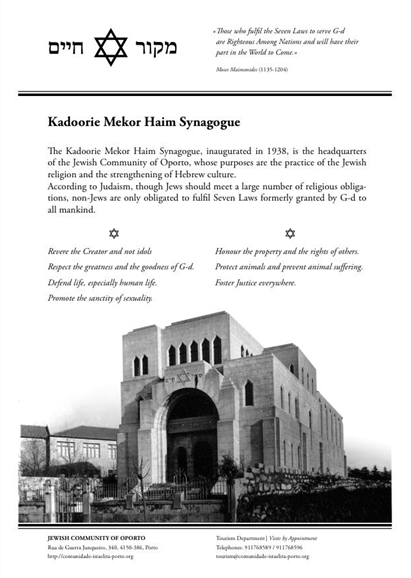
Decade and a half ago, when the Jewish Community of Porto conceived a plan to attract visits from schools throughout the country, as well as non-Jewish tourism in general (which was subsequently prohibited for security reasons), a pamphlet containing the Sheva Mitzvot began to be distributed to each visitor.
Although each of the Seven Laws is best known in its original negative formulation – "Thou shalt not..." – the Jewish Community of Porto has always disseminated them through a contrary model:
- Revere the Creator and not idols
- Respect the greatness and the goodness of G-d.
- Defend life, especially human life.
- Promote the sanctity of sexuality.
- Honour the property and the rights of others.
- Protect animals and prevent animal suffering.
- Foster Justice everywhere.
These commandments represent the universalistic aspect of Jewish theology, showcasing that God expects moral behavior from all people, not just Jewish people. Abraham, Isaac, Jacob, Joseph and even Moses before Sinai, were not Jews, but Noahides.
Moses Maimonides (1135-1204) never gave up fighting for a civilized world society. He stated everywhere that "Those who fulfil the Seven Laws to serve G-d are Righteous Among Nations and will have their part in the World to Come."
The Seven Laws provide a basis for peaceful interaction and legal order, as they are the pillars of human civilization, designed to keep humanity from reverting to the chaos of violence that necessitated the flood.


