


Synagogues across Europe are currently on high alert following a wave of attacks and thwarted plots linked to escalating Middle East tensions. Security has been significantly ramped up as officials warn of a "complex and heterogeneous" threat landscape involving state-sponsored actors, radicalised lone wolves, and new militant groups.
Within the last week, explosions and arson attacks have targeted synagogues in Liège, Belgium, and Rotterdam, Netherlands. Also, a large-magnitude attack targeted Jewish interests in Amsterdam.
A previously unknown Shi'ite group calling itself Ashab al-Yamin al-Islamiyya has claimed responsibility for these incidents. Israeli experts stated this is a front for Iranian-backed networks, and Israel's National Security Council has issued urgent guidance not only for the Jewish communities but also for those who are on vacation in Europe. Citizens are advised to avoid visiting synagogues, Chabad houses, and Jewish restaurants where possible. Recommendations include concealing items that identify one as Jewish or Israeli, ie, maintain anonymity. Travelers are urged to stay vigilant of suspicious objects or individuals in communal venues.
Major nations on alert
Authorities in Germany and Cyprus recently disrupted plots intended to target Jewish institutions, including an alleged Hamas-linked arms smuggling operation. In France, security forces have intensified patrols and fortification around synagogues and community centres, with some regions raising terror alerts to the highest level. In the Uk, following a deadly attack on a Manchester synagogue in October 2025, MI5 and the Community Security Trust (CST) remain on heightened alert, urging Jewish residents to strictly follow security protocols. In Belgium, discussions are underway regarding the deployment of soldiers to guard sensitive sites in major cities following the Liège explosion.

Portugal
While European nations in general have taken increasingly severe measures to discourage and even frighten terrorist movements, Portugal has opted for a different strategy: the silence. The apparent state inertia is so striking that it astonishes not only the terrorists but also the Jews themselves who can be targeted.
The strategy is consistent and lasting. It did not begin weeks ago, but has lasted for years. The political mainstream never publicly condemned the attempted poisoning of Israelis at a festival (2025), nor the lists of Israeli businessmen from Porto published in a newspaper (2024), nor the “apartheid” graffiti on the city’s central synagogue (2023), nor the attempted murder of young Jewish leader Ilan Cohen (2022).
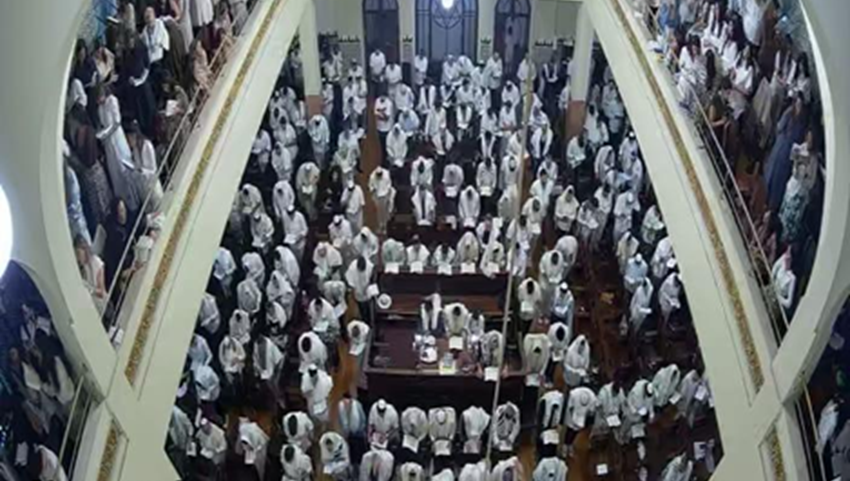
In Porto, the strongest Portuguese Jewish community in numerical, religious and cultural terms, ensures its own security without knowing what the State officials are doing. At the last Purim ceremony, with 800 Jews present at Porto’s central synagogue, not a single police officer was seen on the street. This, in a time of war with Iran.

Although some experts believe this to be a brilliant strategy on the part of the Portuguese state, a kind of lethal and well-thought-out trap aimed at hunting down all the terrorists at once, others believe it is a blatant abandonment of the community, and a total disregard for its physical safety.
In either perspective, the Jewish community in Porto has become the best target for a terrorist attack in Portugal and at least an attractive one — both for the value of the Jewish work it has produced, and for the Israeli vitality of its congregation, and also for the defamation campaign to which the organisation has been subjected some years ago.


